
by Paul Eliefrom Georgetown University
A Pause, for No Particular Reason
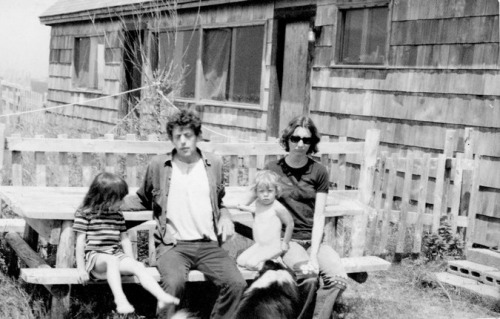
“You were living your life is what you were doing.” So a friend of mine replied when I asked rhetorically what I’d been doing one spring and where the time had gone.
Even before my overloaded computer crashed while I was out of town in early July and I stopped posting for a week or more, I had my friend’s insight in mind. I paused for no particular reason. Nothing was wrong. Nothing was lost. I was living my life is what I was doing.
It was a remarkable time to press pause. Ten Days in June, David Remnick called it, with the historic echoes fully intended and fully justified. What a June it was: the church shootings in Charleston; the Supreme Court’s rulings on same-sex marriage and lethal injection; the Greek debt crisis; the online return of Andrew Sullivan; the heat wave in Pakistan, the mayor-vs.-governor feud in New York, the manhunt upstate, and on and on – it was as consequential a month as any in memory.
In the pause – if that’s what it was – I was living my life: closing a magazine piece; seeing through a personal essay for the New Yorker website and a book review for the Times; planning a complex trip to France and Italy; watching NYCFC; reading Philip Glass’s autobiography and the Zaleskis’ new book about Lewis, Tolkien & Company and Thom Beller’s essay on Joseph Mitchell; meeting with colleagues in Washington, and on and on.
Hey, even Philip Glass, hardworking composer to beat all, spent twenty straight summers with his family in Nova Scotia.
Now – as swiftly as it crashed – the computer is restored; but I’ll likely be posting only intermittently while abroad. The main reason isn’t any aversion to writing while traveling. It’s that I’ve found the search for an internet connection comes to define travel more than I like. It’s that the fall will yield plenty to comment on, with Pope Francis’s visit right near the beginning. It’s that I hope to return having gained a firm toehold on a long piece of writing. It’s that I’ll be living my life.
“Unacknowledged Legislators” 2015

For some people, it’s the favor of free books in perpetuity; for others, it’s the half-sentence of acknowledgment in somebody else’s back pages; but for me, the best fringe benefit of a couple of decades’ work in literary publishing is that I have friends who are poets – real live called-to-the-role poets.
Three such are in full poetic flower this week. There’s Cecily Parks in The New Yorker, MFA’d, Ph.D’d, prize-published, fitting herself into the morning suit of the doctor’s wife:
Inside
the coughing man’s lung the surgeons
found a fir tree. The dark interior
of a lung or a leaf bud, imagined
long enough, becomes a wilderness.
Your mind can do this
in the morning when you don’t have
a body. Wilderness isn’t paradise.
There’s Rowan Ricardo Phillips, down at McNally Jackson with Tracy K. Smith, doubtless reading new poems about heaven, such as one this comes from:
Even Heaven has its dream of being
Paris. A flawed Paris in a flawed light.
A proper Paris. You arive there by
Accident: like Narcissus to his pond.
Cecily
and Rowan have new books – O'Night
and Heaven – and I
hope to post a fresh piece about each of them.
Lawrence Joseph, meanwhile, is between books, as the saying goes, but each of his new poems has a greater density and singularity of expression than most poets’ whole books. Here are a few lines from “Visions of Labour,” behind the paywall in the London Review of Books:
Static model,
dynamic model, alternate contract environments,
enterprise size and labour market functions,
equilibrium characterisation, elasticity of response
to productivity shocks: the question in this Third
Industrial Revolution is who owns and controls
the data. That’s what we’re looking at …
Larry invokes Blake at the beginning of the poem, and against heavy odds the poem makes good on the invocation: “Visions of Labour” is a radical poem, an an apt pendant to the street-shout of vexation over things-as-they-are that is Pope Francis’s first encyclical.
The photograph is of an anti-austerity rally held in London last weekend.
Forgiveness Makes the Front Page
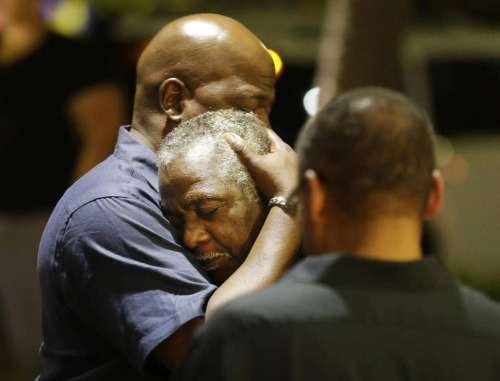
“Families of South Carolina Church Massacre Victims Offer Forgiveness.”
That, or something like it, was the headline running across the front page, above the fold, of Saturday’s New York Times. The word “forgiveness” stood out. When, I asked myself, had I last – had I ever – seen the word in a Times headline before? But there it was on the top paper in the stack at the Hudson News outlet in Penn Station.
Camping in the Catskills in the hours after the massacre took place, and then taking part in the American Pilgrimage Project in Albany, I had missed the developing story – seeing only a tabloid picturing the killer near the cash register at a diner in Demming, Sullivan County.
Already, President Obama was marveling at the forgiveness shown by the families of the victims; already David Remnick, on the New Yorker web site, was marveling at the long history of forgiveness and forbearance among African Americans. For me the story, in effect, began with forgiveness – and this made the ability of the victims’ families to forgive all the more striking.
Alas, by Monday the Times – its headline writers, at any rate – was back onto a familiar message of conflict. “Defiant Show of Unity in Church That Lost 9 to Racial Violence,” the headline read. Why “Defiant”? I read the story straight through to the end, and there is nothing in it to support the headline’s claim of defiance. Here are Christians in Charleston, black and white, joining together in faith; worshiping; singing the “sturdiest” of hymns, such as “Amazing Grace”; forming resolve against “every demon on hell and on earth”; praying together; and reaching out in prayer to the parents of the killer:
“They are shattered,” Bishop Herman R. Yoos told the congregation at a later service. “But their faith is strong.”
Why is all this presented as “Defiant”? Is it because the people at the church in Charleston are – lest we forget – black people? Or is it because forgiveness is so strange in our society that it must be infused with aggression and violence – must be made “Defiant” – lest it be unintelligible?
“Laudato Sii” to the Hudson Valley and the Catskills

“I went to the woods because I wished to live deliberately, to front only the essential facts of life, and see if I could not learn what it had to teach …”
Today, as Pope Francis’s encyclical on creation and climate change gets an official release, I’ll be offline and out of range – with family and friends on a school camping trip in the Catskills. And I’ll be glad to be there and not in the hurly-burly of instant commentary. How better to deliberate about the natural world and our place in it than to go out in the natural world for a little while?
Cardinal Newman in the Apologia pro vita sua told of a man who wished to have a papal bull with his Times and his breakfast each morning. That’s a little bit what the anticipatory chatter about the creation-and-climate encyclical feels like. I haven’t read it – haven’t read much of the summaries, either – but there’s every indication that the encyclical is necessary, eirenic, expressive of the tradition of the church and the character of Francis alike, and well timed. And yet there’s something nutty about the thought of several thousand members of the press speed-reading the text and drawing instant conclusions from it, at once racing against each other and borrowing from each other as they comment, post, tweet, retweet, and opine. And we most of us know that.
I’ll read Laudato Sii over the weekend. Meanwhile, I’ll have in mind the letter to the world that is Thoreau’s Walden:
“Let us spend one day as deliberately as Nature, and not be thrown off the track by every nutshell and mosquito’s wing that falls on the rails. Let us rise early and fast, or break fast, gently and without perturbation; let company come and let company go, let the bells ring and the children cry — determined to make a day of it.”
One Door Closes, Another Opens
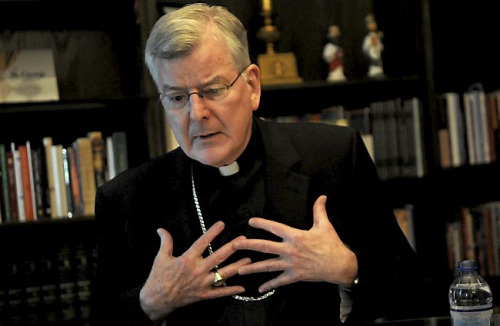
“Cardinals Face F.B.I. Inquiry in Hacking of Astros’ Network.” The headline caught my eye, and my heart sank. Then my heart returned to its regular place. The FBI isn’t pursuing a case against Roman Catholic cardinals. It’s pursuing a case against the St. Louis Cardinals baseball team.
But the agency might have been going after the cardinals who are called princes of the church, to judge from the news of the day.
The best and the worst in the Roman Catholic church are on simultaneous display just now. The Vatican is about to issue Pope Francis’s encyclical letter on creation. For once a papal encyclical seems aptly timed. The church, a late adopter in principle and an even later adopter in practice, has waited out the obvious proposed solutions to global warming – a market fix, a solution through carbon-credit or cap-and-trade schemes, a natural course correction, a global citizens’ movement, a China enlightened overnight – so as to come at the problem fresh, follow it to the roots, and say, “Let’s change the way we live together, together.”
At the same time, a big-city archbishop has just resigned under accusations that he failed to deal with priestly sexual abuse on his watch – and it is so commonplace an occurrence that the paper of record, long accused by the church of hyping the priestly-sexual abuse crisis, runs its story on print page A11.
Laconic and matter-of-fact is the paper’s remark that “sexual misconduct by individual priests has long drawn headlines in Minnesota and around the world.” Matter-of-fact is its citation that “Since the papacy of John Paul II — now St. John Paul — began in 1978, 16 other bishops have resigned or been forced from office under a cloud of accusations that they mishandled abuse cases … Archbishop Nienstedt is the 17th, by that group’s count.”
Matter-of-fact is its report that John Nienstedt – let’s not dignify him with the title of archbishop any longer – faces a separate accusation involving “claims regarding alleged misbehavior against him … about a series of sexual relationships with men, including seminarians and priests” – relationships troublesome, if they took place, not just because they were sexual relationships, and so suggest hypocrisy, or because they were relationships with other men, and so suggest hypocrisy, but also because they were evidently relationships with people under his authority and in his employ, and so suggest the abuse of power.
Alas, these things fit together. John Neinstedt resigned in part because it’s obvious that under Pope Francis the Vatican won’t try to protect bishops from the unlawful consequences of their actions in the way that it did for so long. And Francis’s encyclical is eagerly awaited in part because it’s obvious to all of us that at this point the pope can speak with greater moral authority about the environment than about the things his predecessors usually spoke about.
It’s as if Francis – who denounces carbon-credit schemes in the forthcoming encyclical – is practicing the credit-trading approach himself, storing up some moral credits with the creation-and-climate encyclical so that he can apply them to the synod on the family, where men like John Nienstedt have cost the church moral credibility beyond all reckoning.
Rothko & Glass, Pulsating Together

At this point no living artist better personifies the postwar New York art spirit – the spirit of experimentation and collaboration among painters, composers, musicians, dancers, and performance artists downtown – than Philip Glass.
So it is surprising to learn from his autobiography, Words Without Music, that Glass, a native of Baltimore, first encountered some of the paintings that were most decisive for him at the Phillips Collection in Washington, not in Manhattan. Glass, in his teens and early twenties, went to the Phillips Gallery (as it was called) by bus from Baltimore with a painter named Bob Janz, four years older:
Duncan Phillips had built up a private collection during his lifetime that turned out to be a most remarkable selection of contemporary work, ranging from the impressionists and early Picasso to ground-breaking work by American painters of the fifties and sixties. Besides a roomful of paintings by the Swiss artist Paul Klee, the Americans included Milton Avery, Arthur Dove, and Georgia O'Keeffe, all of whom I admired. The painters, however, whom I loved and who were wonderfully represented in the collection were Morris Louis, known to us as a Washington painter, as well as Kenneth Noland, and Mark Rothko.
For me, Rothko was a revelation. There was a small room at the Phillips that had three of his beautiful paintings. These did not resemble the dark paintings he would make later for the Rothko Chapel in Houston, but were huge amorphous squares, one above the other and only two to a canvas. They were painted in warm shades of orange and red. The effect was that of an organic pulsating canvas. I could, and did, sit in front of these paintings for long stretches, bathing in their strength and wisdom.
“Pulsating” is the key word there. If you had to choose a single word to characterize Glass’s music, you couldn’t do better than “pulsating.” It’s striking to think that Glass felt the Rothko paintings pulsating in the mid-fifties – a decade before he had a breakthrough with pulsating works of his own, such as “Strung Out,” from 1967, which I listened to on YouTube while writing this.
Our Kind of Spirituals, No. 63: Ornette Coleman Trio, “European Echoes”
At a book party twenty years ago a trim man in a dark suit, after a brief conversation, which I had initiated, gave me his business card.
He was Ornette Coleman, and the unlikelihood of meeting this most original of originals at a book party was topped only by the unlikelihood of him representing himself to me with an ordinary business card, and of him representing himself to me, not the other way around.
That was Ornette Coleman, who died this week, age 85. Most artists we like we consider originals, and we’re probably right. They are originals. They sound like themselves and not somebody else. But not so many are such originals that you couldn’t imagine a whole way of art-making without them. These artists paint in their own colors, speak a language in which they alone are articulate. In their work the push-and-pull in all art between the original and the good can be heard loud and clear.
The alto sax playing lines at once thin and strong, earthy and a touch sharp, simple and yet jagged and polyvalently complicated: that’s Ornette Coleman’s language. Coleman was so voluminously original that it has taken his death – and WKCR’s weeklong memorial broadcast – for the extent of his expression (thousands of recorded hours) to become clear. He was so insistently original that much of his music, sounding like nobody else’s but his, also winds up sounding much like much other music of his. A musician who expresses himself in a musical language he alone speaks is bound to sound narrow to the rest of us – is bound to sound, at times, unmusical, even unlistenable.
Ornette Coleman always sounded like Ornette Coleman. In his work, the spiritual proposition that every human person is an original, a one-off, recognizable finally and when it counts as no one but ourselves, is made music.
This track is simply the Ornette Coleman tune I know best, because I (not so much an original as he – but who is?) based a song of my own on the opening riff when I was in college.
At PEN, Prizing Narrative Art

PEN presented its book awards the other night, and Andrew Solomon struck the right note when he pointed out that the night was devoted not to freedom of expression but to excellence of expression.
As a judge of the nonfiction prize – the PEN/Galbraith Award for Nonfiction – I had a hand in the citation for the winner, Five Days at Memorial, by Sheri Fink. The citation is a compact effort to frame books of this kind not as nonfiction, or current affairs, or cultural history, or reportage, but as narrative art, and to articulate something like a narrative artist’s ars poetica:
How do we, individually and as a society, make crucial decisions about matters of life and death?’ The question was posed again and again in 2005 as Hurricane Katrina ravaged New Orleans, and it is the underlying question in Sheri Fink’s Five Days at Memorial, a book that finds in the events that took place in one tempest-tossed New Orleans hospital a story, biblical in its elemental grandeur, about matters of life and death. Five Days at Memorial has all that one could wish for in a work of narrative art: comprehensive reportage, vivid and sensitive depictions of living people, a human sense of the immediacy of events and of the sprawl of underlying conditions (social, political, medical, financial) that placed those people in the circumstances to make the decisions they made. Life must be understood backwards but lived forwards, Kierkegaard said; and Five Days at Memorial shows the power of narrative art to enable us to understand life backwards so that we might live our lives forwards with greater understanding.
A narrative artist’s ars poetica: That was a lot to lay on the person to whom I explained it at the reception afterwards, but that’s what I had in mind.
Maybe some future PEN ceremony will feature an award for best work of narrative art.
Remember the Name: Kalief Browder
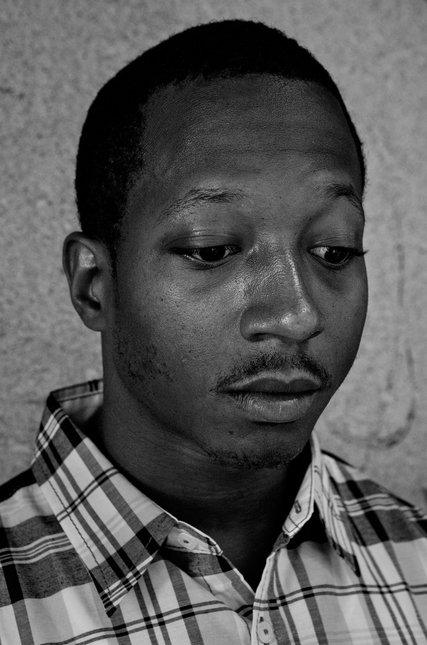
First the group email; then the personal report, the when-where-how-and-why; then the obituary-shaped article in the newspaper.
That’s how news of a suicide comes to the circle of acquaintances, and that’s how the news of Kalief Browder’s suicide came: an email from Dave, pointing to Jen’s personal report, which was followed, two days later, by an article in the Times. Kalief Browder – accused of petty theft, locked up on Rikers Island without a trial, beaten and tortured there, kept in solitary confinement for a couple of years, released abitrarily, and then profiled by Jen for the New Yorker while he tried to put his life back together – had taken his own life, and in a terrible way. The Times: “He was 22 years old.”
Many
thousands of people are in grief over Kalief Browder just now. I
know I am. What’s striking is that so many of us weren’t acquainted with Browder except through Jen’s New Yorker
pieces and the photographs that accompanied them. And yet we feel
the loss of him, and feel – beyond the horrible injustice of it,
beyond the emergence of the truth that Rikers Island and places like
it are torture sites no less than the ones the government maintains
offshore, beyond the further evidence that black lives just don’t matter all that much to people in positions of power – we feel, beyond all this, that Kalief Browder’s life was
taken for him long before Saturday night.
Myself,
I feel shame over the fact that I would not have come to know of Kalief Browder if he hadn’t been flagrantly abused at Rikers Island
and if Jennifer Gonnerman hadn’t devoted herself unstintingly to
making sure I and we knew all about him. Now – too late – he
has a face and a name.
After Browder spent more than a thousand days in jail, the majority in solitary confinement, a judge offered to release him on time served, provided he pleaded guilty to two misdemeanors. Amazingly – matter-of-factly – he maintained his innocence:
“If you want that, I will do that today,” DiMango said. “I could sentence you today. . . . It’s up to you.”
“I’m all right,” Browder said. “I did not do it. I’m all right.”
“You are all right?” DiMango said.
“Yes,” he said. “I want to go to trial.”
Back at Rikers, other prisoners were stunned. “You’re bugging,” they told him. “You’re stupid. If that was me, I would’ve said I did it and went home.” Browder knew that it was a gamble; even though he was innocent, he could lose at trial. “I used to go to my cell and lie down and think, like, Maybe I am crazy; maybe I am going too far,” he recalled. “But I just did what I thought was right.”
Why should we be amazed when a person who is innocent by all indications maintains his innocence? Has racial profiling gone this far, that we expect whole populations to take the deal and get on with it, to plea-bargain their way through life?
Now Kalief Browder, Emmett Till-like, will be made a representative figure, as in this Times editorial. It is necessarily so. But to read about him, or to see a photograph of him, is to know that he, like Till, who was murdered by white racists at age fourteen in 1955, was a person who hardly got to know himself or to live his life before the opportunity was taken from him.
Kalief, we hardly knew you. May your name be known forever.
Catching with James Parker Catching Up with Chesterton

News
it is to me that there are people proposing (as if his coarse remarks
about Jews are no big deal) that G.K. Chesterton should be declared a
saint – an actual, canonized, statue-inspiring devotion-eliciting
saint.
I’ll never be a Chestertonian, or even close, but James Parker – whose own approach is akin to G.K.’s in its blend of epigrammatic reason and outflowing passion – makes as good as case as can be made for him. (It was in the Atlantic, weeks ago now; somehow I missed it.) Here’s the best bit:
His prose, if you don’t like it, is an unnerving zigzag between flippancy and bombast—and somewhere behind that, even more unnerving, is the intimation that these might be two sides of the same thing. If you do like it, it’s supremely entertaining, the stately outlines of an older, heavier rhetoric punctually convulsed by what he once called (in reference to the Book of Job) “earthquake irony.” He fulminates wittily; he cracks jokes like thunder. His message, a steady illumination beaming and clanging through every lens and facet of his creativity, was really very straightforward: get on your knees, modern man, and praise God.
The problem with Chestertonians is that they are Chestertonian: they make the case for their man in their man’s own terms – and then (with G.K.-style overstatement) suggest that the terms are actually those of Jesus himself. Parker does that – but does it better than most:
The Chestertonian paradox, in fact, was a kind of ideogram of the foundational paradox of the Incarnation, of God being born as Man, when “the hands that had made the sun and stars were too small to reach the huge heads of the cattle,” as he wrote in another book of Christian apologetics, The Everlasting Man. And has anyone gone further than Chesterton into the agonizing paradox of the Crucifixion—Jesus’s cry of abandonment from the cross, when “God seemed for an instant to be an atheist”?
Chestertonians glory in the fact that their man was old-fashioned; but Parker’s concluding point there makes clear that in crucial ways he was ahead of his time.