
by Paul Eliefrom Georgetown University
One Door Closes, Another Opens
“Cardinals Face F.B.I. Inquiry in Hacking of Astros’ Network.” The headline caught my eye, and my heart sank. Then my heart returned to its regular place. The FBI isn’t pursuing a case against Roman Catholic cardinals. It’s pursuing a case against the St. Louis Cardinals baseball team.
But the agency might have been going after the cardinals who are called princes of the church, to judge from the news of the day.
The best and the worst in the Roman Catholic church are on simultaneous display just now. The Vatican is about to issue Pope Francis’s encyclical letter on creation. For once a papal encyclical seems aptly timed. The church, a late adopter in principle and an even later adopter in practice, has waited out the obvious proposed solutions to global warming – a market fix, a solution through carbon-credit or cap-and-trade schemes, a natural course correction, a global citizens’ movement, a China enlightened overnight – so as to come at the problem fresh, follow it to the roots, and say, “Let’s change the way we live together, together.”
At the same time, a big-city archbishop has just resigned under accusations that he failed to deal with priestly sexual abuse on his watch – and it is so commonplace an occurrence that the paper of record, long accused by the church of hyping the priestly-sexual abuse crisis, runs its story on print page A11.
Laconic and matter-of-fact is the paper’s remark that “sexual misconduct by individual priests has long drawn headlines in Minnesota and around the world.” Matter-of-fact is its citation that “Since the papacy of John Paul II — now St. John Paul — began in 1978, 16 other bishops have resigned or been forced from office under a cloud of accusations that they mishandled abuse cases … Archbishop Nienstedt is the 17th, by that group’s count.”
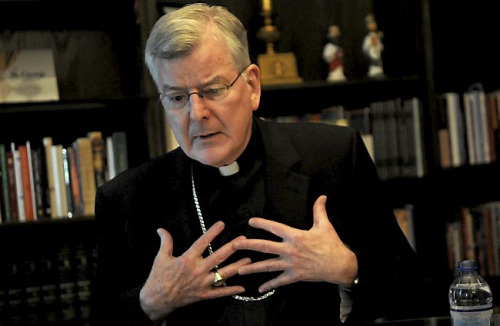
Matter-of-fact is its report that John Nienstedt – let’s not dignify him with the title of archbishop any longer – faces a separate accusation involving “claims regarding alleged misbehavior against him … about a series of sexual relationships with men, including seminarians and priests” – relationships troublesome, if they took place, not just because they were sexual relationships, and so suggest hypocrisy, or because they were relationships with other men, and so suggest hypocrisy, but also because they were evidently relationships with people under his authority and in his employ, and so suggest the abuse of power.
Alas, these things fit together. John Neinstedt resigned in part because it’s obvious that under Pope Francis the Vatican won’t try to protect bishops from the unlawful consequences of their actions in the way that it did for so long. And Francis’s encyclical is eagerly awaited in part because it’s obvious to all of us that at this point the pope can speak with greater moral authority about the environment than about the things his predecessors usually spoke about.
It’s as if Francis – who denounces carbon-credit schemes in the forthcoming encyclical – is practicing the credit-trading approach himself, storing up some moral credits with the creation-and-climate encyclical so that he can apply them to the synod on the family, where men like John Nienstedt have cost the church moral credibility beyond all reckoning.