by Paul Eliefrom Georgetown University
“Unacknowledged Legislators” 2015
For some people, it’s the favor of free books in perpetuity; for others, it’s the half-sentence of acknowledgment in somebody else’s back pages; but for me, the best fringe benefit of a couple of decades’ work in literary publishing is that I have friends who are poets – real live called-to-the-role poets.
Three such are in full poetic flower this week. There’s Cecily Parks in The New Yorker, MFA’d, Ph.D’d, prize-published, fitting herself into the morning suit of the doctor’s wife:
Inside
the coughing man’s lung the surgeons
found a fir tree. The dark interior
of a lung or a leaf bud, imagined
long enough, becomes a wilderness.
Your mind can do this
in the morning when you don’t have
a body. Wilderness isn’t paradise.
There’s Rowan Ricardo Phillips, down at McNally Jackson with Tracy K. Smith, doubtless reading new poems about heaven, such as one this comes from:
Even Heaven has its dream of being
Paris. A flawed Paris in a flawed light.
A proper Paris. You arive there by
Accident: like Narcissus to his pond.
Cecily
and Rowan have new books – O'Night
and Heaven – and I
hope to post a fresh piece about each of them.
Lawrence Joseph, meanwhile, is between books, as the saying goes, but each of his new poems has a greater density and singularity of expression than most poets’ whole books. Here are a few lines from “Visions of Labour,” behind the paywall in the London Review of Books:
Static model,
dynamic model, alternate contract environments,
enterprise size and labour market functions,
equilibrium characterisation, elasticity of response
to productivity shocks: the question in this Third
Industrial Revolution is who owns and controls
the data. That’s what we’re looking at …
Larry invokes Blake at the beginning of the poem, and against heavy odds the poem makes good on the invocation: “Visions of Labour” is a radical poem, an an apt pendant to the street-shout of vexation over things-as-they-are that is Pope Francis’s first encyclical.
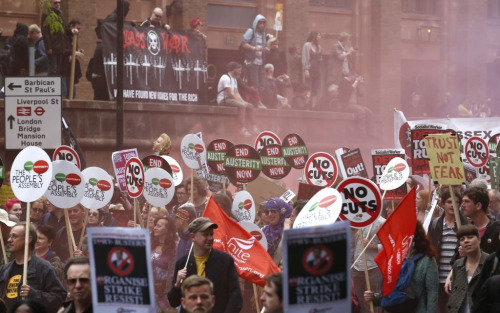
The photograph is of an anti-austerity rally held in London last weekend.