
by Paul Eliefrom Georgetown University
Rothko & Glass, Pulsating Together
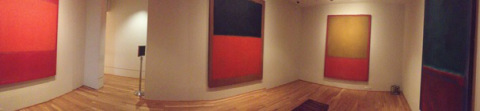
At this point no living artist better personifies the postwar New York art spirit – the spirit of experimentation and collaboration among painters, composers, musicians, dancers, and performance artists downtown – than Philip Glass.
So it is surprising to learn from his autobiography, Words Without Music, that Glass, a native of Baltimore, first encountered some of the paintings that were most decisive for him at the Phillips Collection in Washington, not in Manhattan. Glass, in his teens and early twenties, went to the Phillips Gallery (as it was called) by bus from Baltimore with a painter named Bob Janz, four years older:
Duncan Phillips had built up a private collection during his lifetime that turned out to be a most remarkable selection of contemporary work, ranging from the impressionists and early Picasso to ground-breaking work by American painters of the fifties and sixties. Besides a roomful of paintings by the Swiss artist Paul Klee, the Americans included Milton Avery, Arthur Dove, and Georgia O'Keeffe, all of whom I admired. The painters, however, whom I loved and who were wonderfully represented in the collection were Morris Louis, known to us as a Washington painter, as well as Kenneth Noland, and Mark Rothko.
For me, Rothko was a revelation. There was a small room at the Phillips that had three of his beautiful paintings. These did not resemble the dark paintings he would make later for the Rothko Chapel in Houston, but were huge amorphous squares, one above the other and only two to a canvas. They were painted in warm shades of orange and red. The effect was that of an organic pulsating canvas. I could, and did, sit in front of these paintings for long stretches, bathing in their strength and wisdom.
“Pulsating” is the key word there. If you had to choose a single word to characterize Glass’s music, you couldn’t do better than “pulsating.” It’s striking to think that Glass felt the Rothko paintings pulsating in the mid-fifties – a decade before he had a breakthrough with pulsating works of his own, such as “Strung Out,” from 1967, which I listened to on YouTube while writing this.
El Greco: The Upward Gaze
Even before I entered Gallery 28, the single room that is the site of the El Greco quattrocentenary exhibit at the National Gallery of Art in Washington, I was glad I was there. Sure, I know El Greco; his St. Jerome and Christ Cleansing the Temple in New York are familiar as old friends – but I’d forgotten enough about him that as I refreshed my memory by reading the tags I felt I was learning about him for the first time.
I’d forgotten that El Greco (1541-1614) was a contemporary of Shakespeare as well as of Caravaggio. That in Crete he first trained as an icon painter.
That he spent most of two decades living and working in Venice and
Rome before settling in Toledo. That in Rome this artistic outrider
lived in the grand Palazzo Farnese, which has a ceiling by
Michelangelo – and where Caravaggio also lived for a time. That
even his most disruptive painting – Christ Cleansing the Temple –
was a direct representation of the impulses of the
Counter-Reformation, whose leaders styled it as a cleansing of the
church by any means necessary.
The paintings themselves: well, they were El Grecos – amazing, every one.
John Borelli, a Georgetown colleague who joined me at the exhibit, pointed out that most of the works showed their protagonists gazing upward. That is signficant. I have the notion that in the past twenty-five years El Greco seems to have been supplanted by Caravaggio as the great independent among Catholic painters, an artist who bent his commissions to fit his own vision of things rather than the other way around. If that is so – and I think it is – then why is it so? Why is Caravaggio up and El Greco down? Is it the photo-realism of Caravaggio’s paintings – his use of lighting and close framing of the scene? His attention to violence – even his consecration of violence? His colorful life, and the fact that his paintings are on display in Rome, which outdoes Toledo in the tourism way?
It’s all those things. But it’s also that upward gaze. El Greco’s paintings, for all their rugged individualism, their stylized exaggerations and attenuations, are paintings of frankly religious aspiration. His figures are devotees, people at prayer, who are prone to piety rather than fighting against it – and in all these ways they are less representative, less resonant with our age (in which we can’t have faith without a fight) than they were a quarter century ago.
Less representative, but no less amazing.
Matisse’s Cut-outs: Time Running Out
“I will get out of my head seeing that Matisse chapel in Vence,” Flannery O'Connor told her friends
Sally and Robert Fitzgerald in 1958. A pious cousin had arranged
for her to join a pilgrimage of Georgia Catholics to Rome and Lourdes
(the latter in the hope of a miracle cure for O'Connor’s lupus). O'Connor had other aspirations for the trip: “The one thing in
France I have a real desire to see is Matisse’s chapel in Vence; but
of course they won’t be going anywhere near suchlike as that …”
That’s the way I’ve felt all fall, going around New York with the knowledge that Matisse’s cut-outs are on view at the Museum of Modern Art — and with the knowledge that, likely as not, I won’t be going anywhere near suchlike as that. And that’s the way I feel just now, learning that MoMA is going to stay open round the clock through 5:30 Sunday to enable us laggards to see the cutouts – and knowing that, likely as not, I’ll not get there anyhow.
What is it that has kept me from clearing an hour in a busy season – of soccer games, basketball games, skiing, and the circus; of restaurant nights out; of movies and long-form television, of live rock-and-roll and live Bach, of pocket exhibitions about St. Francis of Assisi and Thomas Merton – what has kept me from clearing an hour to see one of the great works of art of recent times?
It’s the high cost of MoMA: admission $25, with no discounts for families or children old enough to walk and talk (the admission is being cut in half during the overnights).
It’s the museum’s still-strange hours: closed at 5:30 weekdays like a cobbler’s, closed Wednesdays, open late Friday and Saturday evenings – great for a date, not so great for a family outing.
It’s the thought that the cut-outs show is so fundamental that it would be wrong to go to it solo, without my wife or our children: better not to go at all than to leave them out.
It’s the impression I’ve got – wrong, maybe, still very strong, I’d say – that the Museum of Modern Art is a museum for adults, for French and Japanese tourists and glamorous people wearing clothes that aspire to be art, and that it isn’t a welcome place for a home-school outing or for middle-schoolers who don’t yet bend the knee to line and color and significant form.
It’s the very lightness of the cut-outs: surely I would make time for a similar exhibit of Da Vinci drawings or late Rembrandt self-portraits.
It’s the high cost of MoMA, fed through the expectation that the price of culture (unlike sports, or good cooking) should be nil or nominal.
It’s
all those things: but behind them, or beneath them, it’s the vague
recollection that all this already happened: that I rushed to see
Matisse “once and for all” once before, when the Matisse
retrospective – one of the first contemporary museum blockbusters –
was held at MoMA in 1992.
I saw
the cut-outs in that show, didn’t I? I saw them. I did. I know I
did. I am sure I did.
Strange
to think that a blockbuster show can create such an aura around the
artist and the event that we can be left doubting our own visual
memories of the actual works of art.
Why am I not rushing to the cut-outs, rushing to seize the reprieve of the final weekend? I’m not proud to say so, but it’s because I’ve seen them before.
Hoping to get to Matisse’s chapel in Vence before my time runs out.
`The Nutcracker’: Light and Lighter
Years ago, I saw a publishing colleague leave the office early to take his children to The Nutcracker, an outing that seemed about as ordinary for him as taking them to get a Christmas tree.
Tonight – at age 49 – I made it to The Nutcracker for the first time, walking over to the Brooklyn Academy of Music in the company of my own children. (I did see Mark Morris’s The Hard Nut at BAM in 1993, after having a hand in Joan Acocella’s biography of him.) This was the American Ballet Theatre’s acclaimed production, which will go to Los Angeles for several seasonal runs beginning next year.
Well, was The Nutcracker what I expected? No and yes. This Nutcracker isn’t a stuffy 19th-century confection, a music box whose moving parts are humans. And it’s not all that Christmas-y: it’s a winter’s tale, a winter night’s dream. After the opening two scenes the big candle-laden Christmas tree is withdrawn, not to return (as it did in the New York City Ballet production my wife saw as a girl), and the party the household is preparing – kids nipping at the food in the kitchen, mice emerging for the leavings – could be any grand party where children are expected to be on their best behavior and create their own festivities.
It’s not what I expected because it is so much lighter than I would have expected. Truly, The Nutcracker must be the lightest classical-music standard there is. Sure, the first act has a battle scene — but it’s a battle of toys against mice. The second act is people dancing in costumes, and that’s it.
Partly the lightness is owing to the ABT production, which uses color and movement rather than mass or décor to do its thing – and which makes the mice not so much cunning as puckish and playful. But partly it’s the essence of the work. Seeing it, you feel that the ballet itself is a toy, simple and colorful, brought in to brighten a Franco-Russian winter momentarily and then set aside.
The lightness is what makes it distinctive and valuable. Nicholas Rapold, reviewing the third Hobbit movie in today’s Times, suggests that Peter Jackson went astray with the trilogy by moving the focus away from Bilbo Baggins; and the suggestion is that he did so out of the conviction that nobody – not teenagers, not their parents, not Hollywood producers or special effects people – has any use for lightness.
But we need lightness, especially at the dark end of the year.
This Is Not a Painting of Chairs
Our society’s model for the museum visit is All You Can Eat: you pay some portion of the exorbitant suggestion admission fee – now $25 at the Metropolitan Museum, I think – and then blast through the rooms, gorging on masterpieces, and wind up in the gift shop feeling stuffed, even sick.
It doesn’t have to happen that way. With a free hour in Washington the other day, I popped into the Phillips Collection, near Dupont Circle, where admission to the current exhibit is $5 with a university ID and the permanent collection is pay-what-you-wish.
The current exhibit was of American work from the collection. In an hour, I saw everything – well, everything except the Rothkos, which are hung (displayed is the wrong word, and so is exhibited) in a room where only three people are allowed at one time. I saw everything – but I looked, really looked, at something like a dozen paintings, and no more. That way, I could hope to see them, really see them.
And I gave full attention to just one painting: Ben Shahn’s Still Music, from 1948. There’s so much to see in it: the counterpoint between the soft washes of color and the firm line of the drawing; the several lines of horizontal movement (stand shelves, chair seats, chair hinges, stand bases) running over and along the intermittent vertical lines of the stands, like notation running across the bar lines of a piece of music; the tremendous energy of the painting working against the plain truth that the chairs and stands are empty. Here the music, made in this place for a certain passage of time, has gone wherever it is that live music goes.
The philosopher of art Richard Wollheim liked to spend an entire day at the National Gallery in London considering a single painting. I could have spent a full day with Still Music.
Failing that, I now come up from the Metro at Dupont Circle relishing the knowledge that although the exhibit is over, the Shahn painting is part of the permanent collection – so is still in permanent residence nearby.
Love + Violence = Passion
The run of readings from Matthew’s Gospel – and an English-language rendition of the St. Matthew Passion on the stereo – put Caravaggio’s Calling of St. Matthew in mind; and an invitation to write a guest post for the new Cornerstone blog of the Religious Freedom Project at Georgetown led me to think about Caravaggio, and religious freedom, and the Passion narrative, in ways that seem to me to suit the day and the hour.
In an essay about Caravaggio published a year ago I focused on the stress he gave to the antipodes of love and violence rather than orthodoxy and heterodoxy. It is this emphasis that makes Caravaggio an anti-iconographic painter, one who paints scenes that are happening once and for all, as if for the first time.
For his use of living models, his attention to light and its effects, his scrutiny of the body, he is called a naturalist. For his attention to ordinary people – poor, humble, everyday people – he is called a “pauveriste,” an artist working in a tradition that developed in the spirit of St. Philip Neri. But his approach is more complicated than those terms suggest. His subjects are crucial episodes in the Christian adventure. He paints them in a way faithful to scripture, to human action, to the claims and burdens of the flesh. His attention to biblical scenes and episodes from the early church makes them feel early, as if they precede the tradition of Christian iconography that developed in the Middle Ages. Somehow he got back behind the long, grand tradition of Christian art and made it new.
That is what you feel when you look at the paintings. Never before have you seen a biblical scene shown this way. No one before Caravaggio saw it this way. The paintings, breakthroughs four hundred years ago, look like breakthroughs today. The ancient faith is made new and arresting again; the whole epistemologically strained religion is grasped as if for the first time.
At the same time, the paintings exhaust the incidents they depict. His biblical scenes are all but over as he paints them. Lazarus is being raised. Christ is being taken. Catherine sits calm and sexy before the wheel of her impaling. Matthew, Peter, and Paul are being killed in action. Lucy, dead already, is being laid in earth. An epochal action is ending. The hour is getting late.
The Calling of St. Matthew at the church of San Luigi dei Francesi in Rome is a work of love. Strictly speaking, it is about obedience: the teacher points a finger in the darkness and we are to understand that the tax collector will obey. But what passes between Jesus and Matthew is love. Jesus makes his appeal from the shadows – the margins – rather than from the center of the painting. His hand is extended but relaxed, not in anger or accusation. The clear-eyed regard shown to Jesus by the boy to Matthew’s left – who is so handsome, so stylishly dressed and plumed, and so brilliantly lit as to be the center of the painting – shows that there is nothing to fear here. The light of the whole, the diagonal sweep from the right-hand corner across the window in the center, suggests the steadiness of the love in Jesus’s request and command. The accepting gaze of the eventual evangelist, the eternal “Who, me?” – eyebrows raised, eyes soft and wet as if tears are forming – makes clear that he knows his life is changing. So do we: but we feel his old life ending more than his new life beginning.
The painting is as sufficient unto itself as any painting ever was. But in Caravaggio’s body of work it is completed by the painting hung opposite: the Martyrdom of St. Matthew, a painting of violence.
Love and violence: these antipodes of Caravaggio’s work are those of the Passion narratives, too. Christ’s love is met with violence; the violence of his captors and tormenters is met with love. But let’s not forget: it didn’t have to go that way. The love that runs through the story – from the calling of St. Matthew to the crucifixion of the figure who called him – was freely given and freely accepted in response. It happened once and for all, and it keeps happening that way. There is nothing guaranteed or inevitable about it.
This freedom Caravaggio understood as well as any artist ever has, and it is the root of the extraordinary freedom of his paintings.
Piero della Francesca: Tablet-Friendly
“Is that all the Piero della Francescas? That one room?”
Yes, she was right, the woman at the Metropolitan Museum. That was “all” the Pieros: four small paintings in room 624, to the left of the grand staircase, a pass-through on the way to the Dutch masters.
I was not passing through; I was there on a fully intended side trip away from a visit to the museum with family and friends. While they went to see Washington crossing the Delaware, I cut loose to see the Pieros. I was continuing a running encounter with the work of this extraordinary Renaissance painter. In London last spring I spent half of Holy Saturday morning in the company of the Pieros at the National Gallery while a live crucifixion was staged (and shown on giant-screen TVs) at the foot of Nelson’s Column in Trafalgar Square outside. Last summer the Frick Collection exhibited a half-dozen Pieros from American museums that are seldom seen together – and in the space of an hour I got to see them together while the parking meter ran outside. At the time, some colleagues at Georgetown and I were putting together this site, and we made a short piece about Piero the opening post of our “beta” version, so that I now think of him as something like a patron saint of the site.
And now – for another three weeks – there is the Met’s exhibition: the latest expression of the fresh attention being paid to his work by curators and art writers such as Georgetown president emeritus, Leo J. O'Donovan, S.J., who called the Pieros at the Frick “panels of perfection.” It’s a quickening – revival is too strong a word – that recalls the quickening of public interest in Vermeer, who went from being a Dutch miniaturist to a Dutch master (in the public imagination; among curators his reputation was always high) after the National Gallery mounted a large exhibition of his work which came to characterize Washington at its best when it drew crowds during a snowstorm and a government shutdown in 1994.
Why Piero? Why now? Why in the United States? One line of art history would favor a social-slash-material explanation. Piero worked on a small scale. In the age of the small screen, his work seems retinally optimal: in fact, the paintings on the walls suggest digital tablets. (That’s one reason we led off with a post about him.) And because of their small size the paintings are easily loaned from one museum to another. The Piero we are seeing is a new Piero: Piero the intense miniaturist, alongside Piero the painter of fresco cycles you have to go to Arezzo or Sansepulcro in Italy to see for yourself.
But there’s more to it, I think, and the detail above – from “St. Jerome and a Supplicant,” in the Met exhibit – suggests what. The curator, Keith Christiansen, points out that one of Piero’s characteristic moves was to pair two human figures, one shown in profile and the other head on. The effect is to suggest an encounter of two dimensions with three dimensions: the flat with the round, the iconic with the robustly human. One way of being and another are set at something like right angles.
In the same way, the paintings are set at right angles to our way of being today. As Caravaggio is an action painter, Piero is a painter of stillness. And yet his still figures are robustly alive and individual; and as such, they complicate all sorts of stereotypes about the relationship between the past and the present, the traditional and the modern. The painting is small, but St. Jerome is large, even outsize, in his humanity. To my eye he makes us look small.
The New Yorker piece I took up the other day treats religious belief as a set of falsifiable propositions about the divine. What Piero’s work reminds us is that religious belief, especially as expressed by a great artist, is a proposition about the human – about people, to put it plainly. Piero’s people, painted small, suggest that he knows something worth knowing about the human situation writ large.
Hail Mary – and Pass the Olives
“Religious material culture” is the scholarly term for ritual and devotional objects and other stuff of faith, and it’s one of the richest and most complicated subject areas in the the study of religious belief just now – at the Smithsonian Institution, for example.
A new book about collectors of rosaries got a sparkling notice from Eve Kahn, whose antiques column is one of those half-hidden places in the Times where the past makes it to the page as past and not as prologue.
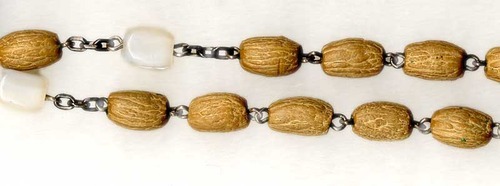
The rosary in the picture (found on a blog called Paternoster) is made from the pits of olives supposedly grown on the Mount of Olives.
Seeing in the Dark
If you were hoping to see the light in the Peacock Room this winter, you’re out of luck.
That room of the Freer Gallery at the Smithsonian is an instance of the American refreshing of Europe that I wrote about in my previous post: the room was decorated by James McNeill Whistler for a house in London; purchased by Charles Freer, taken apart, shipped, and installed in his home in Detroit; and then taken apart and shipped and installed in Washington after Freer gave his collection of Asian and American art to the Smithsonian in 1906.
Amazing, the ambition of our cultural founding fathers.
Usually the shutters on the windows of the Peacock Room are opened on the third Thursday of the month. But they won’t be opened in January or February because two extraordinary light-sensitive works are on display there: a codex of the Book of Deuteronomy, and the seventh-century Byzantine illustrated parchment manuscript of the four gospels known as the Washington Codex.
The codex was probably made in a monastery near Cairo and was acquired for Freer in Giza a little more than a century ago. The Latino Times reports that “the Bibles came into Freer’s hands with sand amid their pages, discovered when they were unpacked from a shoebox at Freer’s mansion in Detroit.”
Amazing, the ambition of our cultural founding fathers.
That’s Matthew on the left, John obscured, Mark in the middle, and Luke to the right, as far as I can tell.
Talking of Michelangelo
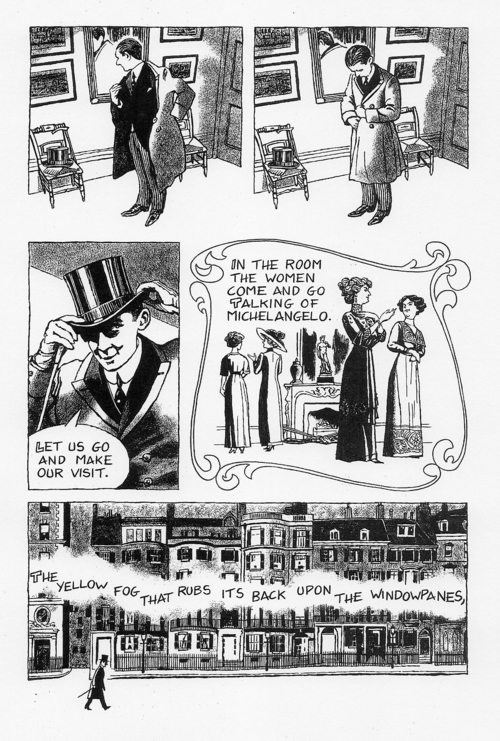
Julian Peters has comicked Eliot’s Prufrock – and Rimbaud, and Yeats, and Poe, and Guns `N’ Roses. Slate has the story. Like it I do – especially because it’s not anything like what I picture when I read the poem. As Faulkner said after reading an admirer’s manuscript: "Well, honey, it’s not the way I’d do it — but you go right ahead.“