by Paul Eliefrom Georgetown University
Rothko & Glass, Pulsating Together
At this point no living artist better personifies the postwar New York art spirit – the spirit of experimentation and collaboration among painters, composers, musicians, dancers, and performance artists downtown – than Philip Glass.
So it is surprising to learn from his autobiography, Words Without Music, that Glass, a native of Baltimore, first encountered some of the paintings that were most decisive for him at the Phillips Collection in Washington, not in Manhattan. Glass, in his teens and early twenties, went to the Phillips Gallery (as it was called) by bus from Baltimore with a painter named Bob Janz, four years older:
Duncan Phillips had built up a private collection during his lifetime that turned out to be a most remarkable selection of contemporary work, ranging from the impressionists and early Picasso to ground-breaking work by American painters of the fifties and sixties. Besides a roomful of paintings by the Swiss artist Paul Klee, the Americans included Milton Avery, Arthur Dove, and Georgia O'Keeffe, all of whom I admired. The painters, however, whom I loved and who were wonderfully represented in the collection were Morris Louis, known to us as a Washington painter, as well as Kenneth Noland, and Mark Rothko.
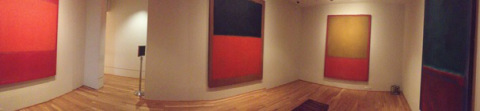
For me, Rothko was a revelation. There was a small room at the Phillips that had three of his beautiful paintings. These did not resemble the dark paintings he would make later for the Rothko Chapel in Houston, but were huge amorphous squares, one above the other and only two to a canvas. They were painted in warm shades of orange and red. The effect was that of an organic pulsating canvas. I could, and did, sit in front of these paintings for long stretches, bathing in their strength and wisdom.
“Pulsating” is the key word there. If you had to choose a single word to characterize Glass’s music, you couldn’t do better than “pulsating.” It’s striking to think that Glass felt the Rothko paintings pulsating in the mid-fifties – a decade before he had a breakthrough with pulsating works of his own, such as “Strung Out,” from 1967, which I listened to on YouTube while writing this.
 pablopicassopaintings likes this
 fear-and-loathing-in-cambridge likes this
 cfcasper likes this
 etr-gu posted this