by Paul Eliefrom Georgetown University
At PEN, Prizing Narrative Art
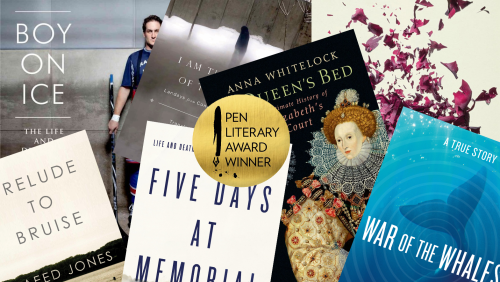
PEN presented its book awards the other night, and Andrew Solomon struck the right note when he pointed out that the night was devoted not to freedom of expression but to excellence of expression.
As a judge of the nonfiction prize – the PEN/Galbraith Award for Nonfiction – I had a hand in the citation for the winner, Five Days at Memorial, by Sheri Fink. The citation is a compact effort to frame books of this kind not as nonfiction, or current affairs, or cultural history, or reportage, but as narrative art, and to articulate something like a narrative artist’s ars poetica:
How do we, individually and as a society, make crucial decisions about matters of life and death?’ The question was posed again and again in 2005 as Hurricane Katrina ravaged New Orleans, and it is the underlying question in Sheri Fink’s Five Days at Memorial, a book that finds in the events that took place in one tempest-tossed New Orleans hospital a story, biblical in its elemental grandeur, about matters of life and death. Five Days at Memorial has all that one could wish for in a work of narrative art: comprehensive reportage, vivid and sensitive depictions of living people, a human sense of the immediacy of events and of the sprawl of underlying conditions (social, political, medical, financial) that placed those people in the circumstances to make the decisions they made. Life must be understood backwards but lived forwards, Kierkegaard said; and Five Days at Memorial shows the power of narrative art to enable us to understand life backwards so that we might live our lives forwards with greater understanding.
A narrative artist’s ars poetica: That was a lot to lay on the person to whom I explained it at the reception afterwards, but that’s what I had in mind.
Maybe some future PEN ceremony will feature an award for best work of narrative art.
 freelyfadingsublime likes this
 cfcasper likes this
 etr-gu posted this