
by Paul Eliefrom Georgetown University
Teju Cole: “The Music Followed Me Home”
Just a few hours after hearing some Mahler utterly unknown to me on BBC3, I come upon this passage in Teju Cole’s novel Open City, whose protagonist is browsing in the old Tower Records on Broadway uptown:
The next disc they played, though utterly unlike the first, was another I immediately recognized: the opening movement of Mahler’s late symphony Das Lied von der Erde. I returned to my browsing, moving from bin to bin, from reissues of Shostakovich symphonies played by long-forgotten Soviet regional orchestras to Chopin recitals by fresh-faced Van Cliburn competition runners-up, feeling that the price reductions were insufficiently sharp, losing any real interest in shopping, and finally beginning to acclimatize to the music playing overhead and to enter the strange hues of its world. It happened subliminally, but before long, I was rapt and might have, for all the world, been swaddled in a private darkness. In this trance, I continued to move from one row of compact discs to another, thumbing through plastic cases, magazines, and printed scores, and listening as one movement of the Viennese chinoiserie succeeded another …
… Then came the final movement, “Der Abschied,” the Farewell, and Mahler, where he would ordinarily indicate the tempo, had marked it “schwer,” difficult.
The birdsong and beauty, the complaints and high-jinks of the preceding movements, had all been supplanted by a different mood. It was as though the lights had, without warning, come blazing into my eyes. It simply wasn’t possible to enter the music fully, not in that public place. I placed the small pile of discs in my hand onto the nearest table and left. I made it into the uptown train just as the doors were closing. By this time, the crowds from the marathon were beginning to thin out. I sat down and leaned back. The five-note figure from “Der Abschied” continued on from where I was as though I were in the store listening to it. I sensed the woodsiness of the clarinets, the resin of the violins and violas, the vibrations of the timpani, and the intelligence that held them all together and drew them endlessly along the musical line. My memory was overwhelmed. The song followed me home.
That’s the kind of writing about music we need now: writing that recognizes, and foregrounds, the mingling of music and our experience, our public lives and our inner lives alike. That’s what I had in mind in writing Reinventing Bach, especially the passages having to do with the WKCR Bachfest – and set in the same neighborhoods as Open City. I wish I’d known of Cole’s writing at the time.
Here’s another piece of mine about his writing.
Jenner, O’Connor, & “Holy Ghost”
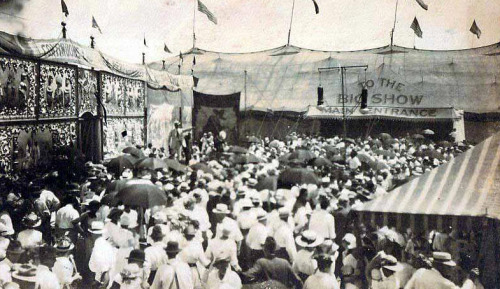
Buzz Bissinger’s story about Caitlyn Jenner (forthcoming in Vanity Fair) “reveals that Jenner has not had genital surgery.” And that puts in mind a story by Flannery O'Connor, “A Temple of the Holy Ghost”:
The tent where it was had been divided into two parts by a black curtain, one side for the men and one side for the women. The freak went from one side to the other, talking first to the men and then to the women, but everyone could hear. The stage ran all the way across the front. The girls heard the freak say to the men, “I’m going to show you this and if you laugh, God may strike you the same way.” The freak had a country voice, slow and nasal and neither high nor low, just flat. “God made me thisaway and if you laugh He may strike you the same way. This is the way He wanted me to be and I ain’t disputing His way. I’m showing you because I got to make the best of it. I expect you to act like ladies and gentlemen. I never done it to myself nor had a thing to do with it but I’m making the best of it. I don’t dispute hit.” Then there was a long silence on the other side of the tent and finally the freak left the men and came over onto the women’s side and said the same thing.
The child felt every muscle strained as if she were hearing the answer to a riddle that was more puzzling than the riddle itself. “You mean it had two heads?” she asked.
“No,” Susan said, “it was a man and a woman both. It pulled up its dress and showed us. It had on a blue dress.”
The child wanted to ask how it could be a man and a woman both without two heads but she did not… .
Was the person in the cover story “made thisaway” or has she “done it to myself”? That is the question – the riddle, if you will; and the answer (to judge from the photographs) is as puzzling, to me right now, as the riddle itself.
Hilary Mantel on How to Write a Novel: Theatrically
Cultivate your inner grandiosity, would-be novelist – because without plenty of inner grandiosity no real imaginative work will come forth.
I’ve told student writers something to that effect many times. Lately I have been trying to tell it to myself– to remind myself. But there’s no better reminder than Hilary Mantel’s essay about the process of adapting her novels Wolf Hall and Bring Out the Bodies – for Masterpiece Theatre, for the Royal Shakespeare Company, and for Broadway. Here is the cultivated inner grandiosity of the authentic artist:
In Stratford-on-Avon, in London, and now in New York, playgoers would ask the big question: How does it feel to see your characters come to life?
I answer with another question: When were they dead? Inside my head, they are whirls and blurs of energy in a show that never sleeps, where even in the small hours the blood runs down the walls. I construct the scenery and source the props, arrange the sound effects: church bells, the cry of hounds. I am my own lighting expert. When a candle comes in (tallow or beeswax, pricket holder or socket), mine is the hand that holds it. I carry it through the dark passages of my narrative, and shelter the flame as we cross the Narrow Sea: out of England and into France, from France to the battlefields and counting houses of Italy, to the wool markets of northern Europe, the waterfronts, the brewers’ yards, the palaces.
There have been no days when my theater is dark.
It’s amazing to realize that Mantel wrote both novels, saw them to publication, accepted Booker Prizes for each, and now has presided over multiple dramatic adaptations – all in the past ten years.
But what’s truly amazing – and the piece makes this clear – is that the novels were written in the first place.
The novel (says Mantel) is a paper theater built inside the novelist’s head.
Our Kind of Spirituals, No. 62: The Who, “I’m One”
In the Who show at the Barclays Center
the other night, “I’m One” stood out as fresher than anything
else Pete and Roger played, and at the same time as more permanent –
more than “My Generation” or “Pinball Wizard” or “Baba
O'Riley” or “Won’t Get Fooled Again.”
I’ve had it in the mind’s ear since
then, hearing it, for the first time, as a country song – akin to
the country songs the Who’s London counterparts the Kinks were doing
on Muswell Hillbillies and
other records in those years.
Hearing
it as the answer to the question “Why did people find Quadrophenia
so confusing?” Here’s why: it was confusing because it was
supposedly about a kid who was double-schizophrenic, inwardly divided
four ways – quadrophenic — but its strongest song is about a
young man’s strong sense of himself and his inner unity.
Hearing
it as a kind of explanation of why so many artists’ personal lives
are such a mess. (Pete Townshend’s certainly was at the time.) Here’s why: they’re finding, or maintaining, an inner unity through
their art (“I’m One”) and this crowds out the quest for unity and order in their lives.
Hearing
it as a spiritual. More than Townshend’s avowedly spiritual songs – the ones inspired by Meher Baba and directed at God, or a god – this one touches the poles of
confusion and order, vulnerability and strength, that are the basis for
so much that we call spiritual.
Krista Tippett’s Space: A Temple of Talk in Minneapolis
At a certain spot on Hennepin Avenue in Minneapolis, several tributaries of culture converge. There’s the Blake School; the Walker Art Center and sculpture garden; the Beaux-Arts Basilica of St. Mary, the oldest Roman Catholic basilica in the United States; and, catty-corner from the basilica, the spacious and and woodbeamed and sunlit headquarters (if that’s the right word) of Krista Tippett Public Productions, where Krista’s weekly On Being broadcasts are created.
All this on an avenue named for Louis Hennepin, the Franciscan missionary who was the one of the first Europeans to spend time in present-day Minneapolis.
I say “if that’s the right word” because 1619 Hennepin Avenue is not so much an office as a public space, which opens – like the broadcasts – both onto inner space and into the wider world.
That’s certainly the case just now. The American Pilgrimage Project is in Minneapolis, recording three days of conversations – several dozen people from the Twin Cities telling stories about how their religious beliefs have figured into crucial moments in their lives. Krista Tippett and the On Being team are our hosts, and their casa is our casa – or so they’ve made us feel.
It’s
an apt pairing. Through On Being
(formerly “Speaking of Faith”), Krista has used the art of
conversation to represent religious experience in all its vitality and
diversity; and through this project – a Georgetown partnership with
StoryCorps – we’re trying to use the art of conversation to
represent religious experience in all its vitality and diversity.
In conversation with Krista yesterday, I found myself saying, “You know, my real religion is narrative”: and if that’s the case, then 1619 Hennepin Avenue is its cathedral – or, better, its basilica.
Thanks to Krista Tippett, Trent Gilliss, and their On Being colleagues.
The Who Hits 50: “I’m One” (and So Are About 60,000 Others)
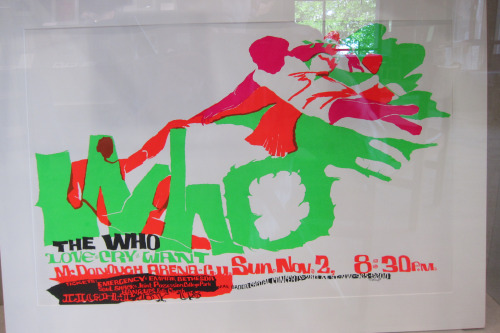
On November 2, 1969 – with Tommy riding high in the charts and the Woodstock festival fresh in the memory – the Who played McDonough Gymnasium at Georgetown for a crowd of about 4000 people.
Wednesday night – thirty-three years after their last proper album and “farewell tour” – the Who played the Barclays Center in Brooklyn for a crowd of about 20,000 people. Last week, they played for a similar crowd at the Nassau Coliseum, a few miles away on Long Island; Friday night they’ll play for another such crowd at the Forest Hills Tennis Stadium a few miles away in Queens.
And therein lies a story of the scale of popular culture then and now.
I went to the Who show at the Barclays Center – as a guest of a friend who is a friend of Pete Townshend’s – and at several points during the set Townshend explained that when the Who first toured America they were playing tiny places: the Village Theater as part of a seven-act variety show; a bar in Michigan where the crowd, said Pete, was “about twenty-five people” (“And four of them were us,” Roger Daltrey chimed in). Even after they wowed the crowd of more than a hundred thousand people at the Monterey Pop Festival in California, they played the one-thousand-capacity Fillmore East in New York; even after bringing the dawn thunder for four hundred thousand people at Woodstock, they played for four thousand people at Georgetown.
It’s the conventional wisdom that the culture of the sixties was unified, “mass” culture par excellence, and that the culture of the present is atomized and fragmented by comparison. In many ways that’s the case. But the population today is larger, and wealthier, and more consumptuous (if that’s a word) than it was in 1969, so that the Who – with no actual occasion, such as a new record or a new stage act, only a silver anniversary – can sell 60,000 tickets at top dollar in the New York area even as reasonable people wonder whether anybody even listens to the Who anymore.
Seen one way, it’s an example of the winner-take-all culture: once you’ve cracked the mass culture, your fragment of the fragmented culture will always be disproportionately large.
Seen another way, it’s an example of baby-boomer dominance at its least attractive, because one reason other bands can’t reach a mass audience is that the boomers, instead of moving on to new bands and new sounds, keep paying up to see the Who over and over again.
See a third way, it’s simply evidence that truly great performers – such as the Who – have no sell-by date. They are perennials.
I sure was glad to see them again (having grown up fully in thrall to them and having seen them in 1982 and 1994). Hearing Pete Townshend play and sing “I’m One” made me think that it may be his best song – and made me remember what a model he has been, for so many of us – the very model of a person who strives for a kind of unity among the fragments of self and society.
The image is of a screenprinted poster for the Who’s concert at Georgetown by the master printmaker Lou Stovall, on display in Lauinger Library (where it is tagged 1970, not 1969). Here’s a bootleg of the concert.
Our Kind of Spirituals, No. 61: Sawyer Fredericks, “Man of Constant Sorrow”
Sometimes justice is done; sometimes the best man wins, etc. That’s what happened the other night on The Voice, when Sawyer Fredericks won the popular vote and the contest (a hundred thousand dollars, a recording contract, a new Nissan …).
“Man of Constant Sorrow” was his breakthrough in the blind audition phase, and what’s striking, hearing it now – a few weeks and many episodes later – is how fully his version carries everything that he brought to the several dozen songs he sang as the competition progressed: vocal strength, grit, restraint, a keen sense of roots that is more punky than curatorial – and above all, the sense that he is singing something he knows and feels. Other singers in the course of the competition; Sawyer seemed to have it all from the get-go.
There’s much to say about him – a home-schooled kid who lives on a farm near Fultonville in upstate New York – and I hope to place a profile of him somewhere. But right now, two things about this song come to mind.
One is that he learned “Man of Constant Sorrow” from the O Brother, Where Art Thou? soundtrack – the soundtrack to a movie released, if you can believe it (I can’t believe it), before he was born. This – strangely, as I tried to work out in The Atlantic – is how folk traditions are perpetuated: a movie with a roots-music soundtrack puts a young musician in touch with those roots, and eventually tens of millions of people are hearing roots music sung on a slick TV stage – but sung in a way that is anything but slick. The song, and the singer, are strong enough to withstand the setting.
The other is that the song – the whole idea of a man of constant sorrow – runs against everything in Sawyer Fredericks’ self-presentation, but it doesn’t matter. He is sixteen years old, gifted, successful, charming, and evidently happy. What can he know of constant sorrow?
Through the song, he can know a lot. This is what art does: it gives us something like direct access to experiences and emotions that aren’t strictly speaking our own. And this is what artists do: they give voice to a sense of humanity that is larger than their literal selves.
Palmyra: Destruction, or Metamorphosis?
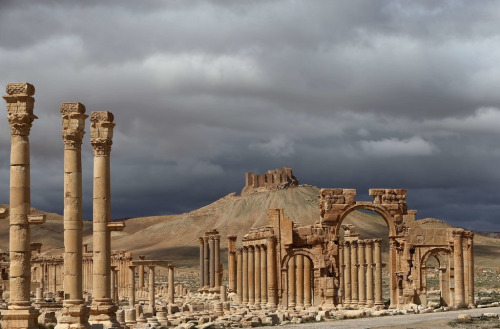
As Palmyra is subjugated by ISIS, its citizens are displaced, and the historic city is left in ruins, I happen on this passage from André Malraux’s The Voices of Silence:
Meanwhile, at a distance from Rome, an art akin to this seemed to be evolving. This was at Palmyra and in the Fayum, where the Roman forms came in contact with the Orient, as Greek forms had come in contact with Asia at the foot of the Pamirs. No doubt the Roman forms had been becoming less and less stable, and Rome did not need Byzantium to make her forget the art of Trajan. The basic elements of the Arch of Constantine and his colossal statue were already in a style directly opposed to what we call the Roman style. What was petrifying Roman figures was not yet Christianity, but the creeping paralysis of Rome herself. The Caesarian gesture was dead and the artists’ problem was not the finding of a new gesture to replace it, but one of somehow breathing life into the inert.
There may well have been other Palmyras, but, if so, they are unknown to us. The Palmyra we know was a desert port of call, but a military one; it was in this oasis that the Romans recruited the Arab cavalry they so often needed in Syria. This much-belittled art which in so many ways adumbrates Byzantine lasted nearly as long as French Romanesque. (How easy it is to imagine a history of art in which the Renaissance would be treated merely as a fleeting humanistic episode!)
Malraux in The Voices of Silence framed an aesthetic of metamorphosis, in which artistic styles are seen metamorphosing one into another across space and time. Often he expressed this through imagery of creative destruction; and often, as in the passage above – let’s imagine the Renaissance as fleeting, not central, he says – he shattered familiar art-historical narratives and put them together in new ways.
It’s striking – and appalling – to see Malraux’s metaphors re-literalized as great and enduring works of art are subjected to actual destruction at the hands of ISIS. Is the ruin of the artistic heritage of Palmyra a loss pure and simple, or is it a stage in the process of artistic metamorphosis? Malraux (to judge from The Voices of Silence) would doubtless say the latter, and a Times opinion writer says “Calm down”– but in the here and now the destruction of Palmyra looks like destruction, full stop.
Tsarnaev Sentence: A Last Spasm for the Death Penalty in America
“The last time a convicted criminal was executed in Massachusetts — 1947 … the high wall in left field at Fenway Park had just been painted green.” But now they want to undo the gains of two-thirds of a century in Massachusetts by putting Dzhokhar Tsarnaev to death.
The death sentence for him is a giant step backwards for us, because the strong evidence is that in the United States the death penalty will soon be a thing of the past.
Mario Marazziti is sure of it. Long the “portavoce” of the Community of Sant'Egidio in Rome, lately a member of the lower house of Italy’s parliament and chair of its human rights committee, Mario – friend to many of us – was a founder of the World Coalition Against the Death Penalty late in the last century. Since then much has changed in the United States, as he spells out in a powerful opinion piece in today’s Los Angeles Times:
The number of executions and new death sentences is at a 20-year low, and just a few states are responsible for the vast majority of executions … A bill to reintroduce the death penalty in Massachusetts was defeated. Bills to outlaw the death penalty are in process in Delaware, Kansas and Colorado. Even in Nebraska, a conservative state, a bill to abolish the death penalty has such strong support that legislators could override an expected veto by the governor.
Much has changed – and much is changing. In the weeks since the publication of Mario’s book Thirteen Ways of Looking at the Death Penalty (I wrote the afterword), the Supreme Court has heard arguments against lethal injection in Oklahoma and two death-row prisoners have been exonerated.
In the hours since he wrapped up the LA Times opinion piece, the Atlantic dropped a new issue with a cover story on lethal injection and Nebraska legislators did indeed vote to abolish the death penalty (and they do have the numbers to overide a veto from the governor).
It
seems possible and even likely that Tsarnaev will still be alive when
the death penalty is declared dead in this country.
Edward Abbey’s Desert Style: “Clear, Intense and Infinitely Suggestive”
Found on the Recent Acquisitions shelf in the suddenly vacant Lauinger Library: All the Wild That Remains, by David Gessner – a just-published double portrait of Wallace Stegner and Edward Abbey as the Emerson and Thoreau of writing about the American West, with an account of the author’s own experience of the West threading the two portraits together.
Here’s a passage, remarkable in its vitality and sensitivity, about the process whereby Abbey, installed as a ranger of a kind at Arches National Monument in eastern Utah, pushed past his apprentice-y first novel and made himself into a writer of a particular kind:
In 1956, the same year that Brave Cowboy was published, he spent his first season as a ranger at Arches. On August 26 of that summer he wrote: “This is the thing. The desert is a good place – clean, honest, dangerous, uncluttered, strong, open, big, vibrant with legend.” In his journals, and in his subsequent nonfiction, he retains some of his early, sensual romanticism: “The more I dim my eyes over print and frazzle my brain over abstract ideas, the more I want and appreciate the delight of being basically an animal wrapped in a sensitive skin: sex, the resistance of rock, the taste and touch of snow, the feel of sun, good wine and rare beefsteak and the company of friends around a fire with guitar and lousy old cowboy songs.” Counterbalancing this is something harder, something leaner. He is learning this leanness in part from the craft of fiction, but also from the desert itself, which seems to be offering up its own aesthetic. Three years later, on August 15, 1959, Abbey, now living in Albuquerque, described what it would mean to “write like the desert”:
“Conrad. To write of – no, to do for the desert what he did for – of – the sea. But I must avoid his rich flowing organ-valved almost lush (tropical) style. Emulate his passion for the exact. My style: something almost harsh, bitter, ugly. The rough compressed, asymmetrical, laconic, cryptic. Cactus. Old Juniper. Rock, dry, heat, the stark contour.
“NO FOG. NO GODDAMED FOG.
“Combine intensity (not density) with clarity. Clear and intense. Like the desert landscape, the desert light, the desert atmosphere – clear, intense and infinitely suggestive. Hard distinctions, precise outlines – but each thing suggesting, somehow, everything else. As in truth each thing does.”
This was a beautiful, and incredibly self-aware, description of one of the effects that Abbey would create in his coming work.
So it was, and is. Abbey would match his style to the desert, and to the garrulous solitude he attained in the desert:
The key in fact would be the embracing of the first-person voice, the voice he had long been sharpening in the journals.