by Paul Eliefrom Georgetown University
Krista Tippett’s Space: A Temple of Talk in Minneapolis
At a certain spot on Hennepin Avenue in Minneapolis, several tributaries of culture converge. There’s the Blake School; the Walker Art Center and sculpture garden; the Beaux-Arts Basilica of St. Mary, the oldest Roman Catholic basilica in the United States; and, catty-corner from the basilica, the spacious and and woodbeamed and sunlit headquarters (if that’s the right word) of Krista Tippett Public Productions, where Krista’s weekly On Being broadcasts are created.
All this on an avenue named for Louis Hennepin, the Franciscan missionary who was the one of the first Europeans to spend time in present-day Minneapolis.
I say “if that’s the right word” because 1619 Hennepin Avenue is not so much an office as a public space, which opens – like the broadcasts – both onto inner space and into the wider world.
That’s certainly the case just now. The American Pilgrimage Project is in Minneapolis, recording three days of conversations – several dozen people from the Twin Cities telling stories about how their religious beliefs have figured into crucial moments in their lives. Krista Tippett and the On Being team are our hosts, and their casa is our casa – or so they’ve made us feel.
It’s
an apt pairing. Through On Being
(formerly “Speaking of Faith”), Krista has used the art of
conversation to represent religious experience in all its vitality and
diversity; and through this project – a Georgetown partnership with
StoryCorps – we’re trying to use the art of conversation to
represent religious experience in all its vitality and diversity.
In conversation with Krista yesterday, I found myself saying, “You know, my real religion is narrative”: and if that’s the case, then 1619 Hennepin Avenue is its cathedral – or, better, its basilica.
Thanks to Krista Tippett, Trent Gilliss, and their On Being colleagues.
On “Pilgrimage”: Stories of Dorothy Day
Tom Cornell was there, telling a story – he who burned his draft card in Union Square in 1965 and was sent to prison for doing so. Robert Ellsberg was there – he who dropped out of Harvard in the early seventies to join in the Catholic Worker. Jane Sammon was there – she who has been a presence at Maryhouse on East 3rd Street since Dorothy Day was living in the house in the 1970’s. So were Martha Hennessy, one of Dorothy Day’s granddaughters and a voice in the cause for her canonization; and Carmen Trotta, who organized things as he has organized so many things for the New York Catholic Workers in the past twenty years; and Monica Cornell, who made filling out the forms a small but sure act of resistance, smiling all the while.
“There” was the StoryCorps Listening Booth in Foley Square in Manhattan. Through the American Pilgrimage Project (a partnership of Georgetown and StoryCorps) it was arranged for Catholic Workers who knew Day – the movement’s foundress – to record their recollections of her. It was apt that the booth is just a few yards away from City Hall Park, where Day and other Catholic Workers protested against civil-defense air-raid drills year after year in the 1950s – and just across the square, Tom Cornell pointed out, from the federal courthouse where he was tried, found guilty, and sentenced to a prison term in 1968.
As Day’s cause is considered in Rome – and considered in the couple of hundred Catholic Worker communities around the world – these stories will form vital parts of the record. And they’ll be valuable beyond price in their own right. What was Dorothy Day like? How can we be sure? Because these people knew her, and they told us.
The recording process put in mind a story that figures into The Life You Save May Be Your Own. Peter Maurin – radical, raconteur, extemporaneous philosopher, author of versified “Easy Essays” – founded the Catholic Worker with Dorothy Day in 1933. In 1947, he had a stroke. He began to mumble his words; then for long stretches he stopped talking altogether.
God “took from him his mind, the one thing perhaps he took delight in,” Day observed. “He could no longer discuss with others, give others in a brilliant overflow of talk his keen analysis of what was going on in the world.” So the Catholic Workers decided to tape-record him reading some of his “Easy Essays” before it was too late. They gathered around his bed, set the reels going, and held the microphone close. “His voice strangely enough was louder and clearer as it came over the wire than it had been for a long time … ,” Day recalled. “Then, after we had triumphantly made a fifteen -minute spool, someone else tried to work the machine and erased it all.”
The photograph, in the Brooklyn Museum’s collection, shows Day and other Catholic Workers protesting in City Hall Park.
Today in Tulsa: The American Pilgrimage Project
A Buddhist convert to Catholicism; a couple of rabbis, married to each other, who recently moved to Tulsa from the Bay Area; a transgender man who is studying for the ministry; a woman who struggled to keep faith after she was blinded in a vicious attack; a survivor of the Holocaust; a pastor whose spirituality blends Pawnee and Baptist traditions …
These are some of the people who are taking part in the American Pilgrimage Project in Tulsa, Oklahoma, this week. The project – a partnership of Georgetown and StoryCorps – has been two years in the making, and Tulsa is the first full stop (following on pilot efforts in New Orleans and western Pennsylvania). Our goal is to gather ordinary Americans’ stories of the ways their religious beliefs have figured into crucial moments in their lives.
But the people who are participating are obviously far from ordinary. Who else? A Catholic priest from Burma who works with Burmese refugees; a local leader in the naturalist spirituality movement; a woman who does outreach work in a prison for women; a young man, a son of immigrants from Mexico, who now captains the University of Tulsa soccer team …
If their stories are as colorful as their capsule biographies, we’ll have a vivid representation of American religious diversity right from the beginning.
Many thanks to all in the people in various communities in Tulsa who have helped us identify and reach out to participants. And thanks to the Jewish Federation of Tulsa and the Unitarian Church of All Souls, which are hosting the three days of conversations.
The American Pilgrimage Project will go to Minneapolis – St. Paul in May and to New York state’s Capital Region (Albany, Schenectady, Troy, Saratoga Springs) in June.
At the Catholic Worker: “Militant Nonviolence — Possible?”
With the American Pilgrimage Project up and running, we are hoping to record the stories of members of the Catholic Worker movement, beginning with those who knew Dorothy
Day, who joined with Peter Maurin in founding the movement and its
newspaper in May 1933.
So this morning I accompanied two
StoryCorps staff members to a meeting with two anchors of the
Catholic Worker community in New York, Carmen Trotta and Martha
Hennessy (one of Dorothy Day’s granddaughters), at Maryhouse on East
3rd Street.
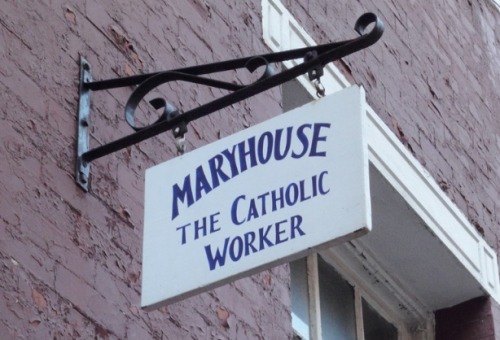
Just to be there was to reminded how much the place, and the movement, means to so many of us – even those of us who know the movement mainly from reading (and writing) about it. Maryhouse is a redbrick building from the 1860s, rambling and welcoming, and was used as a music school before the movement bought it in the 1960s. It’s a place where Catholic faith, nonviolence, anarchism and radicalism, and the ongoing life of New York City have come together fruitfully for half a century.
All that – and Dorothy Day lived her “third half of life” there, died there, and was laid out in the chapel there before the Mass of Christian burial.
I left with the current issue of the Catholic Worker, which features a conversation about nonviolent action in Ferguson, Missouri, between Rev. Osagyefo Segou, who has been involved in direct action there, and Waging Nonviolence author David Hartsough. Nathan Schneider moderated.
The discussion wound around to the notion that the form of protest that is being practiced in Ferguson should be called militant nonviolence” – and the question of whether “militant nonviolence,” if such a thing is possible at all, can be a good thing. About such distinctions, Rev. Segou had this to say:
If I can just make one request. My request of you all in this room is that when this protest doesn’t look the way you are used to it looking, I ask you to look deeper. Yes it’s profane and angry because we have betrayed our children. And so instead of beginning the sentence or conversation with “If they did it this way,” take seriously the way they are doing it. Take them seriously. Take their humanity seriously. I was born again on the streets of Ferguson. I got saved, as we would say in evangelical parlance, by some kids with gold teeth and tattoos and sagging pants, and so I’m asking you to look at their humanity. So when the media start that “they’re violent,” remind them they’ve been nonviolent for the vast majority of their protest even after America betrayed them on every occasion. I ask that you keep track of their humanity … they are just trying to find their way, trying to make sense of it all.
The is conversation is itself an instance of the kind of personal conversation and storytelling that we aim to gather, archive, and make public.
The full conversation is online at wagingnonviolence.org.
A Hundred Seconds of Solitude
Aaron Siskind was teaching English in Manhattan in 1929 when he received a camera as a wedding gift. A teacher he already was; a photographer he soon became, taking pictures of city life for the New York Photo League, and late in his first decade he took this photograph of St. Joseph’s House, the Catholic Worker house in Manhattan, probably at its longtime Mott Street location on the Lower East Side.
What’s striking about this photograph, to my eye, is the profound solitude of the figure. The canonical images of the Catholic Worker movement from its founding era show people in groups: men on the soup line, Catholic Workers “selling” the current issue of the newspaper for the proverbial “a penny a copy,” Catholic Workers arranged in awkward semi-formality outside St. Joseph’s House for a group portrait.
Here the figure, whoever he is, he has gone to the back of the building and found a little space and light; and the photograph finds him in counterpoint with the figure silhouetted in the front doorway of the building, who is possibly seeking a little space and light himself.
Which one is a Catholic Worker, and which is a guest who has come for a meal? You can’t tell. We can’t tell the difference. That is the point of the photograph, and of the movement.
St. Joseph’s House is now at 36 East First Street, still on Manhattan’s Lower East Side. Earlier this fall some of the present-day Catholic Workers sought out StoryCorps, hoping to record firsthand recollections of Dorothy Day, the movement’s foundress. We’re now making arrangements to incorporate these into the American Pilgrimage Project, a partnership between StoryCorps and Georgetown devoted to gathering the stories of the role religious belief plays in the experience of ordinary Americans at crucial moments in their lives.
A slideshow of Siskind’s early work from yesterday’s Times is here. Siskind’s photograph of the St. Joseph’s House interior is here.
As With the Essay, So With the Story?
America’s website features an interview about the American Pilgrimage Project, our Georgetown partnership with StoryCorps. What are we trying to do with it? Here’s what:
In American society today, we hear a great deal about the religious habits of Americans from statisticians and demographers. You know how it goes: a study comes out reporting that 90 percent of people believe in this or that, or that the number of Americans with no religion has tripled, or whatever. We also hear American leaders making broad assertions about religious doctrines and their bearing on public life. But the actual experience of ordinary people is scanted or overlooked. I hope the American Pilgrimage Project will help in some small way to correct that. What do people actually believe? How do their beliefs bear on their daily lives? Those are perennial questions, needless to say. Typically to answer them we look to literature, we look to history, we look to journalism, and the mass media. Now the hope is that we’ll be able to turn to the American Pilgrimage Project archive as well. It will help to broaden and complicate the narrative.
StoryCorps is known for its radio broadcasts, but founder Dave Isay’s four StoryCorps books are bestsellers. My hope is that the American Pilgrimage Project will follow naturally on the approach I’ve taken in my own books and articles, which I think of as “narrative portraiture.” To draw out the connection, America’s Sean Salai SJ let me smuggle in a brief exegesis of my most recent Atlantic article:
We’re so used to news reports that depict Catholic leaders as managers, or strategists, or people with the “leadership gene.” Well, I try to depict them as Catholics, as religious believers first of all. In my Atlantic portrait of Benedict in the time of Francis, for example, I took up the theme of renunciation and wound it deep into the structure of the piece, with the aim of showing how Benedict’s renunciation of the papacy has led him to the more complex act of renunciation involved in largely keeping his silence as Francis has led the church in a different direction and with a notably different style. Instead of just drawing a contrast between Francis and Benedict or making a big deal of the phenomenon of a living ex-pope, I drew on the three books of interviews Benedict gave when he was Cardinal Ratzinger in order to dramatize the life he is living now, which is principally the interior life.
A few days ago Salai interviewed just-retired Georgetown political philosophy professor James V. Schall SJ, who is a devoted reader and writer of essays. Fr. Schall – in the essayist’s way – quoted another essayist:
Josef Pieper, that most insightful man, in commenting on Aquinas, once compared the essay form to the “article” form of St. Thomas. He pointed out that a good short essay and an article in the Summa were about the same length, three or four pages. The article set about to answer a question and give reasons for it, and to come to a conclusion. The essay, the “effort” in French, was looser. It could range widely over its subject matter. It did not have to be tightly argued. Yet, without the article, the essay is in danger of being fuzzy and frivolous, whereas, at its best, the essay contains genuine truths and deep feelings about human things, yes, even divine things.
Range in pursuit of truth: that, Father Schall suggests, is “the genius of the essay.” Now to figure out “the genius of the story.”
The image is the title page of Einstein’s 1930 essay “Religion and Science.”
Scott Cheshire and the American Apocalyptic Tradition
An exchange with a group of scholars who formed a panel at the American Academy of Religion’s annual conference about my Times essay of eighteen months ago sent me back to the essay – and sent me to Scott Cheshire’s just-published novel High as the Horses’ Bridles.
The scholars responded not so much to the essay itself as to the headline – “Has Fiction Lost Its Faith?” – and indicted me twice over, insisting I was wrong to wish for fiction dealing directly with matters of Christian belief and insisting I was wrong to say that such fiction is notable in its absence.
But I had set out from a more complex premise – arguing that one reason the absence of such fiction is notable is that Christianity is so visible in our society, with people of all walks of life reckoning with religious inheritance in dramatic ways.
The run-up to publication of High as the Horses’ Bridles makes the case emphatically. First, several months ago, I got a note from Cheshire, the author: “Having been raised in the American apocalyptic tradition, I hope to bring something new to the conversation with my work,” he told me.
Then came a note from the book’s editor at Henry Holt, Sarah Bowlin, who introduced herself as “a woman who grew up in a very fundamentalist Baptist house” and one “whose life is now influenced, although not necessarily guided, by that upbringing.”
Then – a few days ago – came a review of the book in the Washington Post by Ron Charles, who began this way:
If you were raised, as I was, in a small church with intense ideals at odds with mainstream culture, you can remember that awkward pressure to stand apart from the world and, as the Bible commands, be “separate.” There’s a price to be paid for that separateness … but for me — and for many people I know — faith has been a fierce struggle with the most profound questions of human life.
Here you have author, editor, reviewer, and critic – myself – all with stories to tell about religious belief and its implications. It’s this – sheer numbers, or demographics if you like – that would seem to yield more novels that reckon with religious belief than we have seen lately. Charles goes on:
Considering the persistent varieties of religious experience in America, we aren’t blessed with nearly enough good novels about the diverse currents of spirituality. And the shelves are particularly quiet — or unhelpfully shrill — on the more radical expressions of religious belief.
Needless to say, I agree with him – which is to say that he agrees with the argument of the Times essay.
Now to High as the Horses’ Bridles, which comes festooned with comments from faculty members at the Hunter MFA program (Colum McCann, Claire Messud), among others.
By “the American apocalyptic tradition” Cheshire means the Jehovah’s Witnesses. HBO's The Leftovers deals with the American apocalyptic tradition, too, and the author of a Guardian piece about the series begins: “I grew up fundamentalist in the Appalachians. The Rapture – and the fear and anticipation I felt for it – seeped into the bones of my faith …”
This is the root of the American Pilgrimage Project: truly, there are such stories beyond numbering.
On the “New” NPR, Stories of Changing Beliefs
NPR, striving to become more diverse in its staff, audience, and programming, is taking cues from the Los Angeles public radio program Take Two. And Take Two’s exhibit A in diversity: a report on religious diversity.
“Take Two” topics reflect the interests of the Los Angeles community, said Mr. Martínez, citing a popular story about immigrants to the United States who change religions. “We start with the world around us,” he said.
We are seeking stories like those through the American Pilgrimage Project, a Georgetown partnership with StoryCorps, now up and running. Possibly we’ll gather stories in Los Angeles in the fall.
In the Times, Stories of Pilgrimage(s)
While I was off seeing a bald eagle, the New York Times posted Mark Oppenheimer’s “Beliefs” column about the American Pilgrimage Project – a partnership of Georgetown and StoryCorps devoted to gathering, archiving, and sharing ordinary Americans’ stories of the ways religious belief has figured into crucial moments in their lives. It’s an extraordinary column – and an aptly timed one, because after several years of planning and fund-arranging the project is now getting into gear for the fall.
No sooner had I come out of the woods and into range than I found an email– from a Pulitzer Prize winner – asking why the photograph accompanying the column showed StoryCorps founder Dave Isay and me in an Episcopal church. The project came about due to my despair over the preponderance of stories about priestly sexual abuse in the Catholic church and a wish to make clear that there is more to the story, right? So what were Dave and I doing at St. Bart’s on Park Avenue?
Well, St. Bart’s was nearby and its doors were open, for one thing. But for another, the American Pilgrimage Project isn’t devoted only to Catholic stories – not by any means. The emphasis on Catholic stories has been a point of departure, that’s all.
In 2008, when the priestly sexual abuse crisis flared up again (that time in Ireland, especially) I began to think that the only way Catholics could come to grips with the extent of the crisis was by telling their stories – whatever those stories are. Certainly some of them would counter the stories of sexual malfeasance being given wide play (and rightly so) in the media. Others would themselves be stories of abuse and evil, told in the safe and trusting setting of a StoryCorps listening session. And others would give voice to aspects of Catholic experience that aren’t generally discussed, including the whole range of experiences involving sexuality, authority, priestly power, and the like. Over time, it seemed to me, such truth-telling could only lead to greater candor and integrity in the church.
As the project took shape at Georgetown and at StoryCorps, it became clear that the many of the most powerful stories for American Catholics involve their encounters with people of other faiths. So it naturally followed that the project should take account of these experiences – Catholic-Jewish experiences, for example, beginning with the Catholic-Jewish marriages of several people I know well. And as Pope Francis was elected – the first non-European pope, the first American, the first South American, the first native Spanish speaker, the first Jesuit – and made his own experience of diversity the point of departure for his big-hearted pontificate, it became even clearer that we should open the doors wide.
Setting out this fall, we’ll likely give particular attention to Catholic experiences and Catholic-Jewish experiences. We have to start somewhere. But as the project unfolds, we hope to gather, archive, and share several hundred stories from the whole range of American religious experience.
Mark Oppenheimer’s book Thirteen and a Day – about a variety of bar mitzvahs across America – is thick with such stories, and is one of my personal models for what we are trying to do.
And in connection with the column StoryCorps recorded Mark’s own story, which he told to his wife. It will become part of the StoryCorps archive at the Library of Congress, with something like sixty thousand other stories – and counting.
10,000 Stories in Tulsa
Traveling up I-35, two Times journalists filed this vivid report (one in an ambitious series) from St. Thomas More parish in Tulsa. There are ten thousand parishioners. Nine thousand speak Spanish as their first language, as do two of the three priests. Several hundred others speak principally in Vietnamese.
A Saturday at St. Thomas More in Tulsa takes in baptisms; quinceañeras (the ceremony that marks a girl’s fifteenth year); a wedding or three; food distribution; a folkloric dance class; evening Mass; a concert in the church; a slideshow on life insurance and mutual funds; and a presentation by “officials from the Mexican consulate in Little Rock, Ark; they have driven five hours to explain passport applications and other government services.”
“This is the church where we know we can reach a lot of people,” one of them explains.
In Tulsa a couple of years ago I spent the evening with Michael Paul Mason, editor of the groundbreaking independent newspaper This Land. When I told him about the American Pilgrimage Project – a partnership between Georgetown and StoryCorps devoted to gathering ordinary Americans’ stories about the role of religious belief in their lives – he and his colleagues urged me to bring the project to Tulsa.
We’ll get there for sure. The stories of the people at St. Thomas More parish are stories we need to hear.
So does Pope Francis. After Philadelphia, let him go to Tulsa. Where better can the Argentine pope see – and hear – the Catholic future?