
by Paul Eliefrom Georgetown University
In Paris, a New Reign of Terror?
The age of terror has come emphatically to the heart of Europe. That is the thrust of the weekend’s articles – the ones I read, at any rate – about the terror attacks in Paris. ISIS is not confining itself to Syria. The Paris attacks, an attack in Beirut, and the downing of a Russian jetliner over Egypt are parts in a single scheme. Unlike the Charlie Hebdo attacks, which targeted foes of radical Islam, these attacks targeted the pleasure-seeking French bourgeois, so as to induce unremitting terror in the city and in Europe as a whole.
All true – but it seems to me to miss a crucial point about terror and Paris, namely, that terror hasn’t lately arrived in Paris – main non: Paris is where terror in the modern sense began.
Twenty years ago, if you asked a liberal arts student to name a city associated with terror, it seems to me you’d have gotten Paris as your first answer (with Jerusalem and Tehran second and third). The reason, of course, was the French Revolution. It was in Paris that French revolutionaries carried out the Reign of Terror, so well known to so many through Dickens’ A Tale of Two Cities. It seems to me our use of the term “terror” to describe acts of disordered violence against civilians goes back to 1789 and stops there.
The Reign of Terror lasted eleven months in 1793 and 1794 – just about as long as the eleven months from the Charlie Hebdo attacks to the attacks Friday evening. But this is not to say that this year’s terror attacks in Paris are akin to those of the Reign of Terror. It’s to say the opposite, in fact – if Philip Bobbitt’s arguments in Terror and Consent are to be credited.
Bobbitt, in a giant 2008 book (which I know only through thorough and exacting reviews) argued that the “war on terror” was different from previous wars, and that as the era of the nation-state was characterized by “nation-state wars,” so the era of the market state is characterized by “market-state wars” – otherwise known as wars of terror and wars on terror. Here is The Independent:
For Bobbitt, we live in a time of market states, when we are leaving behind the constitutional order of the nation state in favour of an era of opportunity, entrepreneurship and globalisation. But the same forces shaping this agreeable destiny “are also empowering the forces of terror, rendering societies more vulnerable and threatening to destroy the consent of the individual as the essential source of state legitimacy”. The book is “not so much about al Qaeda as about the larger phenomenon of 21st-century terrorism of which al Qaeda is only a herald”: namely, the groups for whom terror is a “permanent state of affairs”, whose genius is to “copy the decentralised, devolved… and privatised market state of the 21st century”. With both “states of consent and states of terror… evolving into market states”, the central question is which version will succeed. So historians “may one day see the Wars against Terror as an epochal war, an historical and constitutional characterization that can only be made retrospectively”.
1775 to 1789 was a period of fourteen years. 2001 to 2015 has been fourteen years. If it can be said that we are now in an age of terror akin to the “Age of Revolution” Eric Hobsbawm saw beginning in 1789, it may turn out that what happened in Paris in 2015 stands in relation to what happened in America in 2001 in the same way that happened in Paris in 1789 stands in relation to what happened in America in 1775.
In any case, if we are going to understand the age we are in, we need to consider the two events together, the way the American Revolution and the French Revolution are best considered together.
35,000 Millennials Can’t Be Wrong – or Can They?
The new Pew poll affirming that the
people called millennials are (as a group) notably less religious
than their predecessors furnishes statistics to bolster an impression
most of us who care about these things have had for a while now.
But it was a different piece of
demographics in yesterday’s news that caught my eye: the graphic in the
Times illustrating where
every one of the Syrian refugees admitted to the United States this
year has been “placed.”
For
one thing, the graphic shows (as Human Rights First points out) “the
slow pace of U.S. resettlement of Syrian refugees” – only 1,874
refugees since 2012, a tiny number by comparison with past
precedents:
“The United States has also admitted far larger numbers in the past. In 1979, it provided sanctuary to 111,000 Vietnamese refugees, and in 1980, it added another 207,000. Around the same time, the country took in more than 120,000 Cuban refugees during the Mariel boatlift, including around 80,000 in one month alone.”
For
another, it shows that most have been sent not to the largest cities
but to “more affordable, medium-size cities”:
Boise, Idaho, has accepted more refugees than Los Angeles and New York combined; Worcester, Mass., has taken in more than Boston.
The
graphic has little blue boxes representing 50 Syrian refugees who
have been settled in Baltimore and another 20 settled in Maryland
between B'more and the District of Columbia.
The
American Pilgrimage Project (Georgetown’s partnership with
StoryCorps) will be in Baltimore in the coming months, and it seems a good
bet that those refugees – many of them likely Christians in flight
from ISIS – have stories to tell about the ways their religious
beliefs have figured into crucial moments in their lives.
From
the point of view of the Pew study, 1,854 people – the number of
newly settled Syrian refugees – is a rounding error; and from the same point of view 75 people,
statistically, can be said not to exist at all.
But
from the point of view of the American Pilgrimage Project, those 75
people are seventy-five people, with seventy-five different stories
to tell.
Can’t
wait to hear your stories. We’ll meet you in Baltimore.
Adopt a Ruin – Before It’s Too Late
When Hurricane Katrina struck, I was struck by the fact that the New Orleans was a relatively short distance from the three most powerful goods-delivery services known to man: Federal Express in Memphis, UPS in Louisville, and Walmart in Arkansas. Those operations are extraordinarily adept at moving goods from one place to another quickly, precisely, and relatively cheaply – and yet when there arose a need to move goods into New Orleans to help people displaced by the hurricane, the U.S. government was stymied – and no one, as I recall, suggested that the feds ought to call on FedEx or UPS or Walmart (all beneficiaries of corporate welfare) to help get the job done.
This came to mind with news of ISIS’s destruction of a significant Roman ruin – the remains of a monumental triumphal arch and colonnade – in the desert in Syria. There was a picture and a story on page A8 of Tuesday’s print edition of the Times. On the facing page – page A9 – there was a story about a group of researchers who are using CT scans to analyze the plaster molds of people killed when the eruption of Vesuvius swept through Pompeii in 79 AD.
Surely there’s something wrong with our society when we are superbly empowered to study the destruction of a Roman monument 2000 years ago, using the latest technology with the utmost care and patience, but are utterly powerless to prevent the destruction of a Roman monument in our own day.
Obviously,
ISIS is the problem. They destroyed the monument in Palmyra. They did it because they know that we in the West care so very much
about monuments like Pompeii, even in their ruined state: wrecking a
monument, they are hitting us where we used to
live. And they destroyed the monument because they could – because they knew that there aren’t many lovers of Roman antiquity
who would risk their lives to protect it, even if that were
possible.
And
yet it seems to me that that there’s more to this problem – that it involves
a mismatch of resources. Surely the energy companies that have used phenomenal skill and technology to extract petroleum from the earth
could have stepped in and applied some of that skill and technology to
secure monuments in Palmyra and places like it. Surely
UNESCO, which has designated dozens of grand structures in
placid parts of Europe as World Heritage Sites, could have done
more to look out for sites that are in need of urgent
protection right now. Surely the museums and heritage organizations
that seems to renovate the displays of the Elgin Marbles and
Stonehenge every twenty years could “adopt” ruins
where there are no tourists and no admission charge.
On some level, ISIS is right: there is an element of idolatry in our approach to ruins.
Palmyra: Destruction, or Metamorphosis?
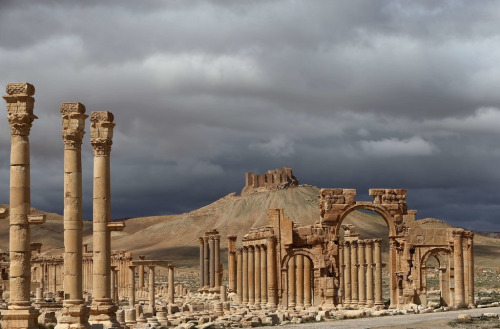
As Palmyra is subjugated by ISIS, its citizens are displaced, and the historic city is left in ruins, I happen on this passage from André Malraux’s The Voices of Silence:
Meanwhile, at a distance from Rome, an art akin to this seemed to be evolving. This was at Palmyra and in the Fayum, where the Roman forms came in contact with the Orient, as Greek forms had come in contact with Asia at the foot of the Pamirs. No doubt the Roman forms had been becoming less and less stable, and Rome did not need Byzantium to make her forget the art of Trajan. The basic elements of the Arch of Constantine and his colossal statue were already in a style directly opposed to what we call the Roman style. What was petrifying Roman figures was not yet Christianity, but the creeping paralysis of Rome herself. The Caesarian gesture was dead and the artists’ problem was not the finding of a new gesture to replace it, but one of somehow breathing life into the inert.
There may well have been other Palmyras, but, if so, they are unknown to us. The Palmyra we know was a desert port of call, but a military one; it was in this oasis that the Romans recruited the Arab cavalry they so often needed in Syria. This much-belittled art which in so many ways adumbrates Byzantine lasted nearly as long as French Romanesque. (How easy it is to imagine a history of art in which the Renaissance would be treated merely as a fleeting humanistic episode!)
Malraux in The Voices of Silence framed an aesthetic of metamorphosis, in which artistic styles are seen metamorphosing one into another across space and time. Often he expressed this through imagery of creative destruction; and often, as in the passage above – let’s imagine the Renaissance as fleeting, not central, he says – he shattered familiar art-historical narratives and put them together in new ways.
It’s striking – and appalling – to see Malraux’s metaphors re-literalized as great and enduring works of art are subjected to actual destruction at the hands of ISIS. Is the ruin of the artistic heritage of Palmyra a loss pure and simple, or is it a stage in the process of artistic metamorphosis? Malraux (to judge from The Voices of Silence) would doubtless say the latter, and a Times opinion writer says “Calm down”– but in the here and now the destruction of Palmyra looks like destruction, full stop.