by Paul Eliefrom Georgetown University
The Who Hits 50: “I’m One” (and So Are About 60,000 Others)
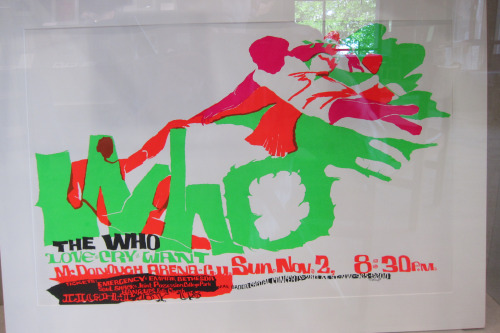
On November 2, 1969 – with Tommy riding high in the charts and the Woodstock festival fresh in the memory – the Who played McDonough Gymnasium at Georgetown for a crowd of about 4000 people.
Wednesday night – thirty-three years after their last proper album and “farewell tour” – the Who played the Barclays Center in Brooklyn for a crowd of about 20,000 people. Last week, they played for a similar crowd at the Nassau Coliseum, a few miles away on Long Island; Friday night they’ll play for another such crowd at the Forest Hills Tennis Stadium a few miles away in Queens.
And therein lies a story of the scale of popular culture then and now.
I went to the Who show at the Barclays Center – as a guest of a friend who is a friend of Pete Townshend’s – and at several points during the set Townshend explained that when the Who first toured America they were playing tiny places: the Village Theater as part of a seven-act variety show; a bar in Michigan where the crowd, said Pete, was “about twenty-five people” (“And four of them were us,” Roger Daltrey chimed in). Even after they wowed the crowd of more than a hundred thousand people at the Monterey Pop Festival in California, they played the one-thousand-capacity Fillmore East in New York; even after bringing the dawn thunder for four hundred thousand people at Woodstock, they played for four thousand people at Georgetown.
It’s the conventional wisdom that the culture of the sixties was unified, “mass” culture par excellence, and that the culture of the present is atomized and fragmented by comparison. In many ways that’s the case. But the population today is larger, and wealthier, and more consumptuous (if that’s a word) than it was in 1969, so that the Who – with no actual occasion, such as a new record or a new stage act, only a silver anniversary – can sell 60,000 tickets at top dollar in the New York area even as reasonable people wonder whether anybody even listens to the Who anymore.
Seen one way, it’s an example of the winner-take-all culture: once you’ve cracked the mass culture, your fragment of the fragmented culture will always be disproportionately large.
Seen another way, it’s an example of baby-boomer dominance at its least attractive, because one reason other bands can’t reach a mass audience is that the boomers, instead of moving on to new bands and new sounds, keep paying up to see the Who over and over again.
See a third way, it’s simply evidence that truly great performers – such as the Who – have no sell-by date. They are perennials.
I sure was glad to see them again (having grown up fully in thrall to them and having seen them in 1982 and 1994). Hearing Pete Townshend play and sing “I’m One” made me think that it may be his best song – and made me remember what a model he has been, for so many of us – the very model of a person who strives for a kind of unity among the fragments of self and society.
The image is of a screenprinted poster for the Who’s concert at Georgetown by the master printmaker Lou Stovall, on display in Lauinger Library (where it is tagged 1970, not 1969). Here’s a bootleg of the concert.