
by Paul Eliefrom Georgetown University
Palmyra: Destruction, or Metamorphosis?
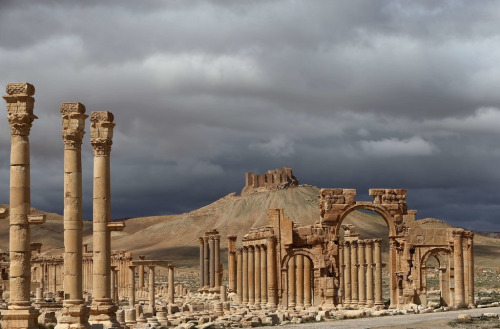
As Palmyra is subjugated by ISIS, its citizens are displaced, and the historic city is left in ruins, I happen on this passage from André Malraux’s The Voices of Silence:
Meanwhile, at a distance from Rome, an art akin to this seemed to be evolving. This was at Palmyra and in the Fayum, where the Roman forms came in contact with the Orient, as Greek forms had come in contact with Asia at the foot of the Pamirs. No doubt the Roman forms had been becoming less and less stable, and Rome did not need Byzantium to make her forget the art of Trajan. The basic elements of the Arch of Constantine and his colossal statue were already in a style directly opposed to what we call the Roman style. What was petrifying Roman figures was not yet Christianity, but the creeping paralysis of Rome herself. The Caesarian gesture was dead and the artists’ problem was not the finding of a new gesture to replace it, but one of somehow breathing life into the inert.
There may well have been other Palmyras, but, if so, they are unknown to us. The Palmyra we know was a desert port of call, but a military one; it was in this oasis that the Romans recruited the Arab cavalry they so often needed in Syria. This much-belittled art which in so many ways adumbrates Byzantine lasted nearly as long as French Romanesque. (How easy it is to imagine a history of art in which the Renaissance would be treated merely as a fleeting humanistic episode!)
Malraux in The Voices of Silence framed an aesthetic of metamorphosis, in which artistic styles are seen metamorphosing one into another across space and time. Often he expressed this through imagery of creative destruction; and often, as in the passage above – let’s imagine the Renaissance as fleeting, not central, he says – he shattered familiar art-historical narratives and put them together in new ways.
It’s striking – and appalling – to see Malraux’s metaphors re-literalized as great and enduring works of art are subjected to actual destruction at the hands of ISIS. Is the ruin of the artistic heritage of Palmyra a loss pure and simple, or is it a stage in the process of artistic metamorphosis? Malraux (to judge from The Voices of Silence) would doubtless say the latter, and a Times opinion writer says “Calm down”– but in the here and now the destruction of Palmyra looks like destruction, full stop.