by Paul Eliefrom Georgetown University
Sanders at Georgetown: Socialism for Thanksgiving
“Ideology,” anyone?
At Georgetown yesterday, Bernie Sanders gave the most consequential address of his political life, taking time and care to explain (as Mother Jones put it) that “yes, he is a democratic socialist, and you should be, too.”
Habitually extemporaneous, to prepare for the Georgetown event he put his text through several drafts and used a teleprompter.
It was an extraordinary address, one equally rich in video “bites” (such as these six on NPR) and extended historical analogies, such as this one, quoted in the Mother Jones piece:
Almost everything [Roosevelt] proposed was called “socialist.” I thought I would mention that just in passing. Social Security, which transformed life for the elderly in this country, was defined by his opponents as “socialist.” The concept of the “minimum wage"—that workers had to be paid at least a certain amount of money for their labor—was seen as a radical intrusion into the marketplace and was described as "socialist.” Unemployment insurance (the idea that if you lose your job at least you have something to fall back), abolishing child labor, the 40-hour work week, collective bargaining (the rights of workers to engage in negotiations with a union), strong banking regulations, deposit insurance, and job programs that put millions of people to work were all described, in one way or another, as “socialist.” Yet as you all know, all of these programs and many more have become the fabric of our nation and in fact the foundation of our middle class.
Sanders represented socialism as thoroughly in the American grain, a rich compote of national traits akin to the ones we celebrate at Thanksgiving.
By now it seems obvious to say that our political system has truly passed through the looking glass when Sanders is derided as a fringe candidate while half a dozen half-cocked extremist Republicans are seen as representing the views of “ordinary Americans.”
But alas, the point needs making. Even as they presented Sanders’ address appreciatively, both NPR and Mother Jones referred matter-of-factly to his “socialist ideology,” with all the connotations – of rigidity, militancy, state repression – that the word carries even today.
It’s as if they didn’t hear a word he said. And if NPR and Mother Jones can’t hear Bernie Sanders clearly, who can?
35,000 Millennials Can’t Be Wrong – or Can They?
The new Pew poll affirming that the
people called millennials are (as a group) notably less religious
than their predecessors furnishes statistics to bolster an impression
most of us who care about these things have had for a while now.
But it was a different piece of
demographics in yesterday’s news that caught my eye: the graphic in the
Times illustrating where
every one of the Syrian refugees admitted to the United States this
year has been “placed.”
For
one thing, the graphic shows (as Human Rights First points out) “the
slow pace of U.S. resettlement of Syrian refugees” – only 1,874
refugees since 2012, a tiny number by comparison with past
precedents:
“The United States has also admitted far larger numbers in the past. In 1979, it provided sanctuary to 111,000 Vietnamese refugees, and in 1980, it added another 207,000. Around the same time, the country took in more than 120,000 Cuban refugees during the Mariel boatlift, including around 80,000 in one month alone.”
For
another, it shows that most have been sent not to the largest cities
but to “more affordable, medium-size cities”:
Boise, Idaho, has accepted more refugees than Los Angeles and New York combined; Worcester, Mass., has taken in more than Boston.
The
graphic has little blue boxes representing 50 Syrian refugees who
have been settled in Baltimore and another 20 settled in Maryland
between B'more and the District of Columbia.
The
American Pilgrimage Project (Georgetown’s partnership with
StoryCorps) will be in Baltimore in the coming months, and it seems a good
bet that those refugees – many of them likely Christians in flight
from ISIS – have stories to tell about the ways their religious
beliefs have figured into crucial moments in their lives.
From
the point of view of the Pew study, 1,854 people – the number of
newly settled Syrian refugees – is a rounding error; and from the same point of view 75 people,
statistically, can be said not to exist at all.
But
from the point of view of the American Pilgrimage Project, those 75
people are seventy-five people, with seventy-five different stories
to tell.
Can’t
wait to hear your stories. We’ll meet you in Baltimore.
Pope Francis: People, Let’s Be Free to Reason Together
A few weeks ago, several dozen of us Georgetown faculty members and students met in the large conference room at the Berkley Center and watched Pope Francis’s address to a joint session of Congress. A lively discussion followed, although I was forced to duck in and out to reply to a raft of messages that came in after Francis put forward Dorothy Day and Thomas Merton—protagonists of my first book, The Life You Save May Be Your Own: An American Pilgrimage—as “representative Americans” in their striving for the common good.
Now the Religious Freedom Project’s Nicholas Fedyk and I are picking up a thread of that day’s conversation and trying to carry it forward. On Cornerstone, Nick has posted a piece about the so-called “Francis effect” in world politics, and here I am following through with a reply.
Taking off from Stalin’s famous quip—“How many divisions has the Pope of Rome?”—Nick cites Francis’s charisma and moral authority among world leaders to suggest how profoundly the political order has changed since Stalin’s time. Under John Paul II, and now under Francis, he declares, “The Church is eagerly reasserting its role in world affairs. Defying realist calculations of power, it relies on the force of ideas, not army divisions.”
In particular, these popes have played the role of advocate for the idea of the common good and the idea of human dignity that underlies it:
"Constructivists have argued for the power and salience of norms for decades, including the value of human dignity. Many scholars, in fact, partially attribute the fall of the communism in Eastern Europe and Latin America to the dynamic leadership of John Paul II. More support for the common good lies in the increasing push for humanitarian action, which is spelled out in numerous international treaties and has formed the basis for a number of interventions—most notably in Kosovo, Libya, and Syria. There is a solidifying norm against the use and proliferation of weapons of mass destruction, including nuclear weapons. States are even making efforts to limit emissions and industrial waste. All of these examples suggest that states may share an awareness of the common good.”
Nick goes on to emphasize their role as advocates of religious freedom, and it’s in this that I think there’s a further point to be made.
“How many divisions has the pope of Rome?” Stalin asked. The implied answer was, and is, “None.” Obviously, the Pope and the Church have something else. What it has, Nick rightly suggests, are ideas.
So far, so good. But the power of its ideas derives from the fact that they are affirmed freely by well more than a billion people through countless individual acts of faith, conscience, and discernment. Francis, and the Church he leads, commands respect precisely to the degree that people bind themselves to the community of faith freely, without coercion, out of no state, ethnic, or other obligation—called there by an inner disposition (a movement of the spirit, if you will) that in the end it falls to them to discern and meet in response.
Historically, the Roman Catholic Church’s relationship to the emerging idea of religious freedom is checkered at best—and this must be kept in mind always as Catholics take the lead in campaigns for religious freedom. So must the fact that in the Church’s recent history in this country—I mean the crisis of priestly sexual abuse and the cover-up by the bishops—church officials have used the idea of religious freedom as a means to evade public scrutiny, to duck pastoral and legal responsibility, and to resist censure and prosecution.
So must the fact—clear from recent history in Western Europe—that people in free societies are free to change their religious “elective affinities” at any time and for any reason, and that many do so. In Western Europe, for example, two world wars and the sense that religion was, at best, ineffectual in ameliorating them and, at worst, a covert sponsor of the conflict, led tens of millions of Western Europeans to stand aside from the religious ideas that had animated Europe for a thousand years. This happened in a period when the Church in Europe enjoyed the very prerogatives of religious freedom—even religious domination—that are now said to be fatally imperiled in the United States.
This truth, it seems to me, is the basis for an argument for greater freedom within religions—within the Roman Catholic Church, for example. It’s a commonplace that the Church is not a democracy. But what Francis has made clear, through his public statements and especially through his direction of the recent synod on the family, is that the Church is a community in which different people see things in different ways and that such freedom as the Church celebrates depends vitally on the ability of reasonable people to disagree, and then to discern the common good by reasoning together.
In other words, the Church’s efforts for greater religious freedom in society depend on the integrity with which it allows and indeed sponsors reasonable disagreement internally as a means of discernment. Of course, there is a need for discipline and internal coherence, to a degree. But to what degree? Francis, with his profound appeal to Catholics and people of good will—people of distinctly different backgrounds and points of view—has left that question open, so that he and we, going forward, might answer it together.
New York Times: Memoir Is a Catholic Art Form
“Why not say what happened? All right, then: St. Augustine stole some pears. Kathryn Harrison had sex with her father. Tobias Wolff didn’t do much of anything to disturb his sleep, it would seem, but he still managed to turn his boyhood into beautiful, reflective music.”
That’s just the first provocation in Gregory Cowles’ review of Mary Karr’s The Art of Memoir in last Sunday’s Times Book Review, a review that has the range and freedom and generative quality – and spirit of provocation – of an essay. You really could just say what happened, Cowles seems to suggest – and all the rest is hoo-ha and window dressing.
The
boldest provocation in the review is Cowles’ straightforward
declaration that “it is, alas, not a very good book.” The title,
probably suggested by the marketing department, has suggested as much
to me for months. Cowles’ report that Karr “pads the book with
chipper lists and pop quizzes and general encouraging bromides”
(did this too come from marketing?) deepens the suspicion. So do two
brief passages he quotes, one (“Every writer worth her salt is sui generis”)
a double cliché, the other (“Deceit in memoir irks me so badly . .
.”) overly
stylized tough talk.
But
the provocation that really caught my attention is Cowles’ suggestion that memoir is in some way a distinctly Catholic literary
form:
Given the inherently confessional nature of memoir, it may be no coincidence that so many of its most successful practitioners have been Catholic to some degree – Karr, Wolff, Harrison, and of course Augustine, but also Mary McCarthy, David Carr, Mary Gordon, Patricia Hampl, Frank McCourt – or that even non-Catholic memoirists slip so easily into the churchly narrative of penitence and redemption.
My first thought is: no, no. For one thing, there are just too many memoirs for the generalization to fit. For another, Catholic culture post-Vatican II has scarcely more to do with confession than society at large.
But my second thought is: yes, possibly. Cowles was the editor of my TBR cover essay on faith and fiction, and with this piece he furnishes part of the answer to the essay’s question of why Christian belief doesn’t figure into contemporary American fiction as much as we might expect.
It’s that it figures into memoir instead. I suggested as much at the end of the essay.
And why is that? Not, I think, because Catholicism is markedly confessional, but because the question about religion in our time – the question as framed by Catholics, at any rate – is whether it is true or untrue, and because memoir, with its affirmation that “this really happened,” may be better suited to that question than the novel is.
I put the point a little differently in a lecture at Georgetown a few years back, characterizing the strong American Catholic writers post-Vatican II to commence our Faith & Culture series.
It sometimes seems that any pulp novelist can crack the code of Christian past and get a bestseller out of it. But these writers work in essay, memoir, narrative history, and the like in a recognition that the church’s claims are “related to truth” – in the belief that the gospel, for all its difficulties, is a work of nonfiction.
Now to Karr’s The Art of Memoir, which is full of provocations, I’m sure.
At Georgetown, Boesak Is Back
Rev. Allan Boesak – an honored guest and lecturer at Georgetown Thursday afternoon – is best known for his efforts in the anti-apartheid movement in the 1980’s.
As a prominent member of the South African Council of Churches, Rev. Boesak worked closely with Archbishop Desmond Tutu to bring about freedom, democratic government, and reconciliation.
In that role, he played a role in a drama whereby the university figured – in a small way – into the end of apartheid and the beginnings of South African democracy.
One day in January 1987 Oliver Tambo, the president of the African National Congress – and as such, Nelson Mandela’s profoundest counterpart beyond the borders of apartheid – spoke at Georgetown. Tambo and Thabo Mbeki had just met with George Shultz, secretary of State in the Reagan administration – a breakthrough for the anti-apartheid movement, for the meeting with Shultz was the first meeting between a high-ranking U.S. government official and a member of the ANC, which was still banned in South Africa.
In an earlier post I told the story of how the visit came about:
John J. DeGioia, now Georgetown’s president, had met Thabo Mbeki while traveling in southern Africa on behalf of the university, and it emerged that Tambo was planning a visit to Washington, D.C. Mbeki suggested that Tambo speak at Georgetown during the visit. Once back in Washington DeGioia worked with Mbeki to arrange a public lecture, and the process led to a meeting between Tambo and Secretary of State Shultz – at a time when the African National Congress was still banned and the apartheid government had declared a state of emergency in order to quell citizen uprisings against it.
Kaizer Mabhiliti Nyatsumba was a Georgetown student at the time, and in a recent memoir he recalls Tambo’s visit. In Johannesburg not long before, Nelson Mandela, in a speech read aloud by one of his daughters, had refused Prime Minister Piet Botha’s offer of release from prison on condition that he return to his childhood home in the rural Transkei and stay out of politics. This Mandela would not do. Principles were maintained; tensions were high.
Nyatsumba
picks up the story:
Georgetown University seized on the opportunity to invite Mr Tambo to address a select audience at the university. As the only black South African at the university, I was invited to sit at the main table with Mr Tambo, Mr Mbeki, Father Healy, Jack DeGioia and other members of the very senior leadership of the university. I was filled with tremendous awe. There I was, a humble black South African student from White River, meeting the president of the ANC and his senior comrade! It was unbelievable.
The two struggle giants were very humble. When I was introduced they shook my hand and chatted to me, asking me some questions about myself. Upon hearing my name, Mr Tambo told me that his other name was Kaizer! I did not believe it, but nevertheless I was flattered ….
In those days Allan Boesak, too, had been invited to speak at Georgetown and to receive a prize in recognition of his work – but the struggle kept him away. As Nyatsumba explains, Rev. Boesak was present in absentia, and his address was “read for him by his wife Dorothy because his passport had been confiscated by the apartheid police … ”
Welcome (back), Rev. Boesak.
David Brooks: Formation, not Information
David Brooks was due to speak at Georgetown the other day, and I hoped to ask him a question I’ve wanted to ask him for months: Why does the jacket of your new book have that silly person-icon on it?
It turned out that he didn’t make it (air traffic stranded him 1500 miles away); and it turned out that I didn’t have to ask him. He wrote a column spelling it out – and giving the context for his visit to Georgetown besides.
Brooks was expected on campus for a full-day group discussion about religious freedom and its role in global governance, led by my Georgetown colleagues Tom Farr and Tim Shah and presented as part of the university’s Global Futures Initiative, led by our colleague Tom Banchoff.
The jacket of Brooks’ most recent book, The Road to Character, has irked me since the moment it came out. The book is about character, and in particular, about the cultivation of depth, or interiority, as the crucial aspect of character – but the jacket represents character through an icon of the human person that owes something to computer graphics and something to road signs from the seventies. It is emphatically simple and shallow. Add that “the road to character” is a commonplace expression, and it seems to me to be a jacket that works directly against the argument of the book it is wrapped around.
Or does it? Brooks’ midweek column suggested that it doesn’t – suggests that he is up to something.
In the column, he sets out the foundational role of religious tradition in American higher education and goes on to suggest the ways in which – apart from religious tradition per se – the values of transcendence and self-examination can be cultivated at colleges and universities today.
The connection with religious freedom is obvious. Without religious freedom, there would be no Harvard, Yale, Princeton, Haverford, Yeshiva – and no Georgetown: all universities founded by religious people for religious objectives. And without religious freedom, these universities can’t be true to their own traditions – and so can’t draw on them as they try to make transcendence and self-examination aspects of the formation of character that higher education traditionally is all about.
Brooks argues all this against the assumption that most universities have given up on religious tradition – and given up on the goal of character formation.
That that is true is far from clear. Certainly the universities I know well still stress the formation of character. At Georgetown, the goal is the formation of “men and women for others” – men and women whose character inclines them to seek the common good and the greater good.
But what is clear is that Brooks and his publishers had a good idea with that person-icon. When I first saw the book, I thought, “That’s right up my street” – not least because Brooks presents Dorothy Day as an exemplar of spiritual depth and self-scrutiny.
It really is right up my street. But Brooks, smart guy, realizes that the questions about character, central as they are to debates such as those about religious freedom, are especially pressing personally for the generation after ours – for the people who are still in the process of character formation, many of them at colleges and universities. In crucial ways, his book is a “book for young readers.”
The argument of The Road to Character is right up my street. The jacket of The Road to Character is right up their street. Here’s hoping it reached them.
When the Pope Looked to Thomas Merton (1967 Edition)
Not twenty-four hours after Pope
Francis returned to Rome, John Carr – this must be record time –
has organized a public conversation at Georgetown on “The Francis
Effect” as seen on Francis’s visit to the United States, and it’s a
sure bet that something like 600 people will show up.
Myself, I am still trying to see the visit clearly – and trying to understand the significance of Francis’s emphatic presentation of Dorothy Day and Thomas Merton as “representative” figures.
My first thought is that Day and Merton don’t need a papal seal of approval – although it sure comes in handy. Their lives and work have an integrity all their own. Francis’s attention has to do with affinity rather than authority.
My second thought is that Merton, at least, was singled out by a pope once before. Actually, twice before. It involved a text Merton was asked to write in 1967, apparently at Pope Paul VI’s initiative. The story is told in The Life You Save May Be Your Own, as follows:
**
Merton had received an invitation from Rome. The Congress of the Laity would be followed by a synod of bishops, and the pope, through two Italian Trappists, asked Merton to contribute to a statement on the contemplative life.
The pope’s request arrived August 21, 1967 … [Merton] put a piece of paper in the typewriter, rapped out the date, and begged off the task. A big statement about contemplation, he explained, would alienate the honest searcher the bishops were hoping to reach. Besides, he was no expert in contemplation. He could not speak for the order. All he could do was write in his own words, one sinner to another.
He wrote all this; and as he wrote, the letter, addressed to the Trappist superior in Rome, became a letter addressed to “my brother who is in the world and who more and more often comes to me with his wounds which turn out to be also my own.” Twenty years earlier Merton had concluded The Seven Storey Mountain with a poem addressed to his brother, the dead airman, and in a sense all his work since then had been directed toward his brother in the world, a person distinct from him , unlike him, yet joined to him beneath it all. This time he began by apologizing for the one-sidedness of the dialogue— for speaking without being asked , and from behind the high wall of a monastery. The wall, he thought, was a problem to them both , yet he still believed that he belonged there. Why was he a monk?
Can I tell you that I have found answers to the questions that torment the man of our time? I do not know if I have found answers. When I first became a monk, yes, I was more sure of “answers.” But as I grow old in the monastic life I become aware that I have only begun to seek the questions. And what are the questions? Can a man make sense of his existence? Can a man honestly give his life meaning merely by adopting a certain set of explanations which pretend to tell him why the world began and where it will end, why there is evil and what is necessary for a good life? My brother, perhaps in my solitude I have become as it were an explorer for you, a searcher in realms which you are not able to visit—except perhaps in the company of your psychiatrist. I have been summoned to explore a desert area of man’s heart in which explanations no longer suffice , and in which one learns that only experience counts.
It is a beautiful and powerful answer, rooted in the sense of place that is basic to Merton’s spirituality, cast forward for the age of the space program and transcendental meditation . Still, the question remains: Why be a monk? Why be a believer at all? Merton’s answer is blunt. Because the desert place in each of us—“ an arid, rocky, dark land of the sou!”— is the place Christ came to earth to save. After two thousand years, he acknowledges, the language of faith engenders such distrust that “you do not know whether or not behind the word ‘cross’ there stands the experience of mercy and salvation, or only the threat of punishment.” But he can vouch for the cross with his own experience—“ can say to you that I have experienced the cross to mean mystery and not cruelty, truth and not deception.”
He speaks with the authority of the holy; but in the present age, when, he allows, the holy is found as often outside of the churches as inside, why should his brother seek God through religion at all? He answers again with his own experience, which is that God is a being to be known, not a problem to be solved, “and we who live the contemplative life have learned by experience that one cannot know God as long as one seeks to solve ‘the problem of God.’ To seek to solve the problem of God is to seek to see one’s own eyes.” God yearns to be known; human sadness is God’s sadness at not being known; and the contemplative is a person who recognizes that he or she is a temple of the Holy Ghost, and that the desert is a place where God is to be found.
“Indeed we exist solely for this, to be the place he had chosen for his Presence,” he declares. “If once we began to recognize, humbly but truly, the real value of our own self, we would see that this value was the sign of God in our being, the signature of God upon our being.” In the lives of most of us, God’s signature is shown to us in the love of others. The monk, seemingly in flight from love, aims behind his wall to remain open to God wholly and directly.
“The message the contemplative offers you, then, brother,” Merton declares, “is not that you need to find your way through the jungle of language and problems that today surround God; but that whether you understand or not, God loves you, is present to you, lives in you, dwells in you, calls you, saves you, and offers you an understanding and light which are like nothing you ever found in books or heard in sermons”: a radiant understanding like the union of self and other in love. In closing, he tells his brother that he loves him.
The letter—“ written in haste”— has the lucidity that his encounter with Camus had led him to strive for, that of a man who understands and loves his condition, with all its limits and complications.
It was not what Rome had asked for, however. Rome had asked for a statement to the Church’s bishops, explaining the contemplative life in expressly Catholic terms. The deadline was approaching. He was depressed and lonely. He had the flu. He spent the weekend in bed in the hermitage, reading Faulkner’s As I Lay Dying —“the central part, the crossing of the river, and the chapter on Addie, and was simply floored by it.” Then he put a fresh sheet of paper in the typewriter and started over.
**
I just swapped messages with a writer with whom I worried the distinction between “Catholic-themed” literature and literature attentive to the core questions of belief.
What do I have in mind by the latter? Merton’s “Message to Contemplatives” gives the idea.
More
tomorrow on his second run at it.
Biden and Colbert’s Late-Night Pilgrimage
I met with StoryCorps founder Dave Isay
about the American Pilgrimage Project at StoryCorps’ Brooklyn offices
yesterday, and the conversation turned to Stephen Colbert and his new
show – specifically, to his conversation (interview is not the
right word) with Vice President Joe Biden.
Dave said the conversation felt like a
StoryCorps conversation about faith.
I confess, that wasn’t my first
thought when I watched the interview. My first thought was one along
the line I took in my Vanity Fair
profile of Pope Francis – that here were two more people who
somehow have managed to remained authentic and personal and true to
themselves despite global responsibility and the glare of fame.
But Dave’s point is exactly right – and not just because Colbert is a a friend of StoryCorps and emceed the outfit’s tenth-anniversary gala. The Colbert-Biden conversation had the qualities we’re striving for with the American Pilgrimage Project – a partnership between StoryCorps and Georgetown devoted to ordinary Americans’ accounts of the role of their religious beliefs at crucial moments in their lives.
Here were two more-ordinary-than-we-thought people sharing accounts of the role their of religious beliefs at crucial moments in their lives: Biden when his son died of cancer earlier this year, Colbert when his father and two of his brothers were killed in a plane crash during his boyhood. They didn’t get all pious, nor did they get all pedantic-explanatory, explaining what they believe and why they believe it.
They simply spoke from experience about the reality of the suffering they’ve faced and the ways the Catholicism with which they were raised has helped them get through one way or another.
It was great television, and great conversation. It will be in mind as we begin a new round of the American Pilgrimage Project, following on sessions in Oklahoma, Minnesota, and upstate New York this past spring.
The Site at Fourteen
Rode over the bridge, took Chambers
Street west, hooked left on Greenwich Street, and locked up a few
yards from the site known – still, always, forever – as Ground
Zero.
I had a meeting with an editor from Condé Nast at a timbered coffee bar a few yards from the building known as 1 World Trade Center, where the company is presently headquartered.
Our society isn’t big on 14th anniversaries, and New York City isn’t big on patriotic ceremonies. Today, then, it was possible to meet an editor for coffee fifty yards from Ground Zero, an hour from the hour the second building fell, and not to know it was the anniversary of the worst terrorist attack on American soil, the anniversary of the beginning of the age — whatever it is called – that we are still in.
The only ceremony I spotted was a compact parade of firefighters in dress blues marching over the Brooklyn Bridge. The only conflict in view was the long-running low-grade war on the bridge between the pedestrians and the bicyclists. On the 14th anniversary, the people of lower Manhattan were outdone by the Georgetown students who spread three thousand American flags on Healy Lawn.
And yet an anniversary it is, and now that night has fallen the disaster comes back into sense memory all over again. Through the beams of light where the towers used to be, visible as I went back over the bridge – in a car this time – eight hours later. Through music: Arvo Part’s Fratres, which I must have played on CD the night the towers were dropped – and which WQXR played last night until the haunting, funereal recording was cut off abruptly by regularly scheduled programming, and which I am playing via YouTube right now.
I turned fifty this week, and it’s strange to think that three tenths of my life has passed since the towers were dropped. It’s strange to think that the era that began with the attacks is now twice as long as the American Revolution, twice as long as World War II in Europe as long as the Great Depression, as long as the time from the fall of Saigon to the fall of the Berlin Wall.
As I write this, the 14th anniversary is about to become yesterday. The day itself feels like yesterday even now.
The Who Hits 50: “I’m One” (and So Are About 60,000 Others)
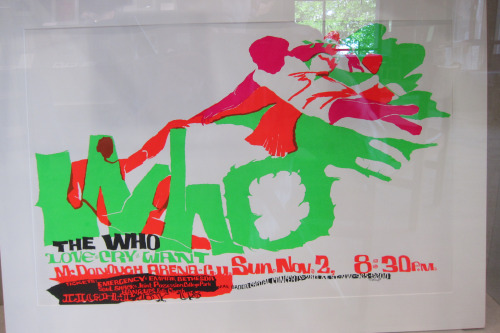
On November 2, 1969 – with Tommy riding high in the charts and the Woodstock festival fresh in the memory – the Who played McDonough Gymnasium at Georgetown for a crowd of about 4000 people.
Wednesday night – thirty-three years after their last proper album and “farewell tour” – the Who played the Barclays Center in Brooklyn for a crowd of about 20,000 people. Last week, they played for a similar crowd at the Nassau Coliseum, a few miles away on Long Island; Friday night they’ll play for another such crowd at the Forest Hills Tennis Stadium a few miles away in Queens.
And therein lies a story of the scale of popular culture then and now.
I went to the Who show at the Barclays Center – as a guest of a friend who is a friend of Pete Townshend’s – and at several points during the set Townshend explained that when the Who first toured America they were playing tiny places: the Village Theater as part of a seven-act variety show; a bar in Michigan where the crowd, said Pete, was “about twenty-five people” (“And four of them were us,” Roger Daltrey chimed in). Even after they wowed the crowd of more than a hundred thousand people at the Monterey Pop Festival in California, they played the one-thousand-capacity Fillmore East in New York; even after bringing the dawn thunder for four hundred thousand people at Woodstock, they played for four thousand people at Georgetown.
It’s the conventional wisdom that the culture of the sixties was unified, “mass” culture par excellence, and that the culture of the present is atomized and fragmented by comparison. In many ways that’s the case. But the population today is larger, and wealthier, and more consumptuous (if that’s a word) than it was in 1969, so that the Who – with no actual occasion, such as a new record or a new stage act, only a silver anniversary – can sell 60,000 tickets at top dollar in the New York area even as reasonable people wonder whether anybody even listens to the Who anymore.
Seen one way, it’s an example of the winner-take-all culture: once you’ve cracked the mass culture, your fragment of the fragmented culture will always be disproportionately large.
Seen another way, it’s an example of baby-boomer dominance at its least attractive, because one reason other bands can’t reach a mass audience is that the boomers, instead of moving on to new bands and new sounds, keep paying up to see the Who over and over again.
See a third way, it’s simply evidence that truly great performers – such as the Who – have no sell-by date. They are perennials.
I sure was glad to see them again (having grown up fully in thrall to them and having seen them in 1982 and 1994). Hearing Pete Townshend play and sing “I’m One” made me think that it may be his best song – and made me remember what a model he has been, for so many of us – the very model of a person who strives for a kind of unity among the fragments of self and society.
The image is of a screenprinted poster for the Who’s concert at Georgetown by the master printmaker Lou Stovall, on display in Lauinger Library (where it is tagged 1970, not 1969). Here’s a bootleg of the concert.