
by Paul Eliefrom Georgetown University
Busboys & Poets Against the Death Penalty
Washington, D.C., is not a City for Life – not yet. Neither is Takoma Park, Maryland – not yet. But on Monday night the Busboys & Poets on the D.C. - Maryland border was a café-bookshop-event-space for life, and against the death penalty, as three activists against the death penalty spoke about their efforts, joining with activists in 2,000 cities, from Berlin to Venice, Florida.
Cities for Life/Cities Against the Death Penalty is an initiative organized by the Community of Sant'Egidio and the World Coalition Against the Death Penalty. On November 30, 1786, Tuscany became the first modern state to abolish the death penalty; and with that in mind, the last day in November is marked in cities which, by one or another form of decree, have become Cities for Life / Cities Against the Death Penalty.
I was invited to moderate the event because I wrote the afterword to 13 Ways of Looking at the Death Penalty, by Mario Marazziti, who has a central role in both Sant'Egidio and the World Coalition. Truly, it was humbling to be in the company of the people there.
Brian Stolarz, a lawyer based in Alexandria, worked for eight years to exonerate Dewayne Brown, a man in Texas falsely accused and wrongly convicted in the murder of a police officer. On stage at Busboys & Poets, he showed us the decisive piece of evidence – a phone record, substantiating Brown’s alibi, that the detective investigating the case had obtained from the phone company and hidden in his garage.
Dani Clark, who works with the World Bank in Washington, corresponds with Ivan Cantu, a man on death row in Texas who she (and many others) is convinced is innocent. She brought some of their letters with her – “about half,” she said – and there were enough to fill a large Rubbermaid storage container.
Art Laffin, a member of the Dorothy Day Catholic Worker community on Rock Creek Church Road, was always against the death penalty – but was moved to deepen his commitment after his younger brother was murdered by a mentally ill patron of the soup kitchen in Connecticut where he was volunteering.
Art pointed the event outward in two directions, in my hearing at least. His presence put in mind the efforts of Dorothy Day, the Catholic Worker’s foundress,who died November 29, 1980 – thirty-five years ago last Sunday. And his insights about “restorative justice” connected opposition to the death penalty with the Year of Mercy declared by Pope Francis, which begins formally on December 8. By maintaining a “death row,” where prisoners’ time with other prisoners and with visitors is strictly limited, the state seeks to place them beyond mercy – beyond the encounters with other people that can be restorative for all concerned. But it doesn’t work, and the activists at Busboys and Poets make that clear through their very personal encounters with people submitted to this frankly barbaric practice.
Our Kind of Spirituals, No. 63: Allen Toussaint, “Southern Nights”
Allen Toussaint was to play the Hamilton in Washington on November 30, and a plan was fallling into place for a group of us to go hear him after an event about the death penalty that day – which is the World Day Against the Death Penalty. But Toussaint died earlier today, age 77, struck by a heart attack after a concert in Madrid; and with him two traditions – the tradition of pre-rock-and-roll New Orleans music, and the pre-rock-and-roll tradition (still going on in Nashville) whereby songwriters subsisted through royalties for versions of their songs done by other artists – go a little deeper into the grave.
It’s an apt coincidence – if not a happy one – that this post follows immediately on one about Elvis Costello, who collaborated with Toussaint in all sorts of ways in recent years – and who has done as much as anyone to carry forward Toussaint-style songwriting, at once direct, complex, and tender.
If you’ve never heard Toussaint
singing his own song “Southern Nights,” do yourself a favor and
click on this video. It’s from Joe’s Pub at the Public Theater in
New York, where Toussaint graced the city with several dozen Southern
nights of solo performances after he was displaced from New Orleans
by Hurricane Katrina. On this video, Toussaint tells the stories of
some of those southern nights, adding sound effects on the piano –
with such easy elegance that you come away thinking we’ve lost not
just one of our great songwriters, but one of our great storytellers,
too.
When the Pope Looked to Thomas Merton (1967 Edition)
Not twenty-four hours after Pope
Francis returned to Rome, John Carr – this must be record time –
has organized a public conversation at Georgetown on “The Francis
Effect” as seen on Francis’s visit to the United States, and it’s a
sure bet that something like 600 people will show up.
Myself, I am still trying to see the visit clearly – and trying to understand the significance of Francis’s emphatic presentation of Dorothy Day and Thomas Merton as “representative” figures.
My first thought is that Day and Merton don’t need a papal seal of approval – although it sure comes in handy. Their lives and work have an integrity all their own. Francis’s attention has to do with affinity rather than authority.
My second thought is that Merton, at least, was singled out by a pope once before. Actually, twice before. It involved a text Merton was asked to write in 1967, apparently at Pope Paul VI’s initiative. The story is told in The Life You Save May Be Your Own, as follows:
**
Merton had received an invitation from Rome. The Congress of the Laity would be followed by a synod of bishops, and the pope, through two Italian Trappists, asked Merton to contribute to a statement on the contemplative life.
The pope’s request arrived August 21, 1967 … [Merton] put a piece of paper in the typewriter, rapped out the date, and begged off the task. A big statement about contemplation, he explained, would alienate the honest searcher the bishops were hoping to reach. Besides, he was no expert in contemplation. He could not speak for the order. All he could do was write in his own words, one sinner to another.
He wrote all this; and as he wrote, the letter, addressed to the Trappist superior in Rome, became a letter addressed to “my brother who is in the world and who more and more often comes to me with his wounds which turn out to be also my own.” Twenty years earlier Merton had concluded The Seven Storey Mountain with a poem addressed to his brother, the dead airman, and in a sense all his work since then had been directed toward his brother in the world, a person distinct from him , unlike him, yet joined to him beneath it all. This time he began by apologizing for the one-sidedness of the dialogue— for speaking without being asked , and from behind the high wall of a monastery. The wall, he thought, was a problem to them both , yet he still believed that he belonged there. Why was he a monk?
Can I tell you that I have found answers to the questions that torment the man of our time? I do not know if I have found answers. When I first became a monk, yes, I was more sure of “answers.” But as I grow old in the monastic life I become aware that I have only begun to seek the questions. And what are the questions? Can a man make sense of his existence? Can a man honestly give his life meaning merely by adopting a certain set of explanations which pretend to tell him why the world began and where it will end, why there is evil and what is necessary for a good life? My brother, perhaps in my solitude I have become as it were an explorer for you, a searcher in realms which you are not able to visit—except perhaps in the company of your psychiatrist. I have been summoned to explore a desert area of man’s heart in which explanations no longer suffice , and in which one learns that only experience counts.
It is a beautiful and powerful answer, rooted in the sense of place that is basic to Merton’s spirituality, cast forward for the age of the space program and transcendental meditation . Still, the question remains: Why be a monk? Why be a believer at all? Merton’s answer is blunt. Because the desert place in each of us—“ an arid, rocky, dark land of the sou!”— is the place Christ came to earth to save. After two thousand years, he acknowledges, the language of faith engenders such distrust that “you do not know whether or not behind the word ‘cross’ there stands the experience of mercy and salvation, or only the threat of punishment.” But he can vouch for the cross with his own experience—“ can say to you that I have experienced the cross to mean mystery and not cruelty, truth and not deception.”
He speaks with the authority of the holy; but in the present age, when, he allows, the holy is found as often outside of the churches as inside, why should his brother seek God through religion at all? He answers again with his own experience, which is that God is a being to be known, not a problem to be solved, “and we who live the contemplative life have learned by experience that one cannot know God as long as one seeks to solve ‘the problem of God.’ To seek to solve the problem of God is to seek to see one’s own eyes.” God yearns to be known; human sadness is God’s sadness at not being known; and the contemplative is a person who recognizes that he or she is a temple of the Holy Ghost, and that the desert is a place where God is to be found.
“Indeed we exist solely for this, to be the place he had chosen for his Presence,” he declares. “If once we began to recognize, humbly but truly, the real value of our own self, we would see that this value was the sign of God in our being, the signature of God upon our being.” In the lives of most of us, God’s signature is shown to us in the love of others. The monk, seemingly in flight from love, aims behind his wall to remain open to God wholly and directly.
“The message the contemplative offers you, then, brother,” Merton declares, “is not that you need to find your way through the jungle of language and problems that today surround God; but that whether you understand or not, God loves you, is present to you, lives in you, dwells in you, calls you, saves you, and offers you an understanding and light which are like nothing you ever found in books or heard in sermons”: a radiant understanding like the union of self and other in love. In closing, he tells his brother that he loves him.
The letter—“ written in haste”— has the lucidity that his encounter with Camus had led him to strive for, that of a man who understands and loves his condition, with all its limits and complications.
It was not what Rome had asked for, however. Rome had asked for a statement to the Church’s bishops, explaining the contemplative life in expressly Catholic terms. The deadline was approaching. He was depressed and lonely. He had the flu. He spent the weekend in bed in the hermitage, reading Faulkner’s As I Lay Dying —“the central part, the crossing of the river, and the chapter on Addie, and was simply floored by it.” Then he put a fresh sheet of paper in the typewriter and started over.
**
I just swapped messages with a writer with whom I worried the distinction between “Catholic-themed” literature and literature attentive to the core questions of belief.
What do I have in mind by the latter? Merton’s “Message to Contemplatives” gives the idea.
More
tomorrow on his second run at it.
Francis Spoke; the Bishops (Let’s Figure) Listened
In the moments before Pope Francis arrived at St. Matthew’s Cathedral in Washington to address the U.S. bishops, crowds massed at both ends of the block of Rhode Island Avenue where the cathedral is. Then in a flash the Pope had arrived and was inside, and the crowds scattered: the people at one end had gotten a glimpse of him; the people at the other had not.
I am staying at the Tabard Inn, and I went back to the hotel, which is in the next street over – N Street, directly behind the cathedral. As I sat eating a salad from Chop’t, it was strange to think that the Pope. right at the apogee of his renown. was in the next block, speaking to a congregation of a few hundred people – as many people as could fit onto the three luxury coaches reserved for the bishops and parked across the street from the inn.
On vanityfair.com, I spelled out the ways in which the visit to St. Matthew’s was symbolically the most consequential event of Pope Francis’s time in Washington, for it joined his Thousand Days – as I am calling them – to those of President Kennedy, whose funeral was held in the cathedral.
But it may be literally consequential as well. Unlike, say the members of Congress, the members of the U.S. episocopate are bound to listen to Francis, and in key respects to obey him. I figure they listened pretty closely.
James vanOosting: Sleepless Nights
In
the middle of the night, in Washington for Pope Francis’s visit and
unable to sleep, I thought of Berlioz – thought of my friend James vanOosting unable to sleep and listening to Berlioz.
Jim, for reasons he sets out in a gorgeous and heartbreaking essay in Commonweal, often finds himself awake in the middle of the night, unable to sleep:
That’s when I tip-toe into the living room, lie down on the sofa, and listen to music. I’ve become a groupie of Hector Berlioz, wild for his Requiem. I’ve probably listened to the entire thing twenty times. It calls for an enormous chorus and orchestra, plus antiphonal brass choirs that play halfway back in Carnegie Hall, which means that Robert Spano, the conductor, must have eyes in the back of his head. Who’d believe that a Mass for the dead could be so majestic, so uplifting?
As the passage makes apparent, Jim is a writer (see his book And the Flesh Became Word). At Fordham, where he a master professor of communications, and where I came to know him, he is known to all as “JVO,” and the initials have always seemed to me correspond to his pointed white beard and thick, artfully combed head of white hair, like an old-school emoji for this man at once witty and wise.
Turns out he is wise like a child. A couple of weeks ago I wrote about Oliver Sacks’s last essay and the way Sacks, near death, made a connection between death and the Sabbath that seemed altogether new – seemed altogether to me, anyhow.
Now JVO has spelled out the way the prospect of death in adulthood is a necessary end to childhood in a way that is utterly fresh and startling:
Dying is an adult activity. This has been one of its bigger surprises for me, so far. I find I’m needing to leave behind the child side of myself in order to go where I now need to go, in order to do what I now need to do. This child-self has been a constant companion of my adult years. It’s helped me slog through the gobbledygook of career, mock the pomposity of achievement and, sometimes, levitate against the downward-sucking gravities of title and résumé.
Where I’m traveling to is not the kind of place a child should go. And my famous destination, about which so much has been written, is not marked clearly on the map, strangely. Instead, where X ought to mark the spot, there’s merely a note telling one to go over to the other side. Any child, spotting this trap, would turn tail and run. That would be the right thing to do, the reasonable thing to do, for a child.
That is wisdom, nothing less. JVO, I am listening. You know things we all need to know, and you know how to say them as well as anybody.
Francis in Philly: It’s So Crowded, Nobody’s Going
Fr. James Martin is generally so enthusiastic, so upbeat, so ready to see the bright side, that when he sees a problem, even a small problem, I take note even more than I usually do of his work.
And Fr. Martin, known as a Jesuit, is first of all a Philadelphian.
So when Fr. Martin returned from
Philadelphia the other day with word that hotels in the city
still have rooms for Pope Francis’s visit, and that people are so
fearful of the vast crowds that, in the spirit of Yogi Berra – who
said “The place is so crowded these days, nobody goes there” –
they are staying home, I figured there must be something to it.
Is there? We’ll know in ten days. Or we won’t, because the people organizing the Congress of Families and the papal Mass on the Ben Franklin Parkway will catch Fr. Martin’s drift – surely they read his Facebook page, which is read by tens of thousands – and distribute some more tickets to boost the crowd.
But I think, on some level, there is
something to it – something I tried to spell out in my profile of
Francis for Vanity Fair. It is this: Francis is not a man whose most authentic self is the self that is seen by huge crowds.
John Paul thrived on crowds. Benedict was indifferent to them, even leery of them. Francis (as we have seen) is perfectly capable in crowds – but he seems most himself when meeting people in twos and threes. So it is that, in his pontificate, the weekly audiences and Angelus in Rome have become places for close encounters with him:
Francis comes to the window and waves, and we see him. Sure, we’re seeing the Pope, on high, an icon in extremest white. But in the mind’s eye we also see the ordinary pastor who embraced a man with boils in St. Peter’s Square; who put on a clown nose without worrying that it might diminish the dignity of the papal office. In spirit, Francis isn’t up there in the palace. He is down in the square with everybody else.
Surely some lucky people will have close encounters with Francis in Washington and New York and Philadelphia. As for those who stay away, I suspect that this is one reason why: they don’t want the feeling of closeness to Francis – which is profound just now – to be amortized over a crowd.
The photograph shows Philadelphians gathered for a Mass celebrated by Pope John Paul II on the Ben Franklin Parkway in 1979. Fr. Martin calls the event “one of my most vivid memories of adolescence.”
Get Thee to the Basement
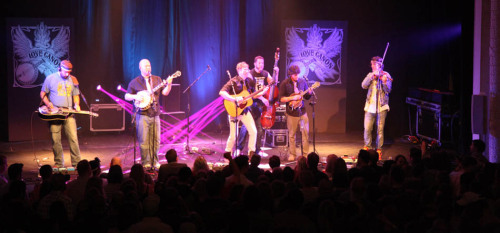
If you’re going to ponder the place of the arts in the economy, you might as well do it while listening to Dire Straits’ “Money for Nothing” being played on dobro and mandolin – which is the way I did it last night in Washington.
One of the strongest pieces of conventional wisdom is the idea that the current economy is inhospitable to the arts. Steven Johnson, in a recent piece in the Times Magazine, deftly summarizes the state of play: for years, the complaints were that the culture industry pandered to popular taste in the pursuit of profit; more recently,
a new complaint has taken center stage, one that flips those older objections on their heads. The problem with the culture industry is no longer its rapacious pursuit of consumer dollars. The problem with the culture industry is that it’s not profitable enough.
This topic – the intersection of technology, commerce, and creativity – is right up Johnson’s street, and he devotes 5000-plus words and applies plenty of data to refuting the notion that art and artists are less well off in the present than they were in the recent past. Taken on its own terms, it’s really extraordinarily convincing; but the terms tell only part of the story.
At 14th and F streets in Washington is a place, four years new, called The Hamilton. At street level, in two huge rooms, is a swanky bar and grill in the spirit of Clyde’s, a place legendary in Washington. Downstairs – in the basement – there’s a room for music: a vast, amply outfitted, windowless space, with three levels of seating, a well-lit stage, and a first-class sound system. I bought a standing-room ticket ($15), went down to the basement, and spent an hour and change listening to Love Canon, a bluegrass group that does spirited and expertly arranged versions of songs by artists from the Eighties. Upstairs, four hundred people were quaffing beers and half-watching the Nationals play the Padres on TV; down in the basement, a hundred and fifty of us were hearing Peter Gabriel, Tears for Fears, Tom Petty, et al. done with strum and twang.
I had just come from a discussion of Lewis Hyde’s book The Gift, which reckons beautifully with the fact that art is valuable in ways that fit awkwardly with the ways things are valued in the formal economy. And there at The Hamilton the point was emphatically on display. A hundred and fifty of us could stand and listen to neo-bluegrass a few blocks from the White House because we were down in the basement, a part of the building that has been made newly valuable, as real estate, because it is being used creatively.
Historically, much great art – painting, music, literature – has been made down in the basement, and the arguments about the supposed centrality of the arts in the past and their prominence or marginality in the present forget this truth.
The power of Bob Dylan and the Band’s Basement Tapes is that in them you can hear the musicians themselves rediscovering this truth from one moment to the next. I’ve spent the last few weeks listening to the “raw” Basement Tapes reissue, trying to rediscover it myself. Clearly, it’s working.