
by Paul Eliefrom Georgetown University
Scannone: Jesuit Who Know Francis When – and Set Him Straight
When I saw the Rolling Stones play at the Carrier Dome in Syracuse in 1981, the saxophonist Bobby Keyes came out to play the solo on “Brown Sugar,” and I thought to myself, “Wow – he’s the guy who played the solo on the original record!” Of course, the other guys onstage – Mick, Keith, Bill Wyman, Charlie Watts – had played on the original record, too: they were the original Rolling Stones. But for some reason the sideman, the ordinary man, had greater aura, and gave off greater reality, than the Stones themselves.
I felt something like that when I met Juan Carlo Scannone at Georgetown the other night. Fr. Scannone, an Argentinian Jesuit, was at the university to deliver the keynote address in Georgetown’s third conference – that’s right, its third – marking the first half century since the Second Vatican Council. At the reception afterward, I had a chance to meet him, and to feel the aura – because Fr. Scannone, author of nine books and co-author of twenty others, was also the Jesuit who more than any other taught Jorge Mario Bergoglio at the Jesuit seminary in that country. Scannone taught Bergoglio Latin and ancient Greek (“ancient Greek not so good, Latin pretty good”), theology, and literature. With casual authority he spoke of the time a few years later when Bergoglio, by then a teacher himself, asked his “disciples” – his students – to write essays on some short stories by Jorge Luis Borges, got Borges to read them, and then brought Borges, a family friend, to meet the students in class.
I listened carefully, but to tell the truth, mainly I was taking in the aura – thinking: This is the man who was Bergoglio’s most important teacher … This is the man who set him right when he was wrong …
The lecture was consequential. In it Fr. Scannone spelled out the authentic “newness” of the Council – which, he proposed, offered a new paradigm, a new method, and a new “content” all at once – to ground the impulse called the “preferential option for the poor,” which emerged under that name at meetings in Latin America after the coucil, as an impulse fundamentally expressive of the Council and its aims.
That is to say, when Fr. Scannone’s student Jorge Mario Bergoglio – Pope Francis – said, “I want a Church poor and for the poor,” he was speaking with a sense of the Church grounded in Vatican II.
Seems to me the idea is a couple of millennia older than that, but people keep insisting otherwise – which is why it is so important that expositors like Juan Carlo Scannone are around.
Regis: “Bring a pen, two #2 pencils and a brain …”
This weekend my two older sons are
sitting for the Regis High School entrance exam – the closest thing
to an autumn rite in the annals of Jesuit education in New York City.
I came late to Jesuit education: I’d
never met a Jesuit priest, and hardly knew what one was, until I
applied to Fordham in 1983. That may be why Regis – a
tuition-free Jesuit high school just off Fifth Avenue on the Upper
East Side – has always seemed to me a New York institution that was there from the beginning, like the Metropolitan Museum, Central
Park, and Grand Central Terminal.
Of course, those institutions were not
there from the beginning: they had to be instituted, and then
developed, expanded, maintained, and guided so that (in Lampedusa’s
famous formulation in The Leopard)
they could change in order to stay the same.
Regis’s
story is told in Teach Me to be Generous,
by Anthony Andreassi, an historian who teaches at Regis and is also
the associate pastor at the Brooklyn Oratory; and it’s told in Father
Andreassi’s distinctive voice, as when he observes in a passage about the Regis endowment that “unfortunately, the early 1970s was a
terrible time to get into the stock market …”
To
spend a few hours with the book is to realize how quirky and
un-inevitable the history of even rock-solid institutions like Regis
can be. I wouldn’t have guessed that the school is named not for
some Latin variant of Christ the King but for a Jesuit saint, John
Francis Regis; or that it was founded by the widow of a mayor of New
York, who was its sole and anonymous funder for half a century; or
that she was one of twelve children from a Catholic family in Troy;
or that (anticipating an issue that, when it concerns public schools,
has gone to the courts) she forbade the use of the school building
for non-educational purposes; or that (again anticipating a current
trend) Regis wound down its football program to focus on basketball
as early as 1930; or that the current dress code (coats and ties) was
a relaxing of the original dress code of collars and cassocks; or
that – today – students come to the school daily from
Connecticut, Long Island, Westchester, and New Jersey as well as the
five boroughs, or that there is no daily Mass schedule.
Or
that the head writer of Saturday Night Live,
the brothers who run the Elias Sports Bureau, and the National Book
Award-winning writer Phil Klay went to Regis; or that Stefani Joanne
Angelina Germanotta – Lady Gaga – used to come over from
Marymount to star in the school’s plays; or that the school had
Manhattan’s first “green” roof. These things I learned from the
slide show given at the school’s open house – a striking contrast
to the dreary recitations at some other schools.
But
the most affecting aspect of the book – and of Regis High School,
evidently – is suggested by its title. Teach Me to Be
Generous comes from a prayer of
St. Ignatius of Loyola, and it is echoed in Andreassi’s dedication:
“To my parents, from whom I first learned what it means to be
generous …”
Teach
me to be generous: What more could a student – and the student’s
father – ask of a secondary school than that?
Pope Francis: People, Let’s Be Free to Reason Together
A few weeks ago, several dozen of us Georgetown faculty members and students met in the large conference room at the Berkley Center and watched Pope Francis’s address to a joint session of Congress. A lively discussion followed, although I was forced to duck in and out to reply to a raft of messages that came in after Francis put forward Dorothy Day and Thomas Merton—protagonists of my first book, The Life You Save May Be Your Own: An American Pilgrimage—as “representative Americans” in their striving for the common good.
Now the Religious Freedom Project’s Nicholas Fedyk and I are picking up a thread of that day’s conversation and trying to carry it forward. On Cornerstone, Nick has posted a piece about the so-called “Francis effect” in world politics, and here I am following through with a reply.
Taking off from Stalin’s famous quip—“How many divisions has the Pope of Rome?”—Nick cites Francis’s charisma and moral authority among world leaders to suggest how profoundly the political order has changed since Stalin’s time. Under John Paul II, and now under Francis, he declares, “The Church is eagerly reasserting its role in world affairs. Defying realist calculations of power, it relies on the force of ideas, not army divisions.”
In particular, these popes have played the role of advocate for the idea of the common good and the idea of human dignity that underlies it:
"Constructivists have argued for the power and salience of norms for decades, including the value of human dignity. Many scholars, in fact, partially attribute the fall of the communism in Eastern Europe and Latin America to the dynamic leadership of John Paul II. More support for the common good lies in the increasing push for humanitarian action, which is spelled out in numerous international treaties and has formed the basis for a number of interventions—most notably in Kosovo, Libya, and Syria. There is a solidifying norm against the use and proliferation of weapons of mass destruction, including nuclear weapons. States are even making efforts to limit emissions and industrial waste. All of these examples suggest that states may share an awareness of the common good.”
Nick goes on to emphasize their role as advocates of religious freedom, and it’s in this that I think there’s a further point to be made.
“How many divisions has the pope of Rome?” Stalin asked. The implied answer was, and is, “None.” Obviously, the Pope and the Church have something else. What it has, Nick rightly suggests, are ideas.
So far, so good. But the power of its ideas derives from the fact that they are affirmed freely by well more than a billion people through countless individual acts of faith, conscience, and discernment. Francis, and the Church he leads, commands respect precisely to the degree that people bind themselves to the community of faith freely, without coercion, out of no state, ethnic, or other obligation—called there by an inner disposition (a movement of the spirit, if you will) that in the end it falls to them to discern and meet in response.
Historically, the Roman Catholic Church’s relationship to the emerging idea of religious freedom is checkered at best—and this must be kept in mind always as Catholics take the lead in campaigns for religious freedom. So must the fact that in the Church’s recent history in this country—I mean the crisis of priestly sexual abuse and the cover-up by the bishops—church officials have used the idea of religious freedom as a means to evade public scrutiny, to duck pastoral and legal responsibility, and to resist censure and prosecution.
So must the fact—clear from recent history in Western Europe—that people in free societies are free to change their religious “elective affinities” at any time and for any reason, and that many do so. In Western Europe, for example, two world wars and the sense that religion was, at best, ineffectual in ameliorating them and, at worst, a covert sponsor of the conflict, led tens of millions of Western Europeans to stand aside from the religious ideas that had animated Europe for a thousand years. This happened in a period when the Church in Europe enjoyed the very prerogatives of religious freedom—even religious domination—that are now said to be fatally imperiled in the United States.
This truth, it seems to me, is the basis for an argument for greater freedom within religions—within the Roman Catholic Church, for example. It’s a commonplace that the Church is not a democracy. But what Francis has made clear, through his public statements and especially through his direction of the recent synod on the family, is that the Church is a community in which different people see things in different ways and that such freedom as the Church celebrates depends vitally on the ability of reasonable people to disagree, and then to discern the common good by reasoning together.
In other words, the Church’s efforts for greater religious freedom in society depend on the integrity with which it allows and indeed sponsors reasonable disagreement internally as a means of discernment. Of course, there is a need for discipline and internal coherence, to a degree. But to what degree? Francis, with his profound appeal to Catholics and people of good will—people of distinctly different backgrounds and points of view—has left that question open, so that he and we, going forward, might answer it together.
New York Times: Memoir Is a Catholic Art Form
“Why not say what happened? All right, then: St. Augustine stole some pears. Kathryn Harrison had sex with her father. Tobias Wolff didn’t do much of anything to disturb his sleep, it would seem, but he still managed to turn his boyhood into beautiful, reflective music.”
That’s just the first provocation in Gregory Cowles’ review of Mary Karr’s The Art of Memoir in last Sunday’s Times Book Review, a review that has the range and freedom and generative quality – and spirit of provocation – of an essay. You really could just say what happened, Cowles seems to suggest – and all the rest is hoo-ha and window dressing.
The
boldest provocation in the review is Cowles’ straightforward
declaration that “it is, alas, not a very good book.” The title,
probably suggested by the marketing department, has suggested as much
to me for months. Cowles’ report that Karr “pads the book with
chipper lists and pop quizzes and general encouraging bromides”
(did this too come from marketing?) deepens the suspicion. So do two
brief passages he quotes, one (“Every writer worth her salt is sui generis”)
a double cliché, the other (“Deceit in memoir irks me so badly . .
.”) overly
stylized tough talk.
But
the provocation that really caught my attention is Cowles’ suggestion that memoir is in some way a distinctly Catholic literary
form:
Given the inherently confessional nature of memoir, it may be no coincidence that so many of its most successful practitioners have been Catholic to some degree – Karr, Wolff, Harrison, and of course Augustine, but also Mary McCarthy, David Carr, Mary Gordon, Patricia Hampl, Frank McCourt – or that even non-Catholic memoirists slip so easily into the churchly narrative of penitence and redemption.
My first thought is: no, no. For one thing, there are just too many memoirs for the generalization to fit. For another, Catholic culture post-Vatican II has scarcely more to do with confession than society at large.
But my second thought is: yes, possibly. Cowles was the editor of my TBR cover essay on faith and fiction, and with this piece he furnishes part of the answer to the essay’s question of why Christian belief doesn’t figure into contemporary American fiction as much as we might expect.
It’s that it figures into memoir instead. I suggested as much at the end of the essay.
And why is that? Not, I think, because Catholicism is markedly confessional, but because the question about religion in our time – the question as framed by Catholics, at any rate – is whether it is true or untrue, and because memoir, with its affirmation that “this really happened,” may be better suited to that question than the novel is.
I put the point a little differently in a lecture at Georgetown a few years back, characterizing the strong American Catholic writers post-Vatican II to commence our Faith & Culture series.
It sometimes seems that any pulp novelist can crack the code of Christian past and get a bestseller out of it. But these writers work in essay, memoir, narrative history, and the like in a recognition that the church’s claims are “related to truth” – in the belief that the gospel, for all its difficulties, is a work of nonfiction.
Now to Karr’s The Art of Memoir, which is full of provocations, I’m sure.
From Time, Some Inspired Q&A
The past couple of weeks have been really remarkably rich for the discussion of literature and religious belief and the ways they fit together.
The interview with Richard Rodriguez on parisreview.org; the running conversation on Twitter about J.F. Powers; the suggestion on Dappled Things that Catholic writers should sing, not shout or whisper; the plunge into the spiritual dimension of Hanya Yanagihara’s A Little Life on newyorker.com – I plan to take up all these, and some others, in the coming days, beginning with Gregory Cowles’ nimble TBR review-essay about Mary Karr’s The Art of Memoir and the Catholic connection to memoir in general.
But first: A new anthology with work by many of the writers tilling these fields is just out – What Would Jesus Ask?, compiled by Time religion correspondent Elizabeth Dias, who asked a question of Pope Francis on the plane from Philadelphia to Rome last month (after John Allen introduced them, apparently).
It’s an inspired conceit: make a list of the questions Jesus asks in the Gospels, and invite a variety of people to answer them – including three cardinals, two archbishops, an ecumenical patriarch, Mark Burnett, Amy Grant, and Marilynne Robinson. (The last shall be first.)
The question I got – “John’s baptism: was it from heaven, or of human origin?” turned out to be as apt as it was surprising:
You know, I’ve never thought about it – not that I recall, anyhow… .
Most of us know that there’s all sorts of stuff in the Gospels that has escaped our notice. And then we come upon a passage like this one, and we feel we’re coming upon it for the first time.
As I say, the book is just out. A selection of the essays is going up, too.
Unbiblical Flood Recedes; Behold, a Church Appears
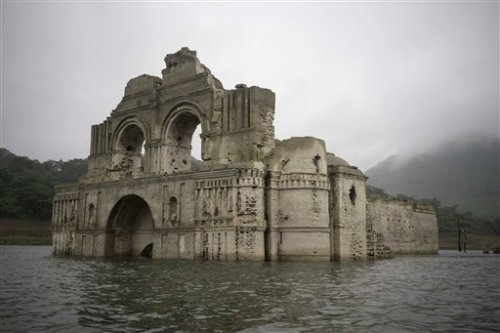
“God help me from inventing when I sing,” Pablo Neruda said, and Gabriel García Márquez quoted him in his Paris Review interview – to make the point he spent half his career making: that “magic realism” involves more realism than magic, and that often the things in his novels that seem most extravagantly invented are the things that actually happened.
The surfacing of a submerged church in Mexico over the weekend is the kind of thing you read about in a Gabriel García Márquez novel – except that it really happened, and I read about it in a wire report from the Associated Press:
Leonel Mendoza fishes every day in a reservoir surrounded by forest and mountains in the southern Mexico state of Chiapas. But in recent days, he also has been ferrying curious passengers out to see the remains of a colonial-era church that has emerged from the receding waters.
A drought this year has hit the watershed of the Grijalva river, dropping the water level in the Nezahualcoyotl reservoir by 25 meters (82 feet).
The church was built in the 1550’s by a group of Dominicans led by Bartolomé de las Casas and was abandoned two centuries later when the expected Catholic population settled elsewhere.
Cometlike, the resurfaced church is making a repeat appearance:
It is the second time a drop in the reservoir has revealed the church since it was flooded when the dam was completed in 1966. In 2002, the water was so low visitors could walk inside the church.
“The people celebrated. They came to eat, to hang out, to do business. I sold them fried fish. They did processions around the church,” Mendoza recalled during a telephone interview Friday.
I am resisting the strong impulse to make a metaphor of the church revealed. God help me from inventing when I sing.
Chimamanda Ngozi Adichie: Catholicism Revisited
Word that the Nigerian-American novelist Chimamanda Ngozi Adichie has been drawn back to Catholicism by Pope Francis put Evelyn Waugh and Life magazine in mind.
Almost seventy years ago Waugh, in a long article for Life called “The American Epoch in the Catholic Church,” spelled out what might be called a geographic or tectonic account of the movements of religious faith in different eras: “It seems that, in every age some one one branch of the Church, racial, cultural, or national, bears peculiar responsibilities toward the whole,” he declared, and went on to say that responsibilities had shifted away from Europe and toward the United States – taking Dorothy Day and Thomas Merton as two examples.
With that insight as a setting-off point, I’ve proposed (here and here) that what is generally taken to be a decline in the vigor of writing that deals
with matters of belief might better be understood as evidence of migration
– as a movement of the spirit away from this continent and toward,
say, Africa and Asia.
On one level, Adichie’s article – for The Atlantic’s website – seems to confirm the point. Here is a first-rate novelist, raised Catholic in the university town of Nsukka in Nigeria, educated further at Drexel and Eastern Connecticut and Johns Hopkins and Yale, feted for her books, fellowed at Princeton, who is suddenly and freshly attracted to her ancestral tradition by Pope Francis.
On another level the article suggests that less about the migratory impulse of the spirit than about how transnational the experience of Catholic writers can be.
In the many Protestant vs. Catholic arguments we had at school, I was the dedicated Catholic apologist, spouting words I knew my adversaries did not understand: synod, magisterium, transubstantiation.
Those fights, unformed and childish, were legacies of the Irish Catholic and English Anglican missionaries who came to my ancestral Igboland in the late 19th century. They established a viciously partisan Christianity; intermarriage and socializing between Catholic and Anglican converts were almost taboo. The tensions faintly linger still. Even though I was forceful in my defense of Catholicism—I selectively quoted scripture that supported the sacraments, I made a case for purgatory—I did not always believe myself.
An early attraction to ritual; a childhood desire to be a priest; disenchantment, rebellion, and falling away, with education and worldly experience; a sense of tribal belonging and possession that abides anyhow; a return to Catholicism when, in some way or some person, it seems once more to embody its own claims – this was the experience, point for point, of many thousands of American Catholics in postwar America. But I’d guess few of them reckoned on Catholics following the same pattern in Nigeria – they figured the experience was unique to postwar, post-Vatican II New York and Chicago.
I am keen to read Nsukka Revisited. Meanwhile, here’s hoping Adichie will be our guest in Georgetown’s Faith & Culture conversations series.
Merton: Everybody’s a Prospective Contemplative
Here’s the rest of the story begun in yesterday’s post – about how Thomas Merton, asked to write a text on the contemplative life at the prompting of Pope Paul VI, wrote a work of genius – but the work of genius was judged unsuitable, so he started over and produced … another work of genius.
The story is from The Life You Save May Be Your Own:
**
Then he put a fresh sheet of paper in the typewriter and started over. The first letter had been addressed to a skeptic. This one would be written for the believer. It would be in the first-person plural, in the temperate voice he admired in Dorothy Day’s pieces. It would be a “Message of Contemplatives,” the title stressing the message— that every believer is a prospective contemplative, “called to taste God.”
The question is the same: Is it possible for modern people to believe? Modern man, as Merton calls him, is beset with religious difficulties so acute that they “call into question the possibility of attaining to knowledge of the transcendent God who has revealed himself to men.” Such difficulties, he proposes, cannot be solved, only encountered; and the contemplative , he suggests, knows them intimately through experience . For although the contemplative life is “a sort of specialization in relationship with God,” it is finally a religious life like any other, except that it is “lived in conditions which favor ‘the experience of God.’” The cloister is a figure of the desert or dark night that every religious pilgrimage must pass through. The trials the contemplative faces there are “the trials and temptations which many of his fellow-Christians are undergoing.” Alone, silent, hidden away in the monastery, the contemplative “feels that he is living at the very heart of the church.”
Written for the bishops, the “Message of Contemplatives ” might be a message to Merton’s critics, the would-be revolutionaries and street-fighting men of the Catholic left. For it makes clear why he sees the contemplative life as crucial to any program for peace and justice. In Merton’s view, the “experience of God,” obedience to the Gospel or the affirmation of human solidarity, must be the basis of the believer’s actions in the world. The contemplative life, in his account, is at once the opposite of worldly life and a concentration of it; it is religious experience exaggerated, grotesequely at times, so as to bring a truth to light— to describe the desert in the heart of every would-be believer, and to see in this desert the springs of religious experience. And it is in such experience that those who call themselves believers strive to “unite ourselves to the suffering of the world, carrying on before God a silent dialogue even with those of our brothers who keep themselves apart from us.”
When the Pope Looked to Thomas Merton (1967 Edition)
Not twenty-four hours after Pope
Francis returned to Rome, John Carr – this must be record time –
has organized a public conversation at Georgetown on “The Francis
Effect” as seen on Francis’s visit to the United States, and it’s a
sure bet that something like 600 people will show up.
Myself, I am still trying to see the visit clearly – and trying to understand the significance of Francis’s emphatic presentation of Dorothy Day and Thomas Merton as “representative” figures.
My first thought is that Day and Merton don’t need a papal seal of approval – although it sure comes in handy. Their lives and work have an integrity all their own. Francis’s attention has to do with affinity rather than authority.
My second thought is that Merton, at least, was singled out by a pope once before. Actually, twice before. It involved a text Merton was asked to write in 1967, apparently at Pope Paul VI’s initiative. The story is told in The Life You Save May Be Your Own, as follows:
**
Merton had received an invitation from Rome. The Congress of the Laity would be followed by a synod of bishops, and the pope, through two Italian Trappists, asked Merton to contribute to a statement on the contemplative life.
The pope’s request arrived August 21, 1967 … [Merton] put a piece of paper in the typewriter, rapped out the date, and begged off the task. A big statement about contemplation, he explained, would alienate the honest searcher the bishops were hoping to reach. Besides, he was no expert in contemplation. He could not speak for the order. All he could do was write in his own words, one sinner to another.
He wrote all this; and as he wrote, the letter, addressed to the Trappist superior in Rome, became a letter addressed to “my brother who is in the world and who more and more often comes to me with his wounds which turn out to be also my own.” Twenty years earlier Merton had concluded The Seven Storey Mountain with a poem addressed to his brother, the dead airman, and in a sense all his work since then had been directed toward his brother in the world, a person distinct from him , unlike him, yet joined to him beneath it all. This time he began by apologizing for the one-sidedness of the dialogue— for speaking without being asked , and from behind the high wall of a monastery. The wall, he thought, was a problem to them both , yet he still believed that he belonged there. Why was he a monk?
Can I tell you that I have found answers to the questions that torment the man of our time? I do not know if I have found answers. When I first became a monk, yes, I was more sure of “answers.” But as I grow old in the monastic life I become aware that I have only begun to seek the questions. And what are the questions? Can a man make sense of his existence? Can a man honestly give his life meaning merely by adopting a certain set of explanations which pretend to tell him why the world began and where it will end, why there is evil and what is necessary for a good life? My brother, perhaps in my solitude I have become as it were an explorer for you, a searcher in realms which you are not able to visit—except perhaps in the company of your psychiatrist. I have been summoned to explore a desert area of man’s heart in which explanations no longer suffice , and in which one learns that only experience counts.
It is a beautiful and powerful answer, rooted in the sense of place that is basic to Merton’s spirituality, cast forward for the age of the space program and transcendental meditation . Still, the question remains: Why be a monk? Why be a believer at all? Merton’s answer is blunt. Because the desert place in each of us—“ an arid, rocky, dark land of the sou!”— is the place Christ came to earth to save. After two thousand years, he acknowledges, the language of faith engenders such distrust that “you do not know whether or not behind the word ‘cross’ there stands the experience of mercy and salvation, or only the threat of punishment.” But he can vouch for the cross with his own experience—“ can say to you that I have experienced the cross to mean mystery and not cruelty, truth and not deception.”
He speaks with the authority of the holy; but in the present age, when, he allows, the holy is found as often outside of the churches as inside, why should his brother seek God through religion at all? He answers again with his own experience, which is that God is a being to be known, not a problem to be solved, “and we who live the contemplative life have learned by experience that one cannot know God as long as one seeks to solve ‘the problem of God.’ To seek to solve the problem of God is to seek to see one’s own eyes.” God yearns to be known; human sadness is God’s sadness at not being known; and the contemplative is a person who recognizes that he or she is a temple of the Holy Ghost, and that the desert is a place where God is to be found.
“Indeed we exist solely for this, to be the place he had chosen for his Presence,” he declares. “If once we began to recognize, humbly but truly, the real value of our own self, we would see that this value was the sign of God in our being, the signature of God upon our being.” In the lives of most of us, God’s signature is shown to us in the love of others. The monk, seemingly in flight from love, aims behind his wall to remain open to God wholly and directly.
“The message the contemplative offers you, then, brother,” Merton declares, “is not that you need to find your way through the jungle of language and problems that today surround God; but that whether you understand or not, God loves you, is present to you, lives in you, dwells in you, calls you, saves you, and offers you an understanding and light which are like nothing you ever found in books or heard in sermons”: a radiant understanding like the union of self and other in love. In closing, he tells his brother that he loves him.
The letter—“ written in haste”— has the lucidity that his encounter with Camus had led him to strive for, that of a man who understands and loves his condition, with all its limits and complications.
It was not what Rome had asked for, however. Rome had asked for a statement to the Church’s bishops, explaining the contemplative life in expressly Catholic terms. The deadline was approaching. He was depressed and lonely. He had the flu. He spent the weekend in bed in the hermitage, reading Faulkner’s As I Lay Dying —“the central part, the crossing of the river, and the chapter on Addie, and was simply floored by it.” Then he put a fresh sheet of paper in the typewriter and started over.
**
I just swapped messages with a writer with whom I worried the distinction between “Catholic-themed” literature and literature attentive to the core questions of belief.
What do I have in mind by the latter? Merton’s “Message to Contemplatives” gives the idea.
More
tomorrow on his second run at it.
Francis’s Four “Representative Americans”: Four Great Writers
Already it seems so long ago that Pope Francis, speaking to a joint session of Congress at the Capitol, organized his remarks around four “representative Americans”: Abraham Lincoln, Martin Luther King Jr. – and Dorothy Day and Thomas Merton.
Spoken – and, as far as I could tell, written – in English, the address was a rhetorical and homiletical masterstroke. Addressing a group of elected representatives, Francis put forward representatives of the striving for the common good that was his subject. Expected to speak about policies, he put the emphasis on people.
The
papal visit, my essays about the visit for vanityfair.com, and attention following on Francis’s address to Congress have kept me
away from this site – away to the point where I felt something like
homesick. Even before the event began I got emails from reporters
who knew that Day and Merton are two protagonists of The Life You
Save May Be Your Own, and the
next few hours were a flurry of compact commentary, as I tried to
characterize in few sentences people whose life stories are told in
500-plus pages in the book.
On Merton, for the Times:
He’s a man who through his writing made the search for God in a Catholic monastery seem a particularly modern and American adventure.
To the Washington Post, whose reported asked what stood out about the four figures Francis chose:
He put forward three nonviolent figures; out of the four people he mentioned, three were categorically against violence. To do that in front of Congress shows that he himself is a radical.
To
CNN, whose reporter
sought to stir up the “scandal” of Dorothy Day’s early life:
What’s made her controversial, while being considered for sainthood, is not these matters but rather her position as a pacifist and anarchist who opposed all war and called out bishops who failed to do the same… . During the Cold War, most notably, she spoke out against American militarism, “in the name of Catholicism,” while criticizing bishops who backed America’s policies.
The speech was an extraordinary moment for American Catholicism. We knew that Day and Merton were great and holy and worth putting alongside President Lincoln and Dr. King; still, it was moving, and a little vindicating, to hear our “representatives” called out by Pope Francis and characterized so aptly.
And
yet it has taken two days for me to see clearly a trait that Lincoln, King, Day, and Merton had in common. It is this: All
four of them were great writers. Holy in their different ways,
geniuses of the common good, they were also exceptional in their use
of the written word to tell the rest of us what they had seen and
heard – and what needs to be done.
That
Pope Francis is not known as a writer himself makes the choice of
these four all the more notable.
It’s a powerful reminder of how fully our encounter (to use a word Francis cherishes) with things of the spirit is bound up with our encounter with the written word.
I know it called me back to my own calling. The next morning I rose at dawn, went straight to the keyboard, and tried to “write the best words that I could write” (as Dylan put it) about Francis’s visit to Ground Zero.
The essay, with photos and video from Vanity Fair staff, is here.