
by Paul Eliefrom Georgetown University
Busboys & Poets Against the Death Penalty
Washington, D.C., is not a City for Life – not yet. Neither is Takoma Park, Maryland – not yet. But on Monday night the Busboys & Poets on the D.C. - Maryland border was a café-bookshop-event-space for life, and against the death penalty, as three activists against the death penalty spoke about their efforts, joining with activists in 2,000 cities, from Berlin to Venice, Florida.
Cities for Life/Cities Against the Death Penalty is an initiative organized by the Community of Sant'Egidio and the World Coalition Against the Death Penalty. On November 30, 1786, Tuscany became the first modern state to abolish the death penalty; and with that in mind, the last day in November is marked in cities which, by one or another form of decree, have become Cities for Life / Cities Against the Death Penalty.
I was invited to moderate the event because I wrote the afterword to 13 Ways of Looking at the Death Penalty, by Mario Marazziti, who has a central role in both Sant'Egidio and the World Coalition. Truly, it was humbling to be in the company of the people there.
Brian Stolarz, a lawyer based in Alexandria, worked for eight years to exonerate Dewayne Brown, a man in Texas falsely accused and wrongly convicted in the murder of a police officer. On stage at Busboys & Poets, he showed us the decisive piece of evidence – a phone record, substantiating Brown’s alibi, that the detective investigating the case had obtained from the phone company and hidden in his garage.
Dani Clark, who works with the World Bank in Washington, corresponds with Ivan Cantu, a man on death row in Texas who she (and many others) is convinced is innocent. She brought some of their letters with her – “about half,” she said – and there were enough to fill a large Rubbermaid storage container.
Art Laffin, a member of the Dorothy Day Catholic Worker community on Rock Creek Church Road, was always against the death penalty – but was moved to deepen his commitment after his younger brother was murdered by a mentally ill patron of the soup kitchen in Connecticut where he was volunteering.
Art pointed the event outward in two directions, in my hearing at least. His presence put in mind the efforts of Dorothy Day, the Catholic Worker’s foundress,who died November 29, 1980 – thirty-five years ago last Sunday. And his insights about “restorative justice” connected opposition to the death penalty with the Year of Mercy declared by Pope Francis, which begins formally on December 8. By maintaining a “death row,” where prisoners’ time with other prisoners and with visitors is strictly limited, the state seeks to place them beyond mercy – beyond the encounters with other people that can be restorative for all concerned. But it doesn’t work, and the activists at Busboys and Poets make that clear through their very personal encounters with people submitted to this frankly barbaric practice.
Pope Francis: People, Let’s Be Free to Reason Together
A few weeks ago, several dozen of us Georgetown faculty members and students met in the large conference room at the Berkley Center and watched Pope Francis’s address to a joint session of Congress. A lively discussion followed, although I was forced to duck in and out to reply to a raft of messages that came in after Francis put forward Dorothy Day and Thomas Merton—protagonists of my first book, The Life You Save May Be Your Own: An American Pilgrimage—as “representative Americans” in their striving for the common good.
Now the Religious Freedom Project’s Nicholas Fedyk and I are picking up a thread of that day’s conversation and trying to carry it forward. On Cornerstone, Nick has posted a piece about the so-called “Francis effect” in world politics, and here I am following through with a reply.
Taking off from Stalin’s famous quip—“How many divisions has the Pope of Rome?”—Nick cites Francis’s charisma and moral authority among world leaders to suggest how profoundly the political order has changed since Stalin’s time. Under John Paul II, and now under Francis, he declares, “The Church is eagerly reasserting its role in world affairs. Defying realist calculations of power, it relies on the force of ideas, not army divisions.”
In particular, these popes have played the role of advocate for the idea of the common good and the idea of human dignity that underlies it:
"Constructivists have argued for the power and salience of norms for decades, including the value of human dignity. Many scholars, in fact, partially attribute the fall of the communism in Eastern Europe and Latin America to the dynamic leadership of John Paul II. More support for the common good lies in the increasing push for humanitarian action, which is spelled out in numerous international treaties and has formed the basis for a number of interventions—most notably in Kosovo, Libya, and Syria. There is a solidifying norm against the use and proliferation of weapons of mass destruction, including nuclear weapons. States are even making efforts to limit emissions and industrial waste. All of these examples suggest that states may share an awareness of the common good.”
Nick goes on to emphasize their role as advocates of religious freedom, and it’s in this that I think there’s a further point to be made.
“How many divisions has the pope of Rome?” Stalin asked. The implied answer was, and is, “None.” Obviously, the Pope and the Church have something else. What it has, Nick rightly suggests, are ideas.
So far, so good. But the power of its ideas derives from the fact that they are affirmed freely by well more than a billion people through countless individual acts of faith, conscience, and discernment. Francis, and the Church he leads, commands respect precisely to the degree that people bind themselves to the community of faith freely, without coercion, out of no state, ethnic, or other obligation—called there by an inner disposition (a movement of the spirit, if you will) that in the end it falls to them to discern and meet in response.
Historically, the Roman Catholic Church’s relationship to the emerging idea of religious freedom is checkered at best—and this must be kept in mind always as Catholics take the lead in campaigns for religious freedom. So must the fact that in the Church’s recent history in this country—I mean the crisis of priestly sexual abuse and the cover-up by the bishops—church officials have used the idea of religious freedom as a means to evade public scrutiny, to duck pastoral and legal responsibility, and to resist censure and prosecution.
So must the fact—clear from recent history in Western Europe—that people in free societies are free to change their religious “elective affinities” at any time and for any reason, and that many do so. In Western Europe, for example, two world wars and the sense that religion was, at best, ineffectual in ameliorating them and, at worst, a covert sponsor of the conflict, led tens of millions of Western Europeans to stand aside from the religious ideas that had animated Europe for a thousand years. This happened in a period when the Church in Europe enjoyed the very prerogatives of religious freedom—even religious domination—that are now said to be fatally imperiled in the United States.
This truth, it seems to me, is the basis for an argument for greater freedom within religions—within the Roman Catholic Church, for example. It’s a commonplace that the Church is not a democracy. But what Francis has made clear, through his public statements and especially through his direction of the recent synod on the family, is that the Church is a community in which different people see things in different ways and that such freedom as the Church celebrates depends vitally on the ability of reasonable people to disagree, and then to discern the common good by reasoning together.
In other words, the Church’s efforts for greater religious freedom in society depend on the integrity with which it allows and indeed sponsors reasonable disagreement internally as a means of discernment. Of course, there is a need for discipline and internal coherence, to a degree. But to what degree? Francis, with his profound appeal to Catholics and people of good will—people of distinctly different backgrounds and points of view—has left that question open, so that he and we, going forward, might answer it together.
Chimamanda Ngozi Adichie: Catholicism Revisited
Word that the Nigerian-American novelist Chimamanda Ngozi Adichie has been drawn back to Catholicism by Pope Francis put Evelyn Waugh and Life magazine in mind.
Almost seventy years ago Waugh, in a long article for Life called “The American Epoch in the Catholic Church,” spelled out what might be called a geographic or tectonic account of the movements of religious faith in different eras: “It seems that, in every age some one one branch of the Church, racial, cultural, or national, bears peculiar responsibilities toward the whole,” he declared, and went on to say that responsibilities had shifted away from Europe and toward the United States – taking Dorothy Day and Thomas Merton as two examples.
With that insight as a setting-off point, I’ve proposed (here and here) that what is generally taken to be a decline in the vigor of writing that deals
with matters of belief might better be understood as evidence of migration
– as a movement of the spirit away from this continent and toward,
say, Africa and Asia.
On one level, Adichie’s article – for The Atlantic’s website – seems to confirm the point. Here is a first-rate novelist, raised Catholic in the university town of Nsukka in Nigeria, educated further at Drexel and Eastern Connecticut and Johns Hopkins and Yale, feted for her books, fellowed at Princeton, who is suddenly and freshly attracted to her ancestral tradition by Pope Francis.
On another level the article suggests that less about the migratory impulse of the spirit than about how transnational the experience of Catholic writers can be.
In the many Protestant vs. Catholic arguments we had at school, I was the dedicated Catholic apologist, spouting words I knew my adversaries did not understand: synod, magisterium, transubstantiation.
Those fights, unformed and childish, were legacies of the Irish Catholic and English Anglican missionaries who came to my ancestral Igboland in the late 19th century. They established a viciously partisan Christianity; intermarriage and socializing between Catholic and Anglican converts were almost taboo. The tensions faintly linger still. Even though I was forceful in my defense of Catholicism—I selectively quoted scripture that supported the sacraments, I made a case for purgatory—I did not always believe myself.
An early attraction to ritual; a childhood desire to be a priest; disenchantment, rebellion, and falling away, with education and worldly experience; a sense of tribal belonging and possession that abides anyhow; a return to Catholicism when, in some way or some person, it seems once more to embody its own claims – this was the experience, point for point, of many thousands of American Catholics in postwar America. But I’d guess few of them reckoned on Catholics following the same pattern in Nigeria – they figured the experience was unique to postwar, post-Vatican II New York and Chicago.
I am keen to read Nsukka Revisited. Meanwhile, here’s hoping Adichie will be our guest in Georgetown’s Faith & Culture conversations series.
Merton: Everybody’s a Prospective Contemplative
Here’s the rest of the story begun in yesterday’s post – about how Thomas Merton, asked to write a text on the contemplative life at the prompting of Pope Paul VI, wrote a work of genius – but the work of genius was judged unsuitable, so he started over and produced … another work of genius.
The story is from The Life You Save May Be Your Own:
**
Then he put a fresh sheet of paper in the typewriter and started over. The first letter had been addressed to a skeptic. This one would be written for the believer. It would be in the first-person plural, in the temperate voice he admired in Dorothy Day’s pieces. It would be a “Message of Contemplatives,” the title stressing the message— that every believer is a prospective contemplative, “called to taste God.”
The question is the same: Is it possible for modern people to believe? Modern man, as Merton calls him, is beset with religious difficulties so acute that they “call into question the possibility of attaining to knowledge of the transcendent God who has revealed himself to men.” Such difficulties, he proposes, cannot be solved, only encountered; and the contemplative , he suggests, knows them intimately through experience . For although the contemplative life is “a sort of specialization in relationship with God,” it is finally a religious life like any other, except that it is “lived in conditions which favor ‘the experience of God.’” The cloister is a figure of the desert or dark night that every religious pilgrimage must pass through. The trials the contemplative faces there are “the trials and temptations which many of his fellow-Christians are undergoing.” Alone, silent, hidden away in the monastery, the contemplative “feels that he is living at the very heart of the church.”
Written for the bishops, the “Message of Contemplatives ” might be a message to Merton’s critics, the would-be revolutionaries and street-fighting men of the Catholic left. For it makes clear why he sees the contemplative life as crucial to any program for peace and justice. In Merton’s view, the “experience of God,” obedience to the Gospel or the affirmation of human solidarity, must be the basis of the believer’s actions in the world. The contemplative life, in his account, is at once the opposite of worldly life and a concentration of it; it is religious experience exaggerated, grotesequely at times, so as to bring a truth to light— to describe the desert in the heart of every would-be believer, and to see in this desert the springs of religious experience. And it is in such experience that those who call themselves believers strive to “unite ourselves to the suffering of the world, carrying on before God a silent dialogue even with those of our brothers who keep themselves apart from us.”
When the Pope Looked to Thomas Merton (1967 Edition)
Not twenty-four hours after Pope
Francis returned to Rome, John Carr – this must be record time –
has organized a public conversation at Georgetown on “The Francis
Effect” as seen on Francis’s visit to the United States, and it’s a
sure bet that something like 600 people will show up.
Myself, I am still trying to see the visit clearly – and trying to understand the significance of Francis’s emphatic presentation of Dorothy Day and Thomas Merton as “representative” figures.
My first thought is that Day and Merton don’t need a papal seal of approval – although it sure comes in handy. Their lives and work have an integrity all their own. Francis’s attention has to do with affinity rather than authority.
My second thought is that Merton, at least, was singled out by a pope once before. Actually, twice before. It involved a text Merton was asked to write in 1967, apparently at Pope Paul VI’s initiative. The story is told in The Life You Save May Be Your Own, as follows:
**
Merton had received an invitation from Rome. The Congress of the Laity would be followed by a synod of bishops, and the pope, through two Italian Trappists, asked Merton to contribute to a statement on the contemplative life.
The pope’s request arrived August 21, 1967 … [Merton] put a piece of paper in the typewriter, rapped out the date, and begged off the task. A big statement about contemplation, he explained, would alienate the honest searcher the bishops were hoping to reach. Besides, he was no expert in contemplation. He could not speak for the order. All he could do was write in his own words, one sinner to another.
He wrote all this; and as he wrote, the letter, addressed to the Trappist superior in Rome, became a letter addressed to “my brother who is in the world and who more and more often comes to me with his wounds which turn out to be also my own.” Twenty years earlier Merton had concluded The Seven Storey Mountain with a poem addressed to his brother, the dead airman, and in a sense all his work since then had been directed toward his brother in the world, a person distinct from him , unlike him, yet joined to him beneath it all. This time he began by apologizing for the one-sidedness of the dialogue— for speaking without being asked , and from behind the high wall of a monastery. The wall, he thought, was a problem to them both , yet he still believed that he belonged there. Why was he a monk?
Can I tell you that I have found answers to the questions that torment the man of our time? I do not know if I have found answers. When I first became a monk, yes, I was more sure of “answers.” But as I grow old in the monastic life I become aware that I have only begun to seek the questions. And what are the questions? Can a man make sense of his existence? Can a man honestly give his life meaning merely by adopting a certain set of explanations which pretend to tell him why the world began and where it will end, why there is evil and what is necessary for a good life? My brother, perhaps in my solitude I have become as it were an explorer for you, a searcher in realms which you are not able to visit—except perhaps in the company of your psychiatrist. I have been summoned to explore a desert area of man’s heart in which explanations no longer suffice , and in which one learns that only experience counts.
It is a beautiful and powerful answer, rooted in the sense of place that is basic to Merton’s spirituality, cast forward for the age of the space program and transcendental meditation . Still, the question remains: Why be a monk? Why be a believer at all? Merton’s answer is blunt. Because the desert place in each of us—“ an arid, rocky, dark land of the sou!”— is the place Christ came to earth to save. After two thousand years, he acknowledges, the language of faith engenders such distrust that “you do not know whether or not behind the word ‘cross’ there stands the experience of mercy and salvation, or only the threat of punishment.” But he can vouch for the cross with his own experience—“ can say to you that I have experienced the cross to mean mystery and not cruelty, truth and not deception.”
He speaks with the authority of the holy; but in the present age, when, he allows, the holy is found as often outside of the churches as inside, why should his brother seek God through religion at all? He answers again with his own experience, which is that God is a being to be known, not a problem to be solved, “and we who live the contemplative life have learned by experience that one cannot know God as long as one seeks to solve ‘the problem of God.’ To seek to solve the problem of God is to seek to see one’s own eyes.” God yearns to be known; human sadness is God’s sadness at not being known; and the contemplative is a person who recognizes that he or she is a temple of the Holy Ghost, and that the desert is a place where God is to be found.
“Indeed we exist solely for this, to be the place he had chosen for his Presence,” he declares. “If once we began to recognize, humbly but truly, the real value of our own self, we would see that this value was the sign of God in our being, the signature of God upon our being.” In the lives of most of us, God’s signature is shown to us in the love of others. The monk, seemingly in flight from love, aims behind his wall to remain open to God wholly and directly.
“The message the contemplative offers you, then, brother,” Merton declares, “is not that you need to find your way through the jungle of language and problems that today surround God; but that whether you understand or not, God loves you, is present to you, lives in you, dwells in you, calls you, saves you, and offers you an understanding and light which are like nothing you ever found in books or heard in sermons”: a radiant understanding like the union of self and other in love. In closing, he tells his brother that he loves him.
The letter—“ written in haste”— has the lucidity that his encounter with Camus had led him to strive for, that of a man who understands and loves his condition, with all its limits and complications.
It was not what Rome had asked for, however. Rome had asked for a statement to the Church’s bishops, explaining the contemplative life in expressly Catholic terms. The deadline was approaching. He was depressed and lonely. He had the flu. He spent the weekend in bed in the hermitage, reading Faulkner’s As I Lay Dying —“the central part, the crossing of the river, and the chapter on Addie, and was simply floored by it.” Then he put a fresh sheet of paper in the typewriter and started over.
**
I just swapped messages with a writer with whom I worried the distinction between “Catholic-themed” literature and literature attentive to the core questions of belief.
What do I have in mind by the latter? Merton’s “Message to Contemplatives” gives the idea.
More
tomorrow on his second run at it.
Francis’s Four “Representative Americans”: Four Great Writers
Already it seems so long ago that Pope Francis, speaking to a joint session of Congress at the Capitol, organized his remarks around four “representative Americans”: Abraham Lincoln, Martin Luther King Jr. – and Dorothy Day and Thomas Merton.
Spoken – and, as far as I could tell, written – in English, the address was a rhetorical and homiletical masterstroke. Addressing a group of elected representatives, Francis put forward representatives of the striving for the common good that was his subject. Expected to speak about policies, he put the emphasis on people.
The
papal visit, my essays about the visit for vanityfair.com, and attention following on Francis’s address to Congress have kept me
away from this site – away to the point where I felt something like
homesick. Even before the event began I got emails from reporters
who knew that Day and Merton are two protagonists of The Life You
Save May Be Your Own, and the
next few hours were a flurry of compact commentary, as I tried to
characterize in few sentences people whose life stories are told in
500-plus pages in the book.
On Merton, for the Times:
He’s a man who through his writing made the search for God in a Catholic monastery seem a particularly modern and American adventure.
To the Washington Post, whose reported asked what stood out about the four figures Francis chose:
He put forward three nonviolent figures; out of the four people he mentioned, three were categorically against violence. To do that in front of Congress shows that he himself is a radical.
To
CNN, whose reporter
sought to stir up the “scandal” of Dorothy Day’s early life:
What’s made her controversial, while being considered for sainthood, is not these matters but rather her position as a pacifist and anarchist who opposed all war and called out bishops who failed to do the same… . During the Cold War, most notably, she spoke out against American militarism, “in the name of Catholicism,” while criticizing bishops who backed America’s policies.
The speech was an extraordinary moment for American Catholicism. We knew that Day and Merton were great and holy and worth putting alongside President Lincoln and Dr. King; still, it was moving, and a little vindicating, to hear our “representatives” called out by Pope Francis and characterized so aptly.
And
yet it has taken two days for me to see clearly a trait that Lincoln, King, Day, and Merton had in common. It is this: All
four of them were great writers. Holy in their different ways,
geniuses of the common good, they were also exceptional in their use
of the written word to tell the rest of us what they had seen and
heard – and what needs to be done.
That
Pope Francis is not known as a writer himself makes the choice of
these four all the more notable.
It’s a powerful reminder of how fully our encounter (to use a word Francis cherishes) with things of the spirit is bound up with our encounter with the written word.
I know it called me back to my own calling. The next morning I rose at dawn, went straight to the keyboard, and tried to “write the best words that I could write” (as Dylan put it) about Francis’s visit to Ground Zero.
The essay, with photos and video from Vanity Fair staff, is here.
Pope Francis and Dorothy Day: Love in Action
Not
long after I spent a midday with him at the offices of La Civiltà
Cattolica in Rome, Pope Francis’s confidant Antonio Spadaro made
a return visit, speaking at the Sheen Center in on the lower East
Side of Manhattan – a k a the East Village. His remarks that day
– about Pope Francis and social media – show up in my profile of
Francis for Vanity Fair:
Spadaro, also a contributor to Wired in Italy, savors the paradox that this gadget-averse Pope has become a social-media phenomenon. “He doesn’t have a tablet. He doesn’t use a mobile—he refused to carry one when he was in Buenos Aires. But he instinctively grasps that if the Church is going to meet people where they are—and one of the places where people are in our time is in the digital space—then you have to go there.”
Today the Sheen Center hosts a different Pope Francis event. With the Holy Father due to visit New York next week, somebody had the inspired idea of connecting the dots between Francis and Dorothy Day in a public conversation at the Sheen Center. So that’s what we’ll do, beginning at 1 p.m. – and our remarks will bracket a screening of Don’t Call Me a Saint, Claudia Larson’s documentary about the Catholic Worker foundress.
The first thing to say about Dorothy Day and Pope Francis together is that they understand poverty. “I condemn poverty, and I advocate it,” she said; he chose the name Francis to affirm that the Catholic Church is a church of the poor first of all and that to be Catholic is to understand our own poverty and make the most of it.
Carmen Trotta, long of St. Joseph’s House, which is nearby, will be there, as will Dorothy Day’s granddaughter Martha Hennessy. Maryhouse – where Dorothy Day died in 1980 – is also nearby. I still hold out the hope that Pope Francis will get there during his visit next week; there’s no better place in the city for him to witness what she (after Dostoevsky) liked to call “love in action.”
On “Pilgrimage”: Stories of Dorothy Day
Tom Cornell was there, telling a story – he who burned his draft card in Union Square in 1965 and was sent to prison for doing so. Robert Ellsberg was there – he who dropped out of Harvard in the early seventies to join in the Catholic Worker. Jane Sammon was there – she who has been a presence at Maryhouse on East 3rd Street since Dorothy Day was living in the house in the 1970’s. So were Martha Hennessy, one of Dorothy Day’s granddaughters and a voice in the cause for her canonization; and Carmen Trotta, who organized things as he has organized so many things for the New York Catholic Workers in the past twenty years; and Monica Cornell, who made filling out the forms a small but sure act of resistance, smiling all the while.
“There” was the StoryCorps Listening Booth in Foley Square in Manhattan. Through the American Pilgrimage Project (a partnership of Georgetown and StoryCorps) it was arranged for Catholic Workers who knew Day – the movement’s foundress – to record their recollections of her. It was apt that the booth is just a few yards away from City Hall Park, where Day and other Catholic Workers protested against civil-defense air-raid drills year after year in the 1950s – and just across the square, Tom Cornell pointed out, from the federal courthouse where he was tried, found guilty, and sentenced to a prison term in 1968.
As Day’s cause is considered in Rome – and considered in the couple of hundred Catholic Worker communities around the world – these stories will form vital parts of the record. And they’ll be valuable beyond price in their own right. What was Dorothy Day like? How can we be sure? Because these people knew her, and they told us.
The recording process put in mind a story that figures into The Life You Save May Be Your Own. Peter Maurin – radical, raconteur, extemporaneous philosopher, author of versified “Easy Essays” – founded the Catholic Worker with Dorothy Day in 1933. In 1947, he had a stroke. He began to mumble his words; then for long stretches he stopped talking altogether.
God “took from him his mind, the one thing perhaps he took delight in,” Day observed. “He could no longer discuss with others, give others in a brilliant overflow of talk his keen analysis of what was going on in the world.” So the Catholic Workers decided to tape-record him reading some of his “Easy Essays” before it was too late. They gathered around his bed, set the reels going, and held the microphone close. “His voice strangely enough was louder and clearer as it came over the wire than it had been for a long time … ,” Day recalled. “Then, after we had triumphantly made a fifteen -minute spool, someone else tried to work the machine and erased it all.”
The photograph, in the Brooklyn Museum’s collection, shows Day and other Catholic Workers protesting in City Hall Park.
David Brooks: Calling the Outer Life
“I
came to the conclusion that wonderful people are made, not born —
that the people I admired had achieved an unfakeable inner virtue,
built slowly from specific moral and spiritual accomplishments.”
That’s David Brooks, introducing what I take to be the main idea of a forthcoming book. An idea he is calling –
“If we wanted to be gimmicky, we could say these accomplishments amounted to a moral bucket list, the experiences one should have on the way toward the richest possible inner life.”
Here’s hoping he comes up with a non-gimmicky name for the idea before the book is published – because the idea is an awfully good one. It fact, it may be the oldest, best good idea there is: the idea that we can learn how to be good, and even can become a little better, by finding out how exceptionally good people came to be good and trying to do likewise.
One of Brooks’ “deeply good people” is Dorothy Day, who, in this abridgment of his taxonomy of goodness, represents Energizing Love.
Dorothy Day led a disorganized life when she was young: drinking, carousing, a suicide attempt or two, following her desires, unable to find direction. But the birth of her daughter changed her. She wrote of that birth, “If I had written the greatest book, composed the greatest symphony, painted the most beautiful painting or carved the most exquisite figure I could not have felt the more exalted creator than I did when they placed my child in my arms.”
That kind of love decenters the self. It reminds you that your true riches are in another. Most of all, this love electrifies. It puts you in a state of need and makes it delightful to serve what you love. Day’s love for her daughter spilled outward and upward. As she wrote, “No human creature could receive or contain so vast a flood of love and joy as I often felt after the birth of my child. With this came the need to worship, to adore.
She made unshakable commitments in all directions. She became a Catholic, started a radical newspaper, opened settlement houses for the poor and lived among the poor, embracing shared poverty as a way to build community, to not only do good, but be good. This gift of love overcame, sometimes, the natural self-centeredness all of us feel.
The more I like a Brooks idea, the more niggly and correcting I am about it, and I like this one a whole lot. So I have to ask: Is it really right to identify goodness with “inner virtue” and the “inner life”? In doing so, isn’t Brooks still captive to the self-focused categories he is trying to break out of with this project? Isn’t a Dorothy Day – and isn’t this is what made her so radical – characterized by outer goodness, by the quality of her outer life?
The photograph is of a signpost indicating public footpaths in Marshlands, East Yorkshire.
At the Catholic Worker: “Militant Nonviolence – Possible?”
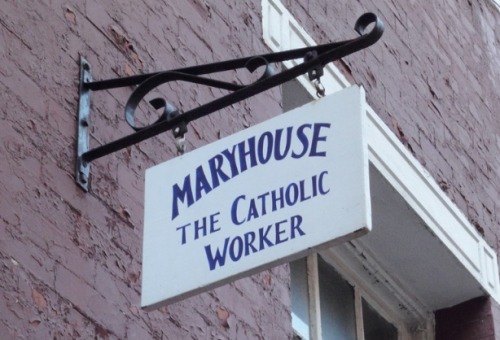
With the American Pilgrimage Project up and running, we are hoping to record the stories of members of the Catholic Worker movement, beginning with those who knew Dorothy
Day, who joined with Peter Maurin in founding the movement and its
newspaper in May 1933.
So this morning I accompanied two
StoryCorps staff members to a meeting with two anchors of the
Catholic Worker community in New York, Carmen Trotta and Martha
Hennessy (one of Dorothy Day’s granddaughters), at Maryhouse on East
3rd Street.
Just to be there was to reminded how much the place, and the movement, means to so many of us – even those of us who know the movement mainly from reading (and writing) about it. Maryhouse is a redbrick building from the 1860s, rambling and welcoming, and was used as a music school before the movement bought it in the 1960s. It’s a place where Catholic faith, nonviolence, anarchism and radicalism, and the ongoing life of New York City have come together fruitfully for half a century.
All that – and Dorothy Day lived her “third half of life” there, died there, and was laid out in the chapel there before the Mass of Christian burial.
I left with the current issue of the Catholic Worker, which features a conversation about nonviolent action in Ferguson, Missouri, between Rev. Osagyefo Segou, who has been involved in direct action there, and Waging Nonviolence author David Hartsough. Nathan Schneider moderated.
The discussion wound around to the notion that the form of protest that is being practiced in Ferguson should be called militant nonviolence” – and the question of whether “militant nonviolence,” if such a thing is possible at all, can be a good thing. About such distinctions, Rev. Segou had this to say:
If I can just make one request. My request of you all in this room is that when this protest doesn’t look the way you are used to it looking, I ask you to look deeper. Yes it’s profane and angry because we have betrayed our children. And so instead of beginning the sentence or conversation with “If they did it this way,” take seriously the way they are doing it. Take them seriously. Take their humanity seriously. I was born again on the streets of Ferguson. I got saved, as we would say in evangelical parlance, by some kids with gold teeth and tattoos and sagging pants, and so I’m asking you to look at their humanity. So when the media start that “they’re violent,” remind them they’ve been nonviolent for the vast majority of their protest even after America betrayed them on every occasion. I ask that you keep track of their humanity … they are just trying to find their way, trying to make sense of it all.
The is conversation is itself an instance of the kind of personal conversation and storytelling that we aim to gather, archive, and make public.
The full conversation is online at wagingnonviolence.org.