by Paul Eliefrom Georgetown University
At the Catholic Worker: “Militant Nonviolence – Possible?”
With the American Pilgrimage Project up and running, we are hoping to record the stories of members of the Catholic Worker movement, beginning with those who knew Dorothy
Day, who joined with Peter Maurin in founding the movement and its
newspaper in May 1933.
So this morning I accompanied two
StoryCorps staff members to a meeting with two anchors of the
Catholic Worker community in New York, Carmen Trotta and Martha
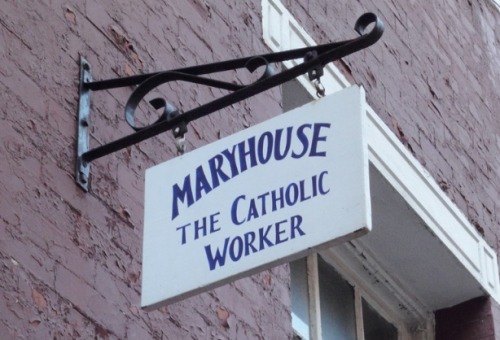
Hennessy (one of Dorothy Day’s granddaughters), at Maryhouse on East
3rd Street.
Just to be there was to reminded how much the place, and the movement, means to so many of us – even those of us who know the movement mainly from reading (and writing) about it. Maryhouse is a redbrick building from the 1860s, rambling and welcoming, and was used as a music school before the movement bought it in the 1960s. It’s a place where Catholic faith, nonviolence, anarchism and radicalism, and the ongoing life of New York City have come together fruitfully for half a century.
All that – and Dorothy Day lived her “third half of life” there, died there, and was laid out in the chapel there before the Mass of Christian burial.
I left with the current issue of the Catholic Worker, which features a conversation about nonviolent action in Ferguson, Missouri, between Rev. Osagyefo Segou, who has been involved in direct action there, and Waging Nonviolence author David Hartsough. Nathan Schneider moderated.
The discussion wound around to the notion that the form of protest that is being practiced in Ferguson should be called militant nonviolence” – and the question of whether “militant nonviolence,” if such a thing is possible at all, can be a good thing. About such distinctions, Rev. Segou had this to say:
If I can just make one request. My request of you all in this room is that when this protest doesn’t look the way you are used to it looking, I ask you to look deeper. Yes it’s profane and angry because we have betrayed our children. And so instead of beginning the sentence or conversation with “If they did it this way,” take seriously the way they are doing it. Take them seriously. Take their humanity seriously. I was born again on the streets of Ferguson. I got saved, as we would say in evangelical parlance, by some kids with gold teeth and tattoos and sagging pants, and so I’m asking you to look at their humanity. So when the media start that “they’re violent,” remind them they’ve been nonviolent for the vast majority of their protest even after America betrayed them on every occasion. I ask that you keep track of their humanity … they are just trying to find their way, trying to make sense of it all.
The is conversation is itself an instance of the kind of personal conversation and storytelling that we aim to gather, archive, and make public.
The full conversation is online at wagingnonviolence.org.


