by Paul Eliefrom Georgetown University
David Foster Wallace: What’s Going on Inside Our “Capped and Bandanna’d Heads”?
As Kurt Cobain made peace between heavy metal and punk, so David Foster Wallace made peace between the systems novel pioneered by William Gaddis and Thomas Pynchon and the novel of personal authenticity represented in the canon by The Catcher in the Rye.
True or false? True, I think, and with that in mind I ran the notion up the pole the other day at a conference at NYU devoted to Wallace’s work. Scott Korb (he of Harper’s and the LA Review of Books) was one of the organizers. Matthew Sitman (he late of Andrew Sullivan’s The Dish) was the moderator of the panel I joined, on Wallace and religion – and he handily produced Lorin Stein’s followup to my Times piece on faith and fiction, in which Lorin said, in effect, “What about Wallace?”
Well, what about Wallace? In the religion-and-literature crowd, it seems to me, too many people in too many ways have sought to baptize him after the facts (of his life and of his death), making too much of the black-ice patches of religiosity in his work. But that doesn’t mean the work itself isn’t powerfully religious at key points (as Jonathan Franzen once explained to me). And it doesn’t mean that his search isn’t pretty precisely suggestive for people whose searches intersect more directly with formal religion – with churches as well as church basements, to flip back Lorin’s way of putting it.
That peacemaking, for example: Wallace made drama (fictional and nonfictional) out of the self’s striving for personal authenticity amid the often obfuscating and counterfeit systems of our place and time – and what is the search of the contemporary would-be believer but that?
Or the controlled overload of his work: Writing at a time when it was axiomatic among progressives that we are self-fashioners, meaning-makers, Wallace seemed to take it as axiomatic that there is more meaning out there than we can possibly superintend – which means the challenge for the self involves making sense of all those different orders of meaning and the ways they might fit together.
We have to choose what to worship, that is. As a wise man once said.
Christian Wiman: Courting the Silence
“Mysticism as an astringent … writing in the dark … silence that is charged instead of afflicted …”
That’s from a particularly attentive audience member’s notes on the conversation with Christian Wiman the other night in Riggs Library. The winter storm in New England nearly kept Christian from getting from New Haven to Washington, and a deep cough kept him from getting comfortable beforehand – but once on stage, reading poems and speaking of poetry, he was mesmerizing.
In his account of things, the struggle to maintain a credible language of belief is not a cultural problem but an existential one, born of the writer’s determination to make an authentic statement while also maintaining an “apophatic” suspicion of all statements about the divine as less than adequate. As if to prove the point paradoxically, he explained that the extraordinary success of My Bright Abyss – David Brooks’ praise of it the other week led a whole printing to sell out overnight – has in his case upped the usual challenge of finding the inner silence where poetry is made.
Christian recalled an amazing account of the parable of the mustard seed by Tomas Halik, the Czech priest and philosopher who helped dedicate Václav Havel’s Place at Georgetown a year or so ago. And after ninety minutes, as if all he’d read and said hadn’t been enough, he took my prompt – Jesuit Heritage Week at the university – and recited, from memory and with a convincing north country burr, Hopkins’ “When kingfishers catch fire …”
And then over dinner unpacked the implications of his call for a “poetics of belief” with a dozen faculty members and other guests.
Christian
was the first poet to take part in the Faith & Culture series.
Here’s hoping Les Murray – with a new book imminent – is the next.
In Jefferson’s Longhouse, Many Mansions
It has been a good month for the sophisticated discussion of religion in Washington. A couple of Mondays back Marilynne Robinson and James Carroll (current book: Christ Actually) were in conversation at Sixth & I. And on Wednesday evening, while Christian Wiman, our guest in Georgetown’s Faith & Culture series, read his poetry and spoke about his remarkable excursions into poetry and Christian belief – more on this soon – Peter Manseau was at Sixth & I speaking about his new book, One Nation, Under Gods. The idea of the book – developed when Peter was a doctoral student at Georgetown – is that the United States has been a multi-religious nation more or less from the beginning and that this can be seen especially well if the national story is told with Christianity largely left out.
Bookforum’s new issue carries a rave (and a times a raving) review:
With a novelist’s verve and a historian’s precision, Manseau deftly guides us through a cacophonous religious landscape, studded with encounters so unexpected and bizarre that they could be the stuff of speculative fiction. Rather than beginning with a city on a hill built by hardy Puritans in search of religious freedom, Manseau reminds us that we are a country of longhouses and pueblos, visionaries and iconoclasts …
Much more than a simple catalogue of diversity, One Nation, Under Gods is a stunning history of religious cross-pollination. Religions “exist only in relation to each other,” Manseau writes. “They change and grow, live and die, through adaptation, competition, imitation, and assimilation.” And that process, in a sense, is the hidden American gospel …
I am eager to read the book – eager to see whether Peter presses the evolutionary metaphor as insistently as the Bookforum reviewer, Tanya Erzen, suggests. Because if followed through to its logical conclusion, this metaphor (a common motif in trade history just now) would suggest – wouldn’t it? – that the history of religion in America is a matter of the survival of the fittest, and that the fairly traditional Christian strains of religion have been the most robustly populated because they are, well, the fittest … which seems to run precisely counter to the argument for a splendid and equable religious diversity that I have understood Peter to be making with the book.
Merton in Brooklyn, Cracking Wise
The other night I took part in a public conversation at the Brooklyn Public Library marking Thomas Merton’s centenary, with Colm Tóibín and Christopher Beha as conversation partners.
Colm was brilliant on Merton’s role as the author of books that arrived as something like Catholic samizdat in sixties Ireland, where the bishops were overtly bent on keeping the insights of the council from impinging on the “simple faith” of the isle. Here’s a vivid piece of his mind.
As for me, the fact that the event had been organized by New Directions – one of Merton’s several publishers, along with Harcourt Brace; Farrar, Straus and Giroux; and Doubleday – prompted me to revisit a passage from the mammoth ND Paperbook of The Literary Essays of Thomas Merton that set me onto questions of the religious imagination in the first place.
The passage is from an essay on Faulkner that Merton wrote in 1967, and in it he suggests both what the religious imagination is and where especially it can be found – in what Merton called sapiential literature.
Sapientia is the Latin word for “wisdom.” And wisdom in the classic, as well as the biblical, tradition is something quite definite. It is the highest level of cognition. It goes beyond scientia, which is systematic knowledge, beyond intellectus, which is intuitive understanding. It has deeper penetration and wider range than either of these. It embraces the entire scope of man’s life and all its meaning. It grasps the ultimate truths to which science and intuition only point …
Wisdom is not only speculative, but also practical: that is to say, it is “lived.” and unless one “lives” it, one cannot “have” it. It is not only speculative but creative. It is expressed in living signs and symbols. It proceeds, then, not merely from knowledge about ultimate values, but from an actual possesion and awareness of these values as incorporated in one’s own existence …
What is this wisdom?
Wisdom, in any case, has two aspects. One is metaphysical and speculative, an apprehension of the radical structure of human life, an intellectual appreciation of man in his potentialities and in their fruition. The other is moral, practical, and religious, an awareness of man’s life as a task to be undertaken at great risk, in which tragic failure and creative transcendence are both possible.
Merton declares emphatically that wisdom is “not to be found in a book” but to be gained through a “living formation,” say, through spiritual direction. But the sapiential examples he gives are literary: Pasternak, Lawrence, and especially Melville as well as Faulkner in fiction; Yeats, William Carlos Williams and St.-John Perse in poetry; Suzuki in spirituality; and the modern critics of Melville and Shakespeare in criticism. Memorably, he explains:
I might say at once that creative writing and imaginative criticism provide a privileged area area for wisdom in the modern world.
“Imaginative criticism”: nearly thirty years after I first read that passage, I hope I can say without immodesty that’s what I have been trying to do in two books and plenty of essays, set in that direction by Merton, Walker Percy, Flannery O'Connor, and Dorothy Day, among others. I hope I can say that that’s what the writers I especially admire – tonight I have Richard Rodriguez, Andrew Sullivan, and Francis Spufford in mind – are after; they might not presume to be holy, but they wouldn’t deny yearning and striving to be wise.
And a hundred years on – he was born January 31, 1915 – I hope we can call Merton what he most characteristically was: not a monk, or “the literary Trappist,” or a contemplative, or a spiritual master, but a wise man.
Christian Wiman’s “Once in the West”: A Critics’ Award Finalist
The Secret
Daily higher the ivy dies,
Leaf by leaf subsiding white
Like a secret that seems to rise
Through vein and vine up to his eyes
And the green of what remains.
In spite of books and better light,
In spite of air and what friends say,
A rare arrested day, brief shoots,
In spite of all he cuts away:
From the ground up to the shelf,
From the leaves into the roots,
In spite of everything he tries,
Utterly the ivy tells itself.
That’s “The Secret,” a poem from Christian Wiman’s current book, Once in the West, which was named a National Book Critics Circle Award finalist in poetry earlier this week.
Christian will be our guest in the Faith & Culture conversation series at Georgetown next Wednesday, January 28. Like previous events, it will be held in Riggs Library, on the inside of walls whose outsides, if I recall right, are generally generously ivied.
Robert Stone (1937-2015): Thank You for Your Service
Before there was Denis Johnson, there was Robert Stone, writing big, bold, American books about wars overt and covert and religion overt and covert and the ways war and religion give cover to each other.
That combination is what stands out to me in Stone’s work. In a piece posted here a year ago I took up the Catholic dimension of Stone’s fiction, prompted by the novelist Thomas Kelly, who had chided me for passing over him in the Times:
Any discussion of Christian belief in American literature is incomplete without the inclusion of Robert Stone … More than any major novelist working today, Stone wrestles with the question of God and faith. Many of his characters are infused with religiosity – driven and haunted by faith lost and found. Even his nonbelievers are scarred and shaped by their upbringings in whichever denominations they were raised.
I think Tom is right; and Stone himself had much to say about the place of religion in his novels. But what sticks in the memory about Stone’s work, especially his novel A Flag for Sunrise – centered on a military plot in Central America and the charismatic nun who winds up set against it – isn’t the characters’ search for God so much as the nexus of institutions in which that search is carried out. In the American society of midcentury the military, the church, the FBI and CIA, and the federal government all fit together (in the way of “interlocking directorates”), and if you were a Catholic man of that era you as likely as not signed up and served one or another of them. So Robert Giroux made crucial literary connections in the Navy. So the first Catholic Worker houses were manned by military veterans who had turned against war. So Rev. John J. O'Connor – later Cardinal O'Connor – was a Navy chaplain in Vietnam. So Don DeLillo graduated from Fordham in the years that the school produced CIA operatives such as G. Gordon Liddy (the current director, John O. Brennan, graduated from there in 1977). So James Carroll grew up in a home in which the military ethos and the Catholic ethos were one.
All that interlocking of institutions was bad for society, it seems obvious to me – but it was good for the novelist. It was good for Robert Stone. Lucky for us, he was in the service of literature.
In Paris, the Present Carries Out the Past’s Threat
“When journalists are killed for expressing their views, it is one step away from burning books, said Annette Gerhard, 60.“
That quote from a report on the massacre of Charlie Hebdo’s editors (written in haste, understandably) gets the situation exactly wrong, and in a way that suggests just how complicated a situation we are now in – and how much the nature of religious violence has intensified in the past quarter century.
A quarter century ago Salman Rushdie published The Satanic Verses and prompted controversy with its depiction of Mohammad the prophet. A quarter century ago enraged Muslims burned the book, an action that evidently incited the Ayatollah Khomeini to call on pious Muslims to kill the author. A quarter century ago Rushdie sought safety underground, and through a combination of prudent security and personal stamina and cunning he lived to tell the tale.
A quarter century later Rushdie is alive and in full voice, tweeting about the massacre: “I stand with Charlie Hebdo, as we all must, to defend the art of satire, which has always been a force for liberty and against tyranny, dishonesty and stupidity.” But let’s not forget that others involved with The Satanic Verses felt the force of violence:
The novel’s Japanese translator was shot and killed, its Italian translator stabbed, its Turkish translator attacked. Its Norwegian publisher was shot and left for dead. (He survived.) Two clerics who spoke out against the fatwa—one Saudi, one Tunisian—were shot and killed in Brussels.
From the threatening of a single author to the shooting of publishers and translators and advocates to the mass murder of a magazine’s editor and staff: with the killings in Paris, religiously motivated violence against people whose words and images some believers consider offensive has escalated dramatically and alarmingly. The killers are members of society rather than rulers of it as was the case in the inquisitions of the past, but the outcome is the same. We are several steps past the burning of books, alas.
The photograph shows Rushdie with two bodyguards.
Charles D'Ambrosio: “The Conflicted Mind in Motion”
New Year’s resolution: Read Charles D'Ambrosio.
Put that way, it sounds like a chore and not an anticipated pleasure long deferred. But an anticipated pleasure long deferred (and doesn’t it sound straight out of the catechism, put that way) is what it is. Again and again people I trust (Brennan O'Donnell, Chris Richards, Fred Bahnson) have sung the song of D'Ambrosio; and over the weekend his new book of essays got an extraordinarily generous review from the current keeper of the keys to the essay, Phillip Lopate.
Lopate’s review – really a compact essay in its own right – is focused on D'Ambrosio’s effects and how he gets them:
“A good essay seemed to question itself in a way that a novel or short story did not,” he explains. “It was a forum for self-doubt, for an attempt whose outcome wasn’t assured.” Happily admitting, “I’ve depended on my ignorance quite a bit” and “rarely researched” these efforts, D’Ambrosio has tried to use his “little store of half-knowledge” to take back some of the space “we’ve ceded … to the expert.” His aim, he states, is to “capture the conflicted mind in motion.” Confessing that he “worked on each of these pieces a stupidly long time,” he claims that “the goal of those revisions was to get the thing to read like a rough draft.”
On Oregon Public Radio a few weeks ago – thanks to Fred Bahnson for sending it – D'Ambrosio explained how his insistent skepticism coexists with a “home-brewed understanding” of the Catholic faith he grew up with. The heart of it is this:
… to recognize other people as human beings. It seems so simple and it’s so difficult … I mean, the most despised, our enemies: they remain human beings. It’s a challenge. It’s not about what it provides me; it’s about what it asks of me, and it asks difficult things.
Put that way, it reads like a home-brewed understanding of Catholic art, a rough draft of the complicated ideas on the subject that some of us have been passing back and forth the past couple of years.
Flannery O'Connor liked to quote Conrad on the novelist’s duty to render “the highest possible justice to the visible universe.” Well, from this point I’ll probably quote Charles D'Ambrosio on the essayist’s duty to render the highest possible justice to the human being – by recognizing other people as human beings.
Christian Wiman: It’s Not About the Abyss – It Is the Abyss
“The best modern book on belief is My Bright Abyss by my Yale colleague Christian Wiman.”
That’s David Brooks – who is a professor in the university’s Jackson Institute of Global Affairs as well as a Times columnist. Needless to say, Brooks’s comment caught the eye – and not just because in it a columnist I trust applies an unstinting superlative to a book I consider remarkable by an author I know and admire. It’s also because it seems to me to praise the book in terms that the book, and the beliefs it sets out, seem to defy.
At Georgetown the past two years I’ve taught a course called World Literature with a Religious Dimension. The central question I take up about the books – from Brideshead Revisited and Wise Blood to My Name Is Red and The Tenth Parallel – is just what the religious dimension in them, in a work of literature, is.
One one level, I propose, the religious dimension of a work has to do with religious subject matter, religious imagery, and a religious aspect to the author’s point of view. On another level, it has to do with the nature or essence, the inner dynamism, of the work.
In Memories, Dreams, Reflections, Jung distinguished between the “psychological novel” (epitomized by Henry James’s novels) and the novel (here Moby-Dick was Jung’s example) that is an extruded piece of the author’s psyche – a piece of his mind, so to speak. In the course, I adapt Jung’s distinction and invite students to say whether each work is more “about” religion or more an extruded piece of religiosity.
In my reading, My Bright Abyss is clearly the latter more than the former. It’s subtitled Meditations of a Modern Believer, and it’s not so much a book “about” belief or a book “on” belief as a book of belief – a book in which Chris finds words for how it is that he believes and sets belief before the reader in terms as nearly whole and true to the experience as possible.
And that’s the source of the book’s power. Chris doesn’t explain belief, primarily (although there are some bang-up explanations). He sets out the character of the bright abyss of belief, and embodies the bright abyss-ininan that is the believer, from one sentence to the next. And he does so in ways that make credible – credible through their difficulty, their cruxes and double-positives – the claims of believers to stand somewhere outside the ambit of everyday explanation.
“Even if you tell people you are merely writing a column on faith, they begin recommending books to you by the dozen,” Brooks remarks in his column. Which books would you recommend? Send me an email about them to [email protected], and I’ll work up a piece about the replies.
Meanwhile, I’ll be reading Chris Wiman’s (relatively) new book of poems, Once in the West, in anticipation of a public conversation with him at Georgetown January 28 – when I’ll get to ask him how he understands the religious dimension of his work and of literature generally.
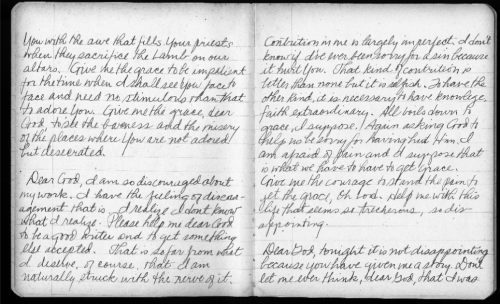
A Missing Piece of the Puzzle: Flannery O'Connor’s `Prayer Journal'
“P.S. Mr. Isaac Rosenfeld unburdened himself on the subject of Wise Blood in the New Republic. He found it completely bogus, at length.”
Flannery O'Connor got treated better in the magazine’s “back-of-the-book” review section after that review from 1952. In the years after I became a regular reader in 1984, there were strong essays about her by Brad Leithauser, Mary Jo Salter, and Christopher Benfey, among others – right up to a brilliant aside in a Diarist by Leon Wieseltier last year: this man so good at finding books or ideas bogus at length found the Prayer Journal satisfactory – and found in it this choice insight:
Can we ever settle on calling ourselves mediocre—me on myself? If I am not this or that that someone else is, may I not be something else that I am that I cannot yet see fully or describe?
Leon had already written that Diarist when he arranged for me to write a review essay about O'Connor and the Prayer Journal. I wrote it with zest. With the turmoil over the direction of the magazine, the piece never made it into print – and it was orphaned there when Leon and a couple of dozen other editors resigned a couple of weeks ago.
Now FSG has posted the whole essay on its books-and-authors website, Works in Progress. As I explain there:
In the years I spent writing The Life You Save May Be Your Own, the large collection of O’Connor materials recently placed with Emory University’s Special Collections was not accessible to writers and scholars. FSG’s publication of the Prayer Journal, then, offered an opportunity for me to add a crucial episode to my published account of O’Connor’s life—to insert a missing piece of the puzzle.
The essay, I am surprised to realize, is just a little bit shorter than the text of the journal. It has been a missing piece of the puzzle that is my own work, too. Thanks to FSG for publishing it, and to Leon for commissioning it – and for commissioning so many extraordinary review essays over the years. Who isn’t eager to know what his next move will be?