by Paul Eliefrom Georgetown University
In Paris, a New Reign of Terror?
The age of terror has come emphatically to the heart of Europe. That is the thrust of the weekend’s articles – the ones I read, at any rate – about the terror attacks in Paris. ISIS is not confining itself to Syria. The Paris attacks, an attack in Beirut, and the downing of a Russian jetliner over Egypt are parts in a single scheme. Unlike the Charlie Hebdo attacks, which targeted foes of radical Islam, these attacks targeted the pleasure-seeking French bourgeois, so as to induce unremitting terror in the city and in Europe as a whole.
All true – but it seems to me to miss a crucial point about terror and Paris, namely, that terror hasn’t lately arrived in Paris – main non: Paris is where terror in the modern sense began.
Twenty years ago, if you asked a liberal arts student to name a city associated with terror, it seems to me you’d have gotten Paris as your first answer (with Jerusalem and Tehran second and third). The reason, of course, was the French Revolution. It was in Paris that French revolutionaries carried out the Reign of Terror, so well known to so many through Dickens’ A Tale of Two Cities. It seems to me our use of the term “terror” to describe acts of disordered violence against civilians goes back to 1789 and stops there.
The Reign of Terror lasted eleven months in 1793 and 1794 – just about as long as the eleven months from the Charlie Hebdo attacks to the attacks Friday evening. But this is not to say that this year’s terror attacks in Paris are akin to those of the Reign of Terror. It’s to say the opposite, in fact – if Philip Bobbitt’s arguments in Terror and Consent are to be credited.
Bobbitt, in a giant 2008 book (which I know only through thorough and exacting reviews) argued that the “war on terror” was different from previous wars, and that as the era of the nation-state was characterized by “nation-state wars,” so the era of the market state is characterized by “market-state wars” – otherwise known as wars of terror and wars on terror. Here is The Independent:
For Bobbitt, we live in a time of market states, when we are leaving behind the constitutional order of the nation state in favour of an era of opportunity, entrepreneurship and globalisation. But the same forces shaping this agreeable destiny “are also empowering the forces of terror, rendering societies more vulnerable and threatening to destroy the consent of the individual as the essential source of state legitimacy”. The book is “not so much about al Qaeda as about the larger phenomenon of 21st-century terrorism of which al Qaeda is only a herald”: namely, the groups for whom terror is a “permanent state of affairs”, whose genius is to “copy the decentralised, devolved… and privatised market state of the 21st century”. With both “states of consent and states of terror… evolving into market states”, the central question is which version will succeed. So historians “may one day see the Wars against Terror as an epochal war, an historical and constitutional characterization that can only be made retrospectively”.
1775 to 1789 was a period of fourteen years. 2001 to 2015 has been fourteen years. If it can be said that we are now in an age of terror akin to the “Age of Revolution” Eric Hobsbawm saw beginning in 1789, it may turn out that what happened in Paris in 2015 stands in relation to what happened in America in 2001 in the same way that happened in Paris in 1789 stands in relation to what happened in America in 1775.
In any case, if we are going to understand the age we are in, we need to consider the two events together, the way the American Revolution and the French Revolution are best considered together.
Poets, Essayists, and Novelists
For two days I’ve wondered how to think, and how to write, about the controversy over PEN’s awarding its “courage” prize to Charlie Hebdo; and then this afternoon the answer came in the mail, in the form of a big book of literary criticism: Harold Bloom’s The Daemon Knows.
Bloom’s book is subtitled Literary Greatness and the American Sublime, and to judge from the flap copy and the first few pages it has everything and nothing to do with the controversy – and with why I, although a member of PEN, a past PEN prize winner, and a judge of one of this year’s book prizes, feel, or am made to feel, something other than competent to express an opinion on the Charlie Hebdo controversy.
Why? Here’s why. PEN, as I understand it – I haven’t gone to Wikipedia or whatnot – originally stood for Poets, Editors, and Novelists. That is, it was a literary organization, not an organization devoted principally to the defense of free expression in all its forms.
Of course, it has always had an extraliterary dimension: as I recall, some great literary critic drily derided Stephen Spender for his PEN Club activities, which the critic saw as detrimental to Spender’s writing. And of course the question of what writing qualifies as “literary” writing is even harder to answer than the questions about Charlie Hebdo that various people are trying to answer.
But just now, it seems to me, the free-expression dimension of PEN is trumping the literary dimension. So while five of us judges consider the literary merits of 140 books among us and deliberate about which one deserves the Galbraith Prize, the organization’s leaders, by processes I don’t understand, decide to award one prominent prize to Charlie Hebdo, which isn’t a literary publication and was never intended to be. And then one of PEN’s members – Deborah Eisenberg, a genius of short fiction – writes a letter to dissent from the choice, and offers a slate of alternative candidates: Edward Snowden, Glenn Greenwald, Laura Poltras, and Chelsea Manning: heroes all, and most of them heroes of mine, but none of them Poets, Essayists, or Novelists, and only Greenwald a writer in the common sense of the term.
Meanwhile, I am saying to myself: alas, I don’t read French any better than I did in college; didn’t know Charlie Hebdo till the controversy; am far from expert on the situation of Muslims in France or the current forms of French secularism and anticlericalism; and have only a developing understanding of the relationship between satire, visual forms of free expression, and Muslim scruples about the depiction of the Prophet. I am a writer . . . can it be that, even in PEN, the international writers’ organization, I am “just” a writer …? In the case of Salman Rushdie’s novel The Satanic Verses, the manifest literary greatness of the book scotched all other arguments. But here? …
I’ll leave it to somebody else to weigh in on whether we the members of PEN ought to have been consulted about the recipient of the “courage” prize, the way we are asked to vote for slates of candidates for the PEN leadership every couple of years. The Academy of Motion Picture Arts and Sciences roots certain of its awards in the votes cast by members; why shouldn’t this particular literary society?
Meanwhile, PEN might take a cue from Harold Bloom. For sixty years this polymath has practiced literary criticism – sometimes in the broadest sense, sometimes more narrowly, but only rarely (I am thinking of his book on the Mormons) as anything but literary criticism, as writing about other writing.
It seems to me that PEN, while remaining firmly committed to free expression, might focus its gaze a little more tightly on literary expression – on written texts that can be read, evaluated, and judged on their merits as written texts, the way the five of us judges are reading, evaluating and judging the books for the Galbraith Prize.
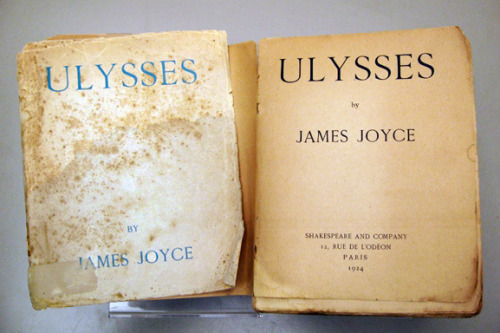
The image is of the first edition of James Joyce’s Ulysses, published in Paris in 1924 after Anglophone publishers decided it was too risky to publish.
In Paris, the Present Carries Out the Past’s Threat
“When journalists are killed for expressing their views, it is one step away from burning books, said Annette Gerhard, 60.“
That quote from a report on the massacre of Charlie Hebdo’s editors (written in haste, understandably) gets the situation exactly wrong, and in a way that suggests just how complicated a situation we are now in – and how much the nature of religious violence has intensified in the past quarter century.
A quarter century ago Salman Rushdie published The Satanic Verses and prompted controversy with its depiction of Mohammad the prophet. A quarter century ago enraged Muslims burned the book, an action that evidently incited the Ayatollah Khomeini to call on pious Muslims to kill the author. A quarter century ago Rushdie sought safety underground, and through a combination of prudent security and personal stamina and cunning he lived to tell the tale.
A quarter century later Rushdie is alive and in full voice, tweeting about the massacre: “I stand with Charlie Hebdo, as we all must, to defend the art of satire, which has always been a force for liberty and against tyranny, dishonesty and stupidity.” But let’s not forget that others involved with The Satanic Verses felt the force of violence:
The novel’s Japanese translator was shot and killed, its Italian translator stabbed, its Turkish translator attacked. Its Norwegian publisher was shot and left for dead. (He survived.) Two clerics who spoke out against the fatwa—one Saudi, one Tunisian—were shot and killed in Brussels.
From the threatening of a single author to the shooting of publishers and translators and advocates to the mass murder of a magazine’s editor and staff: with the killings in Paris, religiously motivated violence against people whose words and images some believers consider offensive has escalated dramatically and alarmingly. The killers are members of society rather than rulers of it as was the case in the inquisitions of the past, but the outcome is the same. We are several steps past the burning of books, alas.
The photograph shows Rushdie with two bodyguards.
Paris XI: Stop All the Clocks, Unplug the Telephone
First the headlines; then the close-ups of ambulances; then the headshots of the victims; and then, maybe an hour after the news broke, the photographs of people already massing in a dusk vigil – in the Place de la Republique in Paris, in Trafalgar Square in London, in Strasbourg, in Marseille …
I was working on a laptop computer all the while, and the photographs of crowds-and-squares gained a fresh dimension because of it. Usually we consider such photographs images of solidarity, of collective political engagement, of urban populism, of the citizenry voting with its feet.
The photographs from the cities of Europe are all those things, and they harked back to an earlier era, when the public rally was a basic tool of organization and inspiration.
They harked back in another way, too – one that the computer I was looking made apparent. Out in the square, starting up a vigil for the murdered Charlie Hebdo writers and cartoonists, all those people were doing something other than sitting somewhere looking at their computers. Sure, they were using their phones to skim headlines, tweet, and send text messages about the mass killing to an unprecedented degree. But they weren’t sitting somewhere looking at their computers. On some level, they had stepped away from the collective experience that is “being online” to an older form of collective experience. The combination of portable technology and dramatic – traumatic – experience had unplugged them.
“Stop all the clocks, unplug the telephone”: so begins Auden’s famous poem of grief. On some level, those citizens went to the square to be present in the moment. And yet the terms of such an outing have been upended: where not so long ago they would go to the square to merge with time (to be in the moment), now I figure those people went to the square in the knowledge that only an event of this magnitude could unhook them from the chrometer of the internet.
This week, I have been away from this website for nearly three days – just about as long as I’ve been away, except for foreign travel, since the site went live fifteen months ago. I wish I could say that I was away was for a significant civic reason such as the terrorist act that pulled Parisians away from their computers and into the streets. But I wasn’t. I’ve just been unexpectedly busy working on other things.
Tomorrow the spring term at Georgetown will begin – will begin, not for the first time in recent years, with prayer vigils and discussions about religion and terrorism.