by Paul Eliefrom Georgetown University
Thanksgiving in Nashville, With Ry Cooder and Friends
This time every year I listen to the Last Waltz concert, which took place on Thanksgiving Day 1976 in San Francisco: the Band and friends – Joni, Neil, Bob, Muddy, Eric, Van, and the rest – celebrating the band’s history and saying a weird and needless farewell.
Concert Vault has audio of the full four-hour-plus concert, including a bit of the “Canterbury Tales” read in Middle English and the Lord’s Prayer recited by Lawrence Ferlinghetti, of all people. Lately, it has added full video: a simple black and white feed probably used by the sound and light technicians to keep track of things. (It’s available on YouTube, too.) To see The Last Waltz in B&W is a strange, reverse effect; this concert, known first through a movie expertly filmed and edited in 70mm by Martin Scorsese and put out in wide release, is now a video bootleg, a concert seen through the keyhole.
That’s the effect of seeing so many of the full-length concerts now posted on YouTube. Once a home for short videos, the site now hosts dozens of shows that are seen as too long to support a commercial release. The Tedeschi- Trucks Band’s full-concert reworking of Joe Cocker’s Mad Dogs & Englishmen is one.
The Americana Music Association’s concert honoring Ry Cooder is another. It took place in September a year ago, but I wouldn’t have known about it except for YouTube. I graze there for old slide guitar videos from time to time, and one night, there it was: a Last Waltz-style gathering of Cooder and his friends and associates from over the years – Flaco Jimenez, Loretta Lynn, Rosanne Cash and Rodney Crowell, Jason Isbell, Taj Mahal (doing a stage-shaking Statesboro Blues) and Jackson Browne (doing “Fountain of Sorrow”). Through it all, there is Ry sitting on a chair stage left and working his rack of customized guitars: the sideman as star.
Meant as an ending, The Last Waltz was the beginning of something: it was the concert that carried the old-time musical revue (perfected at the Grande Ole Opry) into the age of the multiplex, whence it has migrated to YouTube.
The Americana concert is here. Happy Thanksgiving from Ry Cooder and company.
Eric, Call Yo-Yo; Tell Him Robert Johnson Sent You
Yo-Yo Ma and Eric Clapton are destined
to play a concert together.
Why those two? Because they are, as
artists, fundamentally alike: virtuosic, personally expressive,
musically curious, willing to place their musical core (the classical
cello for Ma, the blues guitar for Clapton) at the center of all
manner of musical surroundings; prodigies who were all grown up from
the beginning and who have aged gracefully over long careers.
Why destined? Because there’s a breathtaking precedent for it: the span of time seventy-nine years
ago (November 23, 1936) when Pablo Casals and Robert Johnson commenced their most famous
recordings on the same day – Casals’s recordings of Bach’s cello
suites at Abbey Road Studios in London, and Johnson’s recordings of
his blues at the Gunter Hotel in San Antonio.
It’s as amazing a synchronicity as any
in the history of recorded music. On the same day, in Europe and in
America, two extraordinary musicians, each a man in a room playing a wooden
instrument without accompaniment, made sounds that are still present
to us, undiminished and unsurpassed, most of a century later.
I figured out the coincidence while
reading liner notes as I wrote Reinventing Bach,
and I tell the story there. When he heard about it, my friend Joe
Richman, creator and producer of NPR’s Radio Diaries,
pricked up his ears – and then made an extraordinary program
telling the story with commentary by everyone from Pablo Casals’s
last student to Robert Johnson’s last surviving rival to Billy
Gibbons of ZZ Top. The program is up now as a
podcast on the Radio Diaries site.
Casals’s cello suites and Johnson’s blues recordings are arguably the two greatest and most
consequential solo recordings ever made. Together, they sit in apt
counterpoint: Europe and America, classical and “folk,” white and
black, the one an interpretation of a great composer and the other a
performance of songs composed by the performer himself.
A joint performance of the two works
by Yo-Yo Ma and Eric Clapton would be epochal: a musical conversation
between two great artists, pointing Bach’s cello suites and Robert
Johnson’s blues forward for the next seventy-nine years.
If you happen to know Yo-Yo or Eric, will you pass this on?
Our Kind of Spirituals, No. 63: Allen Toussaint, “Southern Nights”
Allen Toussaint was to play the Hamilton in Washington on November 30, and a plan was fallling into place for a group of us to go hear him after an event about the death penalty that day – which is the World Day Against the Death Penalty. But Toussaint died earlier today, age 77, struck by a heart attack after a concert in Madrid; and with him two traditions – the tradition of pre-rock-and-roll New Orleans music, and the pre-rock-and-roll tradition (still going on in Nashville) whereby songwriters subsisted through royalties for versions of their songs done by other artists – go a little deeper into the grave.
It’s an apt coincidence – if not a happy one – that this post follows immediately on one about Elvis Costello, who collaborated with Toussaint in all sorts of ways in recent years – and who has done as much as anyone to carry forward Toussaint-style songwriting, at once direct, complex, and tender.
If you’ve never heard Toussaint
singing his own song “Southern Nights,” do yourself a favor and
click on this video. It’s from Joe’s Pub at the Public Theater in
New York, where Toussaint graced the city with several dozen Southern
nights of solo performances after he was displaced from New Orleans
by Hurricane Katrina. On this video, Toussaint tells the stories of
some of those southern nights, adding sound effects on the piano –
with such easy elegance that you come away thinking we’ve lost not
just one of our great songwriters, but one of our great storytellers,
too.
Our Kind of Spirituals, No. 62: Elvis Costello, “Deep Dark Truthful Mirror”
In 2005 Oxford, Mississippi, hosted the
Oxford Festival of the Book in the daytime, and the tiny nightclub
catty-corner from Square Books in the center of town hosted Elvis
Costello and the Imposters in the evening. For a while in the
afternoon Elvis and his brilliant keyboardist, Steve Nieve, could be
seen on the porch of the bookstore, working through prospective
purchases.
Elvis – I can’t make myself call him
Costello – was there to work up a live set for recording in Memphis
the next week (and later released as Club Date);
but he was evidently there to soak up the literary rays, too.
Contrariwise, those of us who were there for the festival and
finagled our way into the club set afterward got a visceral reminder
of just how literary his songwriting is.
Seven years later, his memoir is out,
at nearly seven hundred pages; and Bill McGarvey has a column about
it over at America’s web
site. Turns out he was educated at St. Francis Xavier, Liverpool,
where he studied the poetry of Gerard Manley Hopkins – who, it
turns out, had taught at the school nearly a hundred years earlier.
It isn’t much of an imaginative leap in my mind to collapse time and envision Hopkins, the brilliant, sensitive, depressed young poet with a beautiful gift for language, being tortured in the classroom by the exceedingly clever and bold Declan Patrick McManus—Costello’s given name—when he was there in the early 1970s.
“One day you’re going to have to face the deep dark truthful mirror / It’s going to tell you things that I still love you too much to say …”
On the page, the lyric puts in mind
the late Jaroslav Pelikan’s insight that St. Paul’s comment about
seeing “through a glass darkly” makes precise literal sense, once
you look at an actual mirror from late antiquity and see just how
cloudy, how deep and dark, the reflection is.
In the video, the lyric puts in mind
Elvis’ performance in Oxford that night: his throaty vocal rising out
of the club and over the square and out into the country darkness of
Mississippi, the whole territory a deep dark truthful mirror of his
music over a third of a century.
This version is from an “Unplugged” session of 1991. Check it out: Elvis is in full beard and ponytail, like Jim James …
Get Thee to the Basement
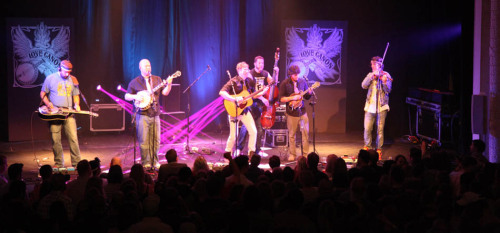
If you’re going to ponder the place of the arts in the economy, you might as well do it while listening to Dire Straits’ “Money for Nothing” being played on dobro and mandolin – which is the way I did it last night in Washington.
One of the strongest pieces of conventional wisdom is the idea that the current economy is inhospitable to the arts. Steven Johnson, in a recent piece in the Times Magazine, deftly summarizes the state of play: for years, the complaints were that the culture industry pandered to popular taste in the pursuit of profit; more recently,
a new complaint has taken center stage, one that flips those older objections on their heads. The problem with the culture industry is no longer its rapacious pursuit of consumer dollars. The problem with the culture industry is that it’s not profitable enough.
This topic – the intersection of technology, commerce, and creativity – is right up Johnson’s street, and he devotes 5000-plus words and applies plenty of data to refuting the notion that art and artists are less well off in the present than they were in the recent past. Taken on its own terms, it’s really extraordinarily convincing; but the terms tell only part of the story.
At 14th and F streets in Washington is a place, four years new, called The Hamilton. At street level, in two huge rooms, is a swanky bar and grill in the spirit of Clyde’s, a place legendary in Washington. Downstairs – in the basement – there’s a room for music: a vast, amply outfitted, windowless space, with three levels of seating, a well-lit stage, and a first-class sound system. I bought a standing-room ticket ($15), went down to the basement, and spent an hour and change listening to Love Canon, a bluegrass group that does spirited and expertly arranged versions of songs by artists from the Eighties. Upstairs, four hundred people were quaffing beers and half-watching the Nationals play the Padres on TV; down in the basement, a hundred and fifty of us were hearing Peter Gabriel, Tears for Fears, Tom Petty, et al. done with strum and twang.
I had just come from a discussion of Lewis Hyde’s book The Gift, which reckons beautifully with the fact that art is valuable in ways that fit awkwardly with the ways things are valued in the formal economy. And there at The Hamilton the point was emphatically on display. A hundred and fifty of us could stand and listen to neo-bluegrass a few blocks from the White House because we were down in the basement, a part of the building that has been made newly valuable, as real estate, because it is being used creatively.
Historically, much great art – painting, music, literature – has been made down in the basement, and the arguments about the supposed centrality of the arts in the past and their prominence or marginality in the present forget this truth.
The power of Bob Dylan and the Band’s Basement Tapes is that in them you can hear the musicians themselves rediscovering this truth from one moment to the next. I’ve spent the last few weeks listening to the “raw” Basement Tapes reissue, trying to rediscover it myself. Clearly, it’s working.
Talk About the Passion (While You Watch It at Home in HD)
Holy Week came early this year – camelast fall, in fact, when Peter Sellars and Simon Rattle brought their semi-staged version of Bach’s St. Matthew Passion to the Park Avenue Armory.
I got to go, and got to write about it for this site; so did Alex Ross, who joined David Remnick in the lobby at the act break. (Alex wrote about it for the New Yorker.)
Now
– ‘tis the season – I am seeing it again, on a video available
through the Berlin Philharmonic’s website. (Type in the code “WQXR”
for a 48-hour pass.) It’s a strange experience. It’s strange to see
the singers performing while they sing. It’s stranger to see them in
the close-ups the camera affords (a bared shoulder, a pair of hands
clasped, Evangelist Mark Padmore’s throat corded with tension during
an aria). It’s stranger still to watch the Passion at my desk,
toggling back and forth between a piece of writing and a Bach Passion
every few minutes – from the sound of the Passion
to the sight of it.
Or
is it so strange? This desk – this square yard of space in
Brooklyn – is where I have listened to several thousand hours of
the recorded music of Bach over the years; and the listening was
undertaken in part with the end of finding words for the cultural
change that such an experience reflects – for the range of
encounters with the music of Bach that new technology has made
possible. That is the idea of Reinventing Bach.
What’s
different this time, here at my desk, is that the technology is video – and it’s with
the ubiquity of video in mind, I suspect, that Sellars and Rattle
devised this semi-performed interpretation.
There
are 30 hours left on my 48-hour pass; I’m going back to Sellars’
Passion now.
Lost and Found: 13,000 Waltzes
A friend is trying to identify “things lost to history” – “ancient texts, extinct species, artworks, cities, medieval manuscripts … ” – and his query has churned in my mind for a couple of weeks now. Not that the topic isn’t on the brain all the time: so much of what we call culture-making is driven by the wish to make sure that things we treasure aren’t lost to history or the attempt to recover things that have been.
Lost to history? The music of Bach comes to mind. At least two full-length sacred passions, dozens of cantatas, and something like a quarter of the organ music is lost – was lost when Bach’s manuscripts were scattered among his heirs after his death. Because Bach is the very image of the complete artist, whose work exists in great variety and abundance – superabundance, as I put it in Reinventing Bach – all that lost work challenges our very sense of abundance, like a great cache of buried treasure submerged offshore.
Set against the idea of “things lost to history” is the great cache of 13,000 concert videos uploaded to YouTube by Wolfgang’s Vault earlier this month. I’ve subscribed to the service for a while now – and have celebrated Thanksgiving several years running by listening to all four hours of the Band’s “Last Waltz” at the Winterland in San Francisco – and just when I thought I’d worked though most of the concert audio recordings I wanted to hear, all of a sudden here are complete concert videos: the Who, Bruce Springsteen, the Clash, Lou Reed, Wilco, and on and on. And that’s just the full-length shows.
It’s striking to read an article about a long-lost vintage Telecaster of Jackson Browne’s and then call up a 1976 concert where the guitar is leaned casually alongside the piano. It’s striking to see that Last Waltz concert, familiar from the odd camera angles Martin Scorsese worked out obsessively for the concert film, now in a steady black-and-white middle-distance shot probably used by the sound-and-lighting technicians. It’s even more striking to see a full Band show from six months earlier – to see that the Band, supposedly burned out, at each other’s throats, working through an unglamorous gig in Asbury Park, playing with as much guts and ardor as they do in their Winterland farewell gig.
(Footnote for Band fans: it’s striking to see that, Levon’s cutting wisecrack to the contrary, Robbie’s haircut for the San Francisco show Scorsese filmed is no fancier than the one he has in Asbury Park.)
But what’s really striking is how much of it there is – and the feeling this superabundance produces. Conventional wisdom would suggest that, because there’s no much of it, I wouldn’t hesitate to dive in, knowing that this particular vault is bottomless, inexhaustible. But I feel the opposite. I am reluctant to dive in. It’s not that I’m afraid I’ll get lost in there. It’s not that I’m afraid of having illusions shattered, legends brought to earth.
It’s just that I’d like all that live music to be lost to history a little longer.
Awash in a Sea of Bach
 “Whenever I find myself growing grim about the mouth; whenever it is a damp, drizzly November in my soul; whenever I find myself involuntarily pausing before coffin warehouses, and bringing up the rear of every funeral I meet; and especially whenever my hypos get such an upper hand of me, that it requires a strong moral principle to prevent me from deliberately stepping into the street, and methodically knocking people’s hats off—then I account it high time to get to sea as soon as I can. This is my substitute for pistol and ball.”
Ishmael took to the sea; myself, when it is drizzling inwardly I take to Rome (if the opportunity arises), or the Metropolitan Museum (last Saturday), or a rock-and-roll joint like Irving Plaza (last night). And when the hat-knocking-off mood comes I take to the sea that is the music of Bach.
With Lent approaching, a jagged piece of Johannine coastline looms up ahead: and it looks different than it did a year ago. Which is no surprise. That the music of Bach changes in order to remain the same (to paraphrase the Leopard, protagonist of Lampedusa’s novel) is a crucial theme that runs through Reinventing Bach, and it’s happening in a big way just now, with several new reinventions of Bach coming into view since the paperback edition of the book was released last fall.
The Royal Ballet in London just premiered “Tetractys,” a new work set to orchestral arrangements of Bach’s protean Art of Fugue by the choreographer Wayne McGregor. “You could assemble a rewardingly hybrid festival of all the choreography of note that’s been made to the music of Bach,” the Times (that’s the New York Times) dance critic Alastair Macauley pointed out. “His scores welcome dance anachronisms: point work or bare feet, jeans or leotards.”
The tenor saxophonist Joshua Redman’s latest record, Walking Shadows, features a setting of the famous Bach adagio, a crucial work for venturesome soloists from Pablo Casals to Walter Carlos to Yo-Yo Ma and Bobby McFerrin. Here is All About Jazz’s critic: “Bach’s mournful composition sounds like a late-night conversation between saxophone and bass, with drummer Brian Blade’s unobtrusive brushes adding a sense of drama without breaking stride or upsetting the tune'snocturnal balance."
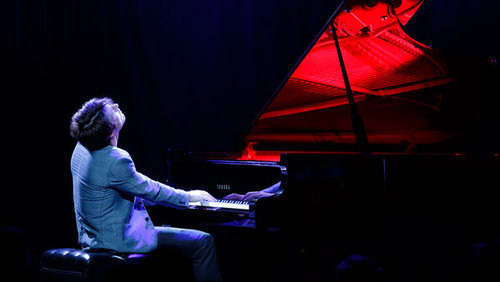
The pianist Dan Tepfer is reinventing the Goldberg Variations one gig at a time. Back in 2011 I somehow missed Tepfer’s jazz-motivated reinvention of the Goldbergs. I was in hiding finishing the book – and it turns out that he was in hiding making the record:
Tepfer recorded the album alone – producing the sessions himself in the middle of the night – in the Yamaha Artist Services Salon in Manhattan, playing one of Yamaha’s new CFX hand-built concert grand pianos. "I think if Glenn Gould were recording the `Goldbergs’ with our technology today, he would’ve wanted to do it just as I did,” Tepfer says. “He loved to work late at night, basically alone in the studio with just the engineers in the booth that he had to have. In the situation that I had, I could work alone all night long if I wanted.”
Dan’s remarks about Bach in our conversation with Simone Dinnerstein the other week were brilliant, intense, and pointed. I turn to his Goldberg Variations / Variations expecting the same – and turn to the book I’ve held off reading full-on till now: Sir John Eliot Gardiner's Music from the Palace of Heaven, a biography by the great English orchestra and choir director which gives special emphasis to Bach’s vocal music.
All the way to heaven is heaven, some holy person said – and so is a fresh venture into the sea of Bach in this season of Bach.