by Paul Eliefrom Georgetown University
Eric, Call Yo-Yo; Tell Him Robert Johnson Sent You
Yo-Yo Ma and Eric Clapton are destined
to play a concert together.
Why those two? Because they are, as
artists, fundamentally alike: virtuosic, personally expressive,
musically curious, willing to place their musical core (the classical
cello for Ma, the blues guitar for Clapton) at the center of all
manner of musical surroundings; prodigies who were all grown up from
the beginning and who have aged gracefully over long careers.
Why destined? Because there’s a breathtaking precedent for it: the span of time seventy-nine years
ago (November 23, 1936) when Pablo Casals and Robert Johnson commenced their most famous
recordings on the same day – Casals’s recordings of Bach’s cello
suites at Abbey Road Studios in London, and Johnson’s recordings of
his blues at the Gunter Hotel in San Antonio.
It’s as amazing a synchronicity as any
in the history of recorded music. On the same day, in Europe and in
America, two extraordinary musicians, each a man in a room playing a wooden
instrument without accompaniment, made sounds that are still present
to us, undiminished and unsurpassed, most of a century later.
I figured out the coincidence while
reading liner notes as I wrote Reinventing Bach,
and I tell the story there. When he heard about it, my friend Joe
Richman, creator and producer of NPR’s Radio Diaries,
pricked up his ears – and then made an extraordinary program
telling the story with commentary by everyone from Pablo Casals’s
last student to Robert Johnson’s last surviving rival to Billy
Gibbons of ZZ Top. The program is up now as a
podcast on the Radio Diaries site.
Casals’s cello suites and Johnson’s blues recordings are arguably the two greatest and most
consequential solo recordings ever made. Together, they sit in apt
counterpoint: Europe and America, classical and “folk,” white and
black, the one an interpretation of a great composer and the other a
performance of songs composed by the performer himself.
A joint performance of the two works
by Yo-Yo Ma and Eric Clapton would be epochal: a musical conversation
between two great artists, pointing Bach’s cello suites and Robert
Johnson’s blues forward for the next seventy-nine years.
If you happen to know Yo-Yo or Eric, will you pass this on?
Our Kind of Spirituals, No. 60: Yo-Yo Ma / Jean-Baptiste Sebastien Bréval, Concertino No. 3
“For
every cigarette you smoke, God takes an hour away from your life and
gives it to Keith Richards.”
“We need to
start worrying about what kind of world we are going to leave for
Keith Richards.”
How many fields are there in which you
can have an eighty-year career? Not many. Music is one. Pablo
Casals had an eighty-year career; so did Albert Schweitzer. So –
it’s possible – will Keith Richards, whose already amazing longevity (Rolling
Stone reports) is the stuff
of jokes.
Yo-Yo Ma, who turned sixty last week,
is on track to have an eighty-year career. His breakthrough adult
recording – of the Bach suites for solo cello – is nearly a third
of a century old, made in 1983, when he was twenty-seven. But Ma
has been so successful as a preternaturally youthful man that it is
easy to forget that he was also a child prodigy, performing on TV
since 1962.
Here’s that 1962 broadcast, a duo with his sister at a command performance for President Kennedy –
November 29, 1962 – with Leonard Bernstein as master of ceremonies. Yo-Yo Ma was seven. Pablo Casals, age eighty-three, performed too.
WQXR has put together a video list of eleven standout collaborations from Yo-Yo Ma’s innumerable televised performances.
The Gift That Is Given Back
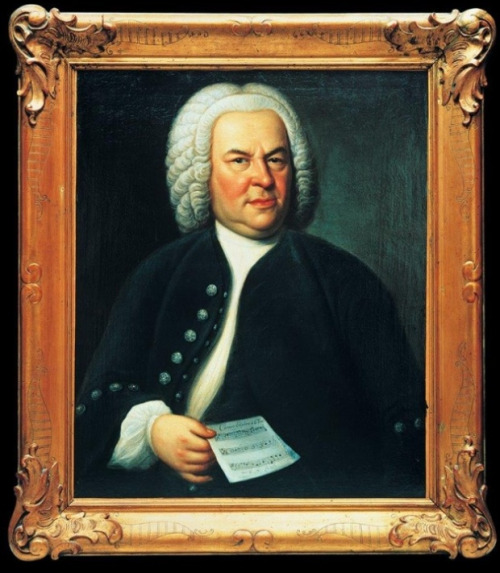
“On
the street, I paused a moment to commune with William Scheide’s
ghost. Scheide, who amassed one of the world’s great collections of
Bachiana, including one of two portraits of Bach that are considered
authentic, had died in Princeton earlier in the week at the age of
one hundred.”
That was last November, after a marathon performance of Bach’s organ music at St. Peter’s Church in Manhattan (which I would write about for newyorker.com). Scheide was dead, and his extraordinary run of contributions to the ongoing life of Bach’s music seemed to be over.
But no. From the grave – via the instrument of his will – Scheide has arranged for the portrait of Bach that he has kept in Princeton for decades to be returned to Leipzig, where Bach lived and made music in the last two decades of his life:
“Bach is Coming Home!” For once a press release gets it pretty well bang-on …
That Guardian piece (by Tom Service) and one by Zachary Woolfe in the Times tell the pretty extraordinary story of how the portrait got from Leipzig to Princeton and back again, and how it happened to make a long sojourn in the boyhood home of John Eliot Gardiner – the great interpreter of Bach’s choral music – along the way. The Guardian also unpacks the handwritten “puzzle canon” that Bach is shown holding in his right hand and explains some numerological correspondences.
What I see in the painting (and spell out in Reinventing Bach) is the way Bach took even the occasion of a portrait as an occasion to compose. The portrait was painted to mark Bach’s membership in a “correspondence” society of composers, who sent work to one another through the mail. The canon is one he had written as a condition of his membership, and through the painting the “correspondence society” comes to stand for Bach’s listeners then and now and the canon as a musical “offering” not just to them but to us:
It is turned outward to face us, as his offering to the Society of Musical Science. At the top is the title Canon Triplex a 6 voci. It is one of the canons he had written out on the back of the published text of the Aria with diverse variations. The whole thing is there on a single page, notated in the painter’s close imitation of the composer’s handwriting, so clearly that you could prop the portrait on a music stand and play the piece from it. It makes the portrait itself, already artful, a piece of music; it makes us members of the society, receiving Bach’s music through correspondence with him.
“Art is the gift that is given back,” as Lewis Hyde has it, and William Scheide has given new life to this work of art – and to Bach’s art – by returning the portrait to Leipzig, if only because it is something like the only one.
Talk About the Passion (While You Watch It at Home in HD)
Holy Week came early this year – camelast fall, in fact, when Peter Sellars and Simon Rattle brought their semi-staged version of Bach’s St. Matthew Passion to the Park Avenue Armory.
I got to go, and got to write about it for this site; so did Alex Ross, who joined David Remnick in the lobby at the act break. (Alex wrote about it for the New Yorker.)
Now
– ‘tis the season – I am seeing it again, on a video available
through the Berlin Philharmonic’s website. (Type in the code “WQXR”
for a 48-hour pass.) It’s a strange experience. It’s strange to see
the singers performing while they sing. It’s stranger to see them in
the close-ups the camera affords (a bared shoulder, a pair of hands
clasped, Evangelist Mark Padmore’s throat corded with tension during
an aria). It’s stranger still to watch the Passion at my desk,
toggling back and forth between a piece of writing and a Bach Passion
every few minutes – from the sound of the Passion
to the sight of it.
Or
is it so strange? This desk – this square yard of space in
Brooklyn – is where I have listened to several thousand hours of
the recorded music of Bach over the years; and the listening was
undertaken in part with the end of finding words for the cultural
change that such an experience reflects – for the range of
encounters with the music of Bach that new technology has made
possible. That is the idea of Reinventing Bach.
What’s
different this time, here at my desk, is that the technology is video – and it’s with
the ubiquity of video in mind, I suspect, that Sellars and Rattle
devised this semi-performed interpretation.
There
are 30 hours left on my 48-hour pass; I’m going back to Sellars’
Passion now.
Check Your Thoughts Before Boarding
Now I know how the theocons feel – the ones who wish that Pope Francis wouldn’t speak off the cuff so much.
It seems to me that the pope – speaking about the murders of the Charlie Hebdo journalists in a presser on the papal plane – spoke too casually. Ten days later, my own thoughts have yet to cohere.
Meanwhile, Bach is everywhere, the voice of coherence in a chaotic world.
The idea behind Reinventing Bach – that the music of Bach has been reinvented to great effect in the past 75 years by standout musicians using new technology to put the work into fresh contexts – is borne out by two incidents related offhandedly in the Times.
Corinna da Fonseca-Wollheim, reviewing violinist Johnny Gandelsman’s “mesmerizing” performance at Bach’s solo violin works at Bargemusic, begins by telling the story of “the pivotal experience that forever changed his approach to this music.”
In 2013 he received a last-minute invitation from the Helicon Foundation, which presents performances and discussions of chamber music, to perform the Chaconne from the second Partita. The gig came with a requirement: He was to play, for the first time, on gut strings and use a Baroque bow. He had one week to prepare. The new tools profoundly reshaped his understanding and playing of Bach’s music, he said on Saturday in remarks from the stage. He said he recalled thinking: “After this, nothing will be the same.”
Business travel writer Joe Sharkey tells the story of a Bach viral video:
Baseball cap turned backward, Zachary De Pue stands on the tarmac by the boarding steps of a US Airways Express regional jet in Charlotte, N.C., furiously fiddling the prelude to the Partita No. 3 in E by J.S. Bach on his 250-year-old violin.
“Bach would be very upset,” Mr. De Pue, 35, who is the concertmaster at the Indianapolis Symphony Orchestra, declares to a video camera held by a fellow violinist, Nicolas Kendall.
The tarmac video went viral last May after Mr. De Pue was not allowed to board with his valuable violin on a flight bound for Fayetteville, Ark., where he and the other members of the jazz-bluegrass string trio Time for Three were scheduled to play.
Mr. De Pue, who has been concertmaster at the Indianapolis Symphony since 2007, said that a flight attendant told him the violin would have to be gate-checked — placed in the cargo hold — because it could not be accommodated in an overhead bin.
So he played the Bach partita on the tarmac as a protest. And it worked: “The two violinists were able to take their instruments on a later flight …”
Some Good Things Must Come to Good Ends
Now that it’s a new year and the hopped-up calendar-induced sense of an ending is receding, some of the actual endings of the year just past stand out more distinctly. Two of them figure into this essay, which I wrote as an Op Ed in the fall …
It took something like the New York equivalent of divine intervention – a favor called in by a person on the inside – but the impossible-to-get ticket was passed through the slot in the glass window and into my hands, and just like that, I was in.
No, I didn’t see Derek Jeter’s last home game at Yankee Stadium – didn’t get to join Jay-Z, Justin Timberlake, Jimmy Fallon and 42,000 others in witnessing the Captain’s game-winning hit. No, I scored the other hot ticket of autumn in New York 2014: a ticket to Bach’s St. Matthew Passion at the Park Avenue Armory, performed by the Berlin Philharmonic and an extraordinary roster of singers and staged with great imagination by the director-provocateur Peter Sellars.
Coming one right after the other, the two events were a reminder of why New York, if emphatically not the sports capital of the United States right now – have New York’s teams ever been this bad all at the same time? – is still our cultural capital, the place where the stories that really matter are still told with such grandeur and daring that they resonate worldwide.
On September 25, as tickets for Jeter’s final home game that night were selling for an average of $845 on the secondary market, the Times reported that tickets for the St. Matthew Passion – the opening event in Lincoln Center’s White Light festival – were on offer for “between $750 and $2,999.99 a pop.” To meet demand, Lincoln Center opened a Saturday rehearsal of the Passion to the public at a price of $75 … for half the rehearsal. It sold out; and on Tuesday tickets for Wednesday’s performance were on offer for $745 on ticket-center.com.
Prices like those give the term “hot ticket” fresh meaning. But on a deeper level, it seems to me, the two events commanded exorbitant prices, and called forth extraordinary passion from New Yorkers, because they took human drama to the level of archetype.
The drama that played out at Yankee Stadium was of a good man coming to the end of his story. His friends (the Core Four) were already gone. His team (failing to make the playoffs this year, as last year) was not what it once was. His body was diminished by age and injury. But his extraordinary ability to seize the moment and make it his own: could he call on it one more time? In a Tuesday-night game against the Orioles, with a man in scoring position in the ninth and the game on the line, he struck out on three pitches. But in the same situation two nights later, with all the world’s cameras trained on him, he came through unforgettably with a walk-off single.
At the Park Avenue Armory, Sellars & Co. sought to present the biblical passion narrative as the story of a people “broken and bereft” after “their leader was executed in public following a sham trial by a discredited government. How could everything have gone so wrong?” To make us feel the wrongness of Jesus’s crucifixion, Sellars (reconstituting a production staged in Berlin and Los Angeles) bent the dramatic action toward archetype. The Evangelist who generally narrates the story dispassionately here acted out Jesus’s tribulations in an unprecedented way – twisting himself into captivity, throwing himself to the ground, breathing his last, dying. The “maidens” who usually lament their Lord’s plight from the side turned their lamentations into full-on caresses. The black-clad choristers who sing the crowd parts ventured off the cruciform stage into the audience, making the audience the crowd – making their grief our grief as they returned to the stage and gathered round the fallen leader’s body. This was the drama of a good man coming to the the end of his story – and of what the end means for those around him.
What should be we do when good things come to an end? The two events together suggest an answer. Baseball is perpetually said to be losing its claim on sports fans, young fans especially – but all it takes is a Derek Jeter, summoning one more late-inning surprise, to remind us why the game is the national pastime. Live classical music is said to be threatened and irrelevant until a Peter Sellars turns to J.S. Bach – a composer whose music calls forth reinvention – and finds a way to reinvent Bach one more time.
This drama – of an end postponed through reinvention – is itself archetypal;and the archetype fits New York well, because it’s by reinventing itself that the city keeps its place at the center of things. The Jeter era has now ended, but it ended with unexpected grandeur; and as the Yankees rebuild without Jeter, a new pro soccer team – New York City Football Club – is preparing to suit up at the Stadium and take a different sport forward for a new generation of fans. Lincoln Center is not the citadel for classical music that it was in the sixties, but the Brooklyn Academy of Music is a new center, building on its Next Wave festival with an extraordinary run of programming –from Philip Glass’s 70th birthday to Nonesuch Records’ 50th anniversary festival, from a rhythmically reinvigorated Robert Plant to a lighter-than air Nutcracker – that shows the city to be, now as ever, a place of musical adventure.
“Why do we live in New York?” New Yorkers ask ourselves from time to time. This is why: it’s a dramatic place to live. Jeter’s farewell and Sellars’ passion have shown New Yorkers – and our counterparts worldwide – what authentic drama feels like.
On WKCR, Bach at the Still Point
For a number of years – years when I was writing Reinventing Bach – there was a certain piece of Bach’s music that I listened to only once a year.
It happened this way. On a day in late July or August, a day when, like the day before and the day after, the city sat on simmer, the air hot and thick and immobile, the daylight constant, I would take out a disc of Bach’s works for flute and click through to the sonata for solo flute.
The single line of it; the elemental simplicity of the sound produced by a metal pipe animated by air transferred from the pipe of flesh in the musician’s chest; the lightness of it – all these seemed to me to capture the apex of summer, the still point of the year.
This past August, I was traveling with family in South Africa, and I didn’t take out the sonata for solo flute this year. But yesterday WKCR took it out and played it. Every December for three decades or so the station – the first FM station, at Columbia University – has played the music of Bach for a week or so. The Bach Festival was my first serious encounter with the music of Bach, a life-changing experience renewed round the clock year after year, Christmas after Christmas.
This Christmas was characterized by other music – a Ray Charles Christmas record, especially – and the Bachfest was kept on standby, to be turned on from time to time.
So it was that while I was making toast in the kitchen yesterday I turned on the transistor radio and there it was, the simple single line of the sonata for solo flute.
Summer in New York is winter in South Africa, and vice versa – and this year the solo flute sonata did its work antipodally, slicing through the seasonal to mark the still point of the year.
The Other New York Marathon
Some great philosopher – was it Isaiah Berlin? – said that the great quandaries of our society aren’t matters of scarcity, but of abundance.
So it is with the quandary of J.S. Bach’s organ music – a quandary I’ve taken up in a piece (the first of many, I hope) on the New Yorker website.
Bach wrote several hundred works for pipe organ: the something like 200 works whose texts we have today, and something like a quarter more which have been lost, and are submerged offshore, a buried treasure challenging our ideas of quantity and completeness.
What you feel, listening to the organ works, is that you will never get to the bottom of them.. Their abundance is not an abstraction, like infinity. A recondite theological term catches the sense of it: supererogatory, which means “more than is necessary for salvation.”
How (I asked in Reinventing Bach) are we supposed to listen to so much music all of it so good?
One way is to hear it over a lifetime, the way churchgoers since Bach’s time have done, encountering the pieces in many months of Sundays.
Another way is to swallow it whole through recordings. Ever since Albert Schweitzer played a selection of the organ works for the recording machine at All Hallows-by-the Tower in London, recordings of the organ works have come in box sets, the pieces listed by catalog number, and to play the music in bulk is an experience without parallel in live music or in our usual encounter with recordings.
And another way is to attend a live organ marathon, such as the one WQXR organized at St. Peter’s Church in midtown Manhattan the Saturday before last as part of its monthlong Bachstock: 30 Days of Peace and Music. That’s what I did, and my account is on newyorker.com. Takeout:
Bach proposed that the purpose of music is “the glory of God and the refreshment of the spirit.” By the time I got to the church, in midafternoon, I had driven twice from Brooklyn to Randall’s Island, watched four matches from the sidelines, seen the end of the Arsenal-Manchester United match on NBC, and toted a frozen turkey home from the Greenmarket in Fort Greene Park. I was ready for some spiritual refreshment.
Video of the event – eighteen hours of it – is here. Have a good marathon.
At the Berlin Wall, November 1989: Bach Marks the Spot
A few hours after the citizens of Germany breached the Berlin Wall – twenty-five years ago this week – Mstislav Rostropovich caught a flight from Washington to Berlin.
Rostropovich had been leading the National Symphony in Washington for a dozen years and playing recitals worldwide. He had taken part in an event at the White House with Ronald Reagan and Mikhail Gorbachev, had received a Presidential Medal of Freedom. But those were small things compared with the fall of the Wall. He had his cello with him. He would bring the music of Bach to its freshly reopened place of origin.
As it happened, the mass movement that led to the breaching of the Wall had begun at Nikolaikirche in Leipzig, one of Bach’s two principal churches in the last two decades of his life. The story is told in Reinventing Bach:
There, antigovernment activists held prayer ser vices for peace, or Friedensgebet, at 5:00 p.m each Monday. The meetings were themselves peaceful. The numbers of people in attendance swelled, surrounding the church, from a few hundred to a few thousand, until tens of thousands of the city’s 600,000 people were assembled in the Augustusplatz, which the GDR called Karl Marx Square.
The mass movement grew to 70,000, then 120,000, then 320,000. On Monday, October 9,the government sent several hundred Stasi officers to the church to suppress the crowds, but the officers, hearing the word, feeling the mood, knowing the truth, stood down. Many of them joined the protest movement that night.
Already a landmark for its association with Bach, the Nikolaikirche had become the spiritual center of the people’s movement that sought to weaken Soviet rule in Germany and then end it altogether across Eu rope.
The interior of the church, stolid brown on the outside, had long since been renovated completely— given a whitewashed neo-Baroque interior, a too-grand nineteenth century organ, and pillars whose capitals featured fronds like the ones on palm trees. But its place in history circa 1989 was consistent with its place in the history of Europe across a thousand years. The church at the crossroads was the site for the crisis of Europe at a crossroads. The place where Bach’s “St. John Passion” had first been heard was the place where peace activists struck the first deathblows of the Cold War, the beginning of the end of the standoff between two sides.
In Berlin, Rostropovich set up at Checkpoint Charlie, the crossing where tens of thousands of foreigners had had their credentials inspected over the years. A symbol in concrete, physically the Wall at that point was as crude and featureless as a parking garage. Fresh graffiti claimed the place as free territory: WILLKOMMEN IN OST-BERLIN, with the OST crossed out. There Rostropovich, just past sixty, with a shock of white hair, in a sweater vest and a blue blazer, played Bach’s music for solo cello for the German people and for West German and French camera crews. A two- minute slice of footage is part of the documentary history of the period. The music is the sarabande from the third suite, in C major. Camera shutters click in counterpoint. The master’s tone is quavery. Frankly, he is playing out of tune. But it is, no question, a historic performance.
The Sound of Halloween: Bach’s `Toccata and Fugue in D Minor'
Traditionally, Halloween and the days it anticipates – All Saints’ Day and then All Souls’ Day, a k a the Day of the Dead – are the point in the year when it is supposed that the firm boundary between the living and the dead is thinner and more porous than usual, so that we feel the ghosts of the dead among us and feel that we can cross over to the far country of the dead (by putting on costumes, say) and move among them there.
Practically, Halloween is also the day when the firm boundary that walls off classical music from popular culture is lowered for a time. You can hear Verdi’s “Dies Irae” – the Day of Wrath piece from his Requiem – as I did while driving to LaGuardia airport the other evening. You can walk into an art-supply story and hear, not Taylor Swift or Ed Sheeran, but the Phantom of the Opera soundtrack, as I did this morning.
And you can hear the music of Bach, particularly the Toccata and Fugue in D minor, which is something like the soundtrack of the modern Halloween. How it came to be this is a story told in Reinventing Bach. In the teens and twenties, silent movies were screened to the accompaniment of live music, played on piano or, in the bigger theaters, on a pipe organ. With the spread of the motion- picture “talkie” after the success of The Jazz Singer in 1927 there was no need for organists to play under the movies. As if in acknowledgment of this displacement, a number of early talkies included scenes featuring pipe organs— and so Bach’s Toccata and Fugue in D Minor as “played” by Bela Lugosi or Boris Karloff became a horror-movie trademark, the very sound of the city at nighttime as a lurid, ill- lit haunted house.
Then Albert Schweitzer – who looked something like a horror-movie victim himself, with his heavy vest and coat and broad white mustache – made a recording of the Toccata and Fugue in D minor in the middle of the night in the Church of All-Hallows-by-the-Tower in London in 1935. As Schweitzer’s grand, reverberant, otherworldly recording became the standard one, it was taken up as haunted-house music. As the public attraction to organ music subsided Schweitzer’s recording, unrivaled, remained the standard – and so his Toccata and Fugue, gaining an ever greater aura of the distant (haunted) past, became part of the Halloween environment, akin to the broomstick and the pumpkin.
It plays every Halloween out the window of a big old house with a mansard roof on Clinton Avenue in Brooklyn – a house expertly ill-lit and cobwebbed for the occasion. Off now to hear it for another year.