by Paul Eliefrom Georgetown University
Mario Marazziti: The Death Penalty, Seen in the Rearview Mirror
Two points especially stood out in Mario Marazziti’s presentation of 13 Ways of Looking at the Death Penaltyat Greenlight Bookstore the other night – two points that arereally two more ways of looking at the death penalty.
The book is frankly what the Wallace Stevens-echoing title promises: the death penalty seen thirteen different ways – the way of history, the way of religion, the way of the families of murder victims, of exonerated death-row prisoners, and the way of men who, condemned to death, went all the way to death, killed for the sake of retributive justice by the state.
And it’s the death penalty seen from Mario Marazziti’s strong point of view. Mario is a force of nature: human rights activist, Italian parliamentarian, longtime spokesman for the Community of Sant'Egidio, lover of life, and friend to countless people around the world. A few years back he took a key role in founding the World Coalition Against the Death Penalty, which has helped establish moratoria against the death penalty worldwide. He has written a regular column for Corriere della Sera. And now he is the author of this book, his first in English, just out from Seven Stories Press. (I contributed an afterword, excerpted in Commonweal.)
On Wednesday he and I will be in conversation in Riggs Library at Georgetown, through the university’s Faith & Culture conversation series.
At the bookstore event Mario told how, country by country, Europe turned against the death penalty. In the first half of the twentieth century Europe saw tens of millions of dead people: two world wars, six million Jewish people killed in the Shoah, five hundred thousand gypsies, gay people … Europe, as Mario told it, was “disgusted with death and so chose life” – chose life by abolishing the death penalty or suspending its use through moratoria.
That’s the first striking point: a profound social change that took place over a few decades. The second point is like it. Today the change that took place in Europe is taking place all over the world. In 1975 25 countries had renounced the death penalty. Today 150 countries do. The U.S. and its counterparts in capital punishment – China, Saudi Arabia, Iran – are distinctly in the minority.
When it comes to state execution, at least, the world, disgusted by death, is choosing life.
Christian Wiman: Courting the Silence
“Mysticism as an astringent … writing in the dark … silence that is charged instead of afflicted …”
That’s from a particularly attentive audience member’s notes on the conversation with Christian Wiman the other night in Riggs Library. The winter storm in New England nearly kept Christian from getting from New Haven to Washington, and a deep cough kept him from getting comfortable beforehand – but once on stage, reading poems and speaking of poetry, he was mesmerizing.
In his account of things, the struggle to maintain a credible language of belief is not a cultural problem but an existential one, born of the writer’s determination to make an authentic statement while also maintaining an “apophatic” suspicion of all statements about the divine as less than adequate. As if to prove the point paradoxically, he explained that the extraordinary success of My Bright Abyss – David Brooks’ praise of it the other week led a whole printing to sell out overnight – has in his case upped the usual challenge of finding the inner silence where poetry is made.
Christian recalled an amazing account of the parable of the mustard seed by Tomas Halik, the Czech priest and philosopher who helped dedicate Václav Havel’s Place at Georgetown a year or so ago. And after ninety minutes, as if all he’d read and said hadn’t been enough, he took my prompt – Jesuit Heritage Week at the university – and recited, from memory and with a convincing north country burr, Hopkins’ “When kingfishers catch fire …”
And then over dinner unpacked the implications of his call for a “poetics of belief” with a dozen faculty members and other guests.
Christian
was the first poet to take part in the Faith & Culture series.
Here’s hoping Les Murray – with a new book imminent – is the next.
Christian Wiman’s “Once in the West”: A Critics’ Award Finalist
The Secret
Daily higher the ivy dies,
Leaf by leaf subsiding white
Like a secret that seems to rise
Through vein and vine up to his eyes
And the green of what remains.
In spite of books and better light,
In spite of air and what friends say,
A rare arrested day, brief shoots,
In spite of all he cuts away:
From the ground up to the shelf,
From the leaves into the roots,
In spite of everything he tries,
Utterly the ivy tells itself.
That’s “The Secret,” a poem from Christian Wiman’s current book, Once in the West, which was named a National Book Critics Circle Award finalist in poetry earlier this week.
Christian will be our guest in the Faith & Culture conversation series at Georgetown next Wednesday, January 28. Like previous events, it will be held in Riggs Library, on the inside of walls whose outsides, if I recall right, are generally generously ivied.
Tim Shriver, Unconditionally
Tim Shriver is probably the only person I’ve ever met who can explain Bernard Lonergan’s thought in a way I fully understand.
Tim was at Georgetown last night to discuss his memoir Fully Alive in a conversation at Riggs Library (I was his conversation partner); and he floored the audience by declaring in unshowy dead earnest that he has read a certain chapter of Lonergan’s Method in Theology a hundred times.
Fully Alive is the story of how Tim as an adult came more fully to life through an encounter with the Special Olympics; but it’s also the story of how he came more fully to life through a complex and circuitous personal search. That search led him to go far down the ladders and stairways of Catholic spirituality – to centering prayer, to Bernard of Clairvaux, to The Cloud of Unknowing, and to Lonergan, the Canadian Jesuit philosophical theologian who followed the long and abstruse and exacting volume Insight with the even longer and more abstruse and more exacting Method in Theology. Lonergan’s thought baffled my roommate and me at Fordham in the eighties – but on stage at Georgetown, as in his book, Tim made Lonergan’s thought seem the most convincing solution to what first-year students study as the problem of God. For Lonergan, the key to reality is found in epistemology, the science of knowing; and the limitless, unconditional dynamism of our knowing expresses our disposition for the unconditional – and for Lonergan the unconditional is what we call God. And how do we most fully dispose ourselves to the unconditional? By “being-in-love,” which must begin with falling in love. In his memoir, Tim spells it out:
Here, in Lonergan’s otherwise dense philosophical theology, was a framing of the code that I hadn’t understood: the search for God that I felt in myself and sensed in others could be satisfied by falling in love – not by talking about it or teaching about it, but by falling into it. Believing in God is not thinking God. It’s believing that we are happy and true to ourselves only when we give ourselves away to another, to the whole of creation, to love. That’s what faith is all about: trusting that you must give yourself away and only then discover the self you were made to be.
Long story short, Tim – under Lonergan’s spell – fell in love with Linda Potter. That story is told in Fully Alive. Spoiler alert: it’s a story with a happy ending.
Christian Wiman: It’s Not About the Abyss – It Is the Abyss
“The best modern book on belief is My Bright Abyss by my Yale colleague Christian Wiman.”
That’s David Brooks – who is a professor in the university’s Jackson Institute of Global Affairs as well as a Times columnist. Needless to say, Brooks’s comment caught the eye – and not just because in it a columnist I trust applies an unstinting superlative to a book I consider remarkable by an author I know and admire. It’s also because it seems to me to praise the book in terms that the book, and the beliefs it sets out, seem to defy.
At Georgetown the past two years I’ve taught a course called World Literature with a Religious Dimension. The central question I take up about the books – from Brideshead Revisited and Wise Blood to My Name Is Red and The Tenth Parallel – is just what the religious dimension in them, in a work of literature, is.
One one level, I propose, the religious dimension of a work has to do with religious subject matter, religious imagery, and a religious aspect to the author’s point of view. On another level, it has to do with the nature or essence, the inner dynamism, of the work.
In Memories, Dreams, Reflections, Jung distinguished between the “psychological novel” (epitomized by Henry James’s novels) and the novel (here Moby-Dick was Jung’s example) that is an extruded piece of the author’s psyche – a piece of his mind, so to speak. In the course, I adapt Jung’s distinction and invite students to say whether each work is more “about” religion or more an extruded piece of religiosity.
In my reading, My Bright Abyss is clearly the latter more than the former. It’s subtitled Meditations of a Modern Believer, and it’s not so much a book “about” belief or a book “on” belief as a book of belief – a book in which Chris finds words for how it is that he believes and sets belief before the reader in terms as nearly whole and true to the experience as possible.
And that’s the source of the book’s power. Chris doesn’t explain belief, primarily (although there are some bang-up explanations). He sets out the character of the bright abyss of belief, and embodies the bright abyss-ininan that is the believer, from one sentence to the next. And he does so in ways that make credible – credible through their difficulty, their cruxes and double-positives – the claims of believers to stand somewhere outside the ambit of everyday explanation.
“Even if you tell people you are merely writing a column on faith, they begin recommending books to you by the dozen,” Brooks remarks in his column. Which books would you recommend? Send me an email about them to [email protected], and I’ll work up a piece about the replies.
Meanwhile, I’ll be reading Chris Wiman’s (relatively) new book of poems, Once in the West, in anticipation of a public conversation with him at Georgetown January 28 – when I’ll get to ask him how he understands the religious dimension of his work and of literature generally.
Bergoglio’s “Core Four” Approach
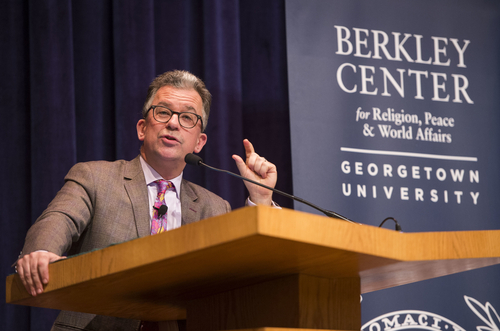
Austen Ivereigh spoke about his new biography of Pope Francis at Georgetown last night, and the event was (among other things) a persuasive argument for an Oxford education.
It was at Oxford (of all places) that Austen wrote a thesis on (of all things) the Catholic Church in Argentina – an experience that equipped him to write this biography; and it was at Oxford, presumably, that he polished the public-speaking skills that enabled him to tell the audience the “best bits” from the book from the stage in such a way that, hearing him, you knew you had to get the full account by reading the book.
He told the story of how the biography came to be the book it is. I don’t mean the story of how he met Pope Francis in Rome and the pope gave him a firm squeeze on the wrist that emboldened him to write the book. I mean the story of how, returning to Buenos Aires to conduct research for the book, he located the bound volumes containing Jorge Mario Bergoglio’s casual homilies and addresses to Jesuits in formation. These – eventually published, as far as I can tell, in Meditaciones para Religiosos and two other books – make it possible for us to know what Bergoglio thought as far back as the mid-1970s. And they mean that in this English-language biography the native-Spanish-speaking pope is alive and audible, speaking in something like his own voice.
The ideas and principles Bergoglio put to paper in the seventies and eighties are the substance of his approach. He has a “core four” principles of Jesuit-style discernment:
Unity comes before conflict.
The whole comes before the part.
Time comes before space.
Reality comes before the idea.
Austen calls these “a kind of sapiental wisdom,” and he is right. Clear, hard, succinct, axiomatic, they sound like something out of the Pensées of Pascal.
I led a conversation with Austen later in the evening, and video will be up soon on the Berkley Center website.
Bergoglio: “Life Is Normal”
“You have to be normal,” Pope Francis told the Jesuit Antonio Spadaro at the beginning of their long interview last summer. “Life is normal.”
That’s what’s remarkable about this photograph of Jorge Mario Bergoglio: he looks absolutely, positively normal.
And that’s what’s remarkable about The Great Reformer, Austen Ivereigh’s just-published biography of Francis: he depicts Bergoglio as an extraordinary figure by showing him in the everyday settings of “normal” life, from Jesuit Colegio Máximo to Buenos Aires streetcar to the Casa Santa Marta and the porch of St. Peter’s in Rome.
Ivereigh makes the now-familiar point that Bergoglio is the first pope of our era not to have taken part in the Second Vatican Council, and from this insight he draws out a main line of the story. A Jesuit in formation during Vatican II, Bergoglio was formed or shaped by the council more than any of the participants could have been:
His formation coincided with a period of epochal change in the Church. Months after he began his novitiate, Pope John XXII announced his intention to call a meeting of the world’s bishops, the first for almost 100 years, in Rome. The Second Vatican Council (1962-65) — overseen first by Pope John; then, from 1963, by Pope Paul VI — unleashed reforms that transformed the way the Church related to the world, and led to far-reaching internal changes. The Council would be Bergoglio’s greatest teacher, and the single greatest source, later, of his pontificate. Among the changes the Council called for was for religious orders to return to the original charisms and activities of their founders. Leading this renewal-by-return would be one of his main tasks as provincial of the Argentine Jesuits in the 1970s.
Jorge’s formation led him to draw deep from the wells of Ignatian spirituality and Jesuit history, developing a vision of formation that he would implement as novice master and provincial. At a time of crisis in the Society, on the eve of the Council, when many Jesuit students were leaving, Jorge discovered both internal spiritual clarity and a distinctive vision of the future of the Society and himself in it. His ideas were the product of different sources: the spirituality and ideas of the early Jesuits, as well as Catholic theology, especially of the Vatican Council; but also of the history of Argentina, and the extraordinary role of the Jesuits in its formative period.
Formed by the Council, Bergoglio set out – like most of us in the postconciliar era– into a story that he knew was as yet only partly told, and Austen Ivereigh makes Bergoglio’s particular story feel like one being told for the first time. No recent pope has gotten a biography as sober, culturally adept, and attuned to the ongoing moment as this one.
Austen will speak and read from the book at Georgetown December 3. I’ll be moderating the conversation – which is to say, I’ll be picking up a conversation that he and I have been having for a decade now.
Flannery O'Connor, Artist of the Global South
Flannery O'Connor died fifty years ago this month: “Late in July she was taken to Milledgeville hospital with a severe kidney failure, and she died there in a coma on the morning of August 3,” as Robert Fitzgerald put it in the prefatory essay to Everything That Rises Must Converge.
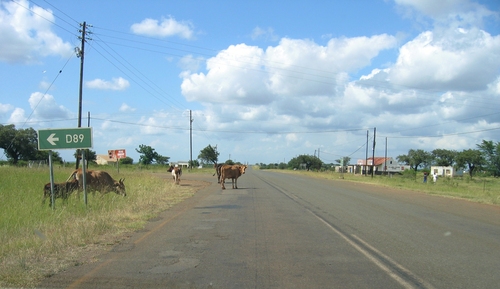
I was in Africa on August 3: driving with family across the border and up into Swaziland en route to the Mkhaya game reserve past Big Bend (where the photograph above was taken). And as we traveled in South Africa for several weeks, I pondered a conviction about O'Connor and her work that had trailed me the eight thousand or so miles from Brooklyn and Georgetown to Johannesburg and KwaZuluNatal and Cape Town.
Which is this: that these days the distinctive half-fictive region cherished as “Flannery O'Connor’s South” is more contiguous with the global South than with the southern part of the United States, and the aptness of O'Connor’s work to the global South is a crucial reason why it seems to point forward, not back.
In an address in Georgetown’s Faith & Culture series several years ago now – an effort to measure the gap between O'Connor’s time and ours – I wound up putting a point this way:
The genius of Flannery O’Connor was that she left many of the cultural distinctions cherished by Catholics of her age out of her work, recognizing that they were not related to truth. Instead, she made work that crossed borders—between North and South, black and white, Catholic and Protestant, the realistic and the grotesque—in order to dramatize the central human question: the question of “the salvation or loss of the soul,” as she put it. Her work will make sense when the “Protestant South” is the territory of Central and South America. It will make sense when the admirable nihilist, the practitioner of a do-it-yourself Christianity, is an oilworker on a derrick in Nigeria or a “house Christian” in Beijing. It will make sense because she looked forward, not back—looked forward imaginatively through the “realism of distances,” another term for prophecy.
Well, to travel in southern Africa is to know that this is true already – or rather, that it has become more true in this part of the global South while it has become less true in Atlanta and Louisville and New Orleans. The coexistence of races, and the separation of the races; the busyness and disorganization and drama of public life at streetside and open market; the do-it-yourself churches with their creeds handpainted on the walls outside; the constancy of poverty; the sense that life is precious, because life is dangerous, and one’s own survival is not assured – all these are recognizable in the big cities, the villages, the townships of South Africa.
Flannery O'Connor was a regionalist, yes; but her region – her country – was the place that Pope Francis (with the Community of Sant'Egidio) calls “the periphery.” The periphery is vast; and to travel on the periphery in South Africa is to recognize that we in America live on the periphery of a world that’s larger and more complicated than we generally realize.
Colum McCann: Radical Empathy
There’s a set of barbells at Frederick Douglass’s house in Anacostia. Some months ago Colum McCann picked them up, so to speak. He relocated them from Washington to Dublin inside a satchel that Douglass, already a prominent abolitionist while still in his twenties, took on a speaking tour in 1845 and 1846. He reconstituted them as barbells made from metal derived from slave-chains melted down. In doing so, he made them a vivid expression of Douglass’s circumstances: still a slave in America, Douglass was a freeman in Ireland, and yet one mindful of the contingent nature of his freedom – and mindful, even so, that he bore in the body which lifted those barbells the certain knowledge that in himself he was free.
And that, in McCann’s work, and his account of it, is an instance of “radical empathy.”
McCann was our guest in the Faith & Culture conversation series at Georgetown yesterday, and our conversation kept coming back to radical empathy. In McCann’s work, it is a quality certain characters possess: the Irish-born Bronx street-monk Corrigan in Let the Great World Spin, the peace broker George Mitchell (yes, the George Mitchell) in Transatlantic. It’s a quality that writers call forth in readers and vice versa. It’s a quality that is fostered and deepened through the telling of stories – a quality that McCann is striving to foster with a new nonprofit organization called narrative4, which invites young people from around the world to trade places and tell each other’s stories.
Most important (by my reckoning), radical empathy is a quality that McCann the novelist brings to the art of fiction. He strives for radical empathy with his characters through reporting and research, through close attention to speech and social details, through a willingness to follow the characters where they lead him (even unto death in some cases) – and through imaginative leaps like the one that led him to put those barbells in Douglass’s luggage and send them on a transatlantic journey.
Radical empathy emphasizes our ability – and our calling – to know others in spite of our differences. It’s akin to the “radical identification” of Dorothy Day and her contemporaries in American Catholic writing, who invited readers to identify with others through a recognition of their common humanity.
It’s a quality we need more of, in life and in art, as the great world spins.