
by Paul Eliefrom Georgetown University
“Fanatics, None Greater”: ISIS via Flannery O'Connor
“They’re not religious leaders – they’re terrorists.”
That’s President Obama, the other day, in vexed reference to the people in Syria and its surroundings who call themselves ISIS – and who, in the way that language has with us, are now accorded the kind of verbal respect shown to religious leaders and heads of state.
Of course he’s right. But the problem with ISIS – the problem with the so-called War on Terror – is that the terrorists are not incidentally religious.
Ten years ago, when the theoconservatives surrounding President George W. Bush declared the war on terror a religious war, I stood firmly with the people who dismissed such talk as politically motivated evangelical hooey.
Now there is pretty obvious evidence that ISIS’s terrorist acts aren’t just directed at “the West,” but against people of Christian belief in the West. An evangelical Christian aid worker murdered. A Catholic photographer beheaded. Twenty-one Coptic Christians beheaded at the seaside. More than ninety Syrian Christians taken captive and threatened with the loss of their lives.
The people who call themselves ISIS are Islamicist fanatics who are making Christians their targets, after the fashion of a religious war.
The question, then, isn’t whether the people who call themselves ISIS are terrorists or religious people. The question is whether religious fanaticism or terrorist violence has priority for them.
Flannery O'Connor, writing to a Catholic nun she knew in 1963, explained the fierce combination of religion and violence in her work this way:
To a lot of Protestants I know, monks and nuns are fanatics, none greater. And to a lot of monks and nuns I know, my Protestant prophets are fanatics. For my part, I think the only difference between them is that if you are a Catholic and have this intensity of belief, you join the convent and are heard from no more; whereas if you are a Protestant and have it, there is no convent for you to join and you go about in the world getting into all sorts of trouble and drawing the wrath of people who don’t believe anything much at all down on your head … .
There, I think O'Connor put something just right. But does it apply to ISIS?
About ISIS, that is, the question is this: Are they religious fanatics who, finding no religious context for their fanaticism, seek it in violence? Or are they people of violence who, finding no social context for their violence – a conventional standing army, for example – seek it in religion?
That, it seems to me, is a question it falls to the religious imagination to try to answer. And if we could answer it, we would understand our age a whole lot better.
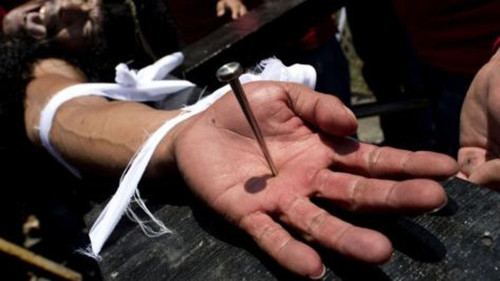
The photograph is of one of many crucifixions performed by ISIS in Syria. Most of the images are far more gruesome. I’ve never seen any of them reproduced in conventional or legacy media.


