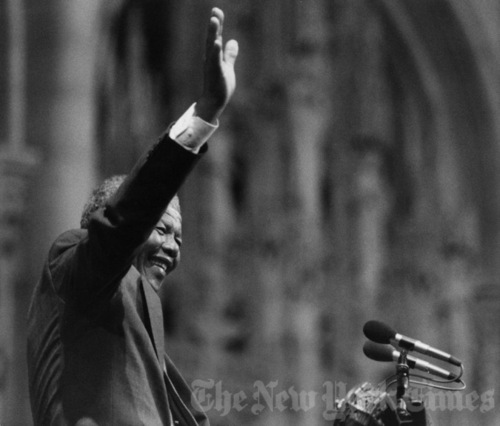
Nelson Mandela’s death makes so many of us feel that we have something to say. It’s a good, pure impulse – the impulse to pay tribute, to testify, to recognize a person “profoundly good” (as President Obama put it) whose like won’t come again. And yet it makes us feel, too, how little there is to say that isn’t inadequate.
So instead of trying to say something new I’m going to interrogate a piece of writing of mine, published in a book called Martyrs some years ago, about the day Nelson Mandela came to to the neighborhood.
“One morning in June 1990 I left my apartment to get a Pepsi, and walked into the new South Africa.”
So far, so good.
“I was a graduate student at Columbia University, and I lived in a neighborhood near the campus that might be called a religious ghetto. Union Theological Seminary and Jewish Theological Seminary face each other across Broadway, and Corpus Christi Church is shoehorned between apartment houses on West 121st Street; behind Union are Riverside Church, its tower looming overhead like a displaced part of Chartres, and the Inter-Church Center, a concrete-and-glass building known (this is what passes for humor among divinity students) as the God Box.
“It is a neighborhood where, perhaps more than anywhere else in Manhattan, religion is still seen and felt to be a going concern. That day it was the setting for the greatest local religious event since the Rev. Dr. Martin Luther King Jr. preached at Riverside Church in 1962. After serving twenty-seven years in a South African prison for his opposition to apartheid, Nelson Mandela had come to New York, free at last.”
And I was busy? What was I doing that day that was so important that I couldn’t pause for a few hours and rubberneck on the street – the street where I lived – to see Nelson Mandela? Writing, editing, working, moping? It couldn’t have been that important, could it?
Mandela was in the neighborhood, and I got a can of soda and went back to my little life. It was a mistake, and one I hope I wouldn’t make today.
And yet his visit to the neighborhood made a strong enough impression that I put it into a polished piece of writing. Maybe it was better to be honest about my own matter-of-factness toward Mandela than to bend the knee to the zeitgeist.
“That morning he would be meeting with American religious leaders at Riverside Church. The neighborhood had been transformed in anticipation. Television crews had laid down their cables, the police their sawhorses. Several thousand people, most of them African Americans, had gathered outside the church, wearing dashikis and robes embroidered with kinte cloth, or T-shirts screened with images of Mandela and the African continent.
“I wandered through the crowd, sipping my soda. I was used to seeing Africa celebrated in the neighborhood. On summer Wednesday evenings a festival of African crafts, food, music and the like is held at Grant’s Tomb, just north of the church. What struck me as odd was that this African feast had a Christian dimension as well as a civic and cultural one. I couldn’t remember a time when I’d seen Christianity so closely linked with unfolding world events. It was powerful, and it was nervous-making. I found myself slipping into the role of devil’s advocate.”
Uh-oh, here it comes. My younger self is going to quibble over the fact that Mandela was getting a hero’s welcome at the church even though he wasn’t a Christian believer.
“Mandela wasn’t a Christian, was he? Not so far as I knew. And wasn’t there something opportunistic in the welcome the church people were giving him? Sure, in recent years the mainline Protestant churches had publicly opposed apartheid, and as churches go, the nondenominational and racially diverse Riverside Church was an ideal place to honor Mandela. But I couldn’t suppress the thought that the event and all its trappings were one more instance of progressive Christians trying to get on the right side of history …”
So they were, and so they did.
When I read the passage now I think that they were right to get on the right side of history, and that I was right to question it.
You can’t get far in the life of religious belief without saying to yourself: If these beliefs are so important, why is it that unimpeachably great figures of the age like Nelson Mandela – holy figures – don’t go along with them? Why is it that, so often, believers are bystanders to the right side of history, when they are not actually opposed to it?
It’s a mystery, and a quandary.
Nelson Mandela’s life made clear that there really is a right side of history. That much is clear; that much is not at all mysterious. And if there is a right side of history, where else should we strive to be than there – even if we go there partially, and belatedly, bringing our own people’s mysteries and quandaries, the way he brought his?
This photograph of the church of St. John Kaneo in Yugoslavia was taken for the National Geographic Society in 1982 — when those of us who were students in public high schools in the United States were being told that there were no more churches behind the Iron Curtain. It’s on NatGeo’s Tumblr, called Found: high-res pictures galore …
“This message is so clear and direct, so simple and eloquent, that no ecclesial interpretation has the right to relativize it. The Church’s reflection on these texts ought not to obscure or weaken their force, but urge us to accept their exhortations with courage and zeal. Why complicate something so simple?”
That short bit of commentary on the early Church Fathers’ message about poverty is the sort of thing that might have been offered during the panel discussion about The Pope and the Poor at Georgetown. I say “might have,” first of all, because the event – which featured E.J. Dionne, Michael Gerson, moderator John Carr and others – took place earlier in the week and I haven’t seen the transcript yet. (More soon.) But I say “might have” mainly because that short bit of commentary concerning the pope and the poor comes from Pope Francis himself – from his recent apostolic exhortation.
Usually popes in their formal statements are sufficiently opaque that they call forth commentators to clarify what they said. But in this – as in so much else – Pope Francis is different. This pope is a good deal clearer and more plainspoken than exegetes such as George Weigel, who all but inserted his own podium-polished formulae of mission-effective evangelical Catholic reform into the pope’s mouth over the Thanksgiving weekend.
The reference to “consumerism” early in Francis’s first letter suggests that he is going to focus first on the challenge of wealth, but no. He will speak to the matter of poverty and poor people, and in case the message is unclear, he’ll do the clarifying himself:
Conceptual tools exist to heighten contact with the realities they seek to explain, not to distance us from them. This is especially the case with those biblical exhortations which summon us so forcefully to brotherly love, to humble and generous service, to justice and mercy towards the poor. Jesus taught us this way of looking at others through his words and his actions. So why cloud something so clear?
There’s no good reason. Better to go and do likewise by drawing near to poor people – which means, as Francis puts it, “not an unruly activism, but above all an attentiveness which considers the poor `in a certain sense as one with ourselves.’” Yes, ourselves:
No one must say that they cannot be close to the poor because their own lifestyle demands more attention to other areas.
The funny thing is, Weigel gets it right more than not. He catches Francis’s ardent Christian faith better than the progressive commentors. But then he turns it into something else.
Why complicate something so simple? Why cloud something so clear?
We’re just beginning to understand the role that technology plays in the development of the traditional arts. That’s a working idea I try to develop every chance I get.
But Robert Pinsky understands the art-and-technology connection far better than most. When he was Poet Laureate, he created the Favorite Poem Project: a recorded archive of the American people reading their favorite poems aloud. As poetry editor of Slate he created the liveliest, most natural-seeming forum yet for the discussion of classic poems.
Now Robert has moved the discussion over to his own site. He explains:
Changes at Slate have removed the memorable discussions of “Classic Poems” that I presented there for several years. The poems themselves and my introductions remain, for those who hunt, but the Fray and Comments texts written by readers are lost.
Rather than simply mourn that loss (and I do mourn it!) I will be presenting the Classic Poems here on my own Forum, hoping to take part in a new, lively conversation, welcoming a range of readers to respond.
The poem up for discussion right now is “There Was a Man of the Double Deed,” author unknown – a poem that, for Robert, “exemplifies how poetry can join reason and unreason, method and wildness, so effectively that the opposites become part of a single process”:
As in dreams or some forms of mental illness, the systematic becomes a form of derangement. Here, the erratic movement from thing to thing also feels fateful, and pointed.
The poem, and the commentary – a single paragraph packed full of insights – are here. So is a recording of Robert reading the poem aloud. You’ll see what it all has to do with an image of a ship run aground.
The piece of that title by Bill Hayes on today’s Op-Ed page is a perfect “essay in disguise.”
A few years ago the New York Times ran an ad campaign called “My Times” – calling attention to the different things the paper is to different people.
Well, “my” Times is a place for essays in disguise.
The term was coined by Wilfrid Sheed, who died in 2011 and didn’t get a properly appreciative send-off, as far as I know. Sheed’s work as a writer, he explained in the preface to a book of essays, consisted of taking assignments for book reviews, profiles, travel pieces, and the like and turning them into “essays in disguise” – and so getting paid to produce pieces of writing he would have been happy to write in any circumstances.
Just as the writer who is temperamentally an essayist is always on the hunt for the opportunity to work up an essay, so the reader who is drawn to essays is always on the lookout for a piece of journalism that is an essay in disguise — or that seems to have turned into an essay as the writer gained access to the combination of curiosity and formal freedom that characterizes the essay (I was going to say “the essay form,” but caught myself: what makes it an essay is its relative freedom from form).
So I keep an eye out. My mentor Verlyn Klinkenborg’s piece about the decline and fall of the English major was an essay in disguise. So was Ben Ratliff’s piece (just yesterday) on the strange kinship of Boston and Black Flag. And so is Hayes’s piece, in which he takes the strange news that a scientists have just “discovered” a new part of the body (it’s in the knee) and up and runs with it – through the story of the Renaissance anatomist Vesalius, his own spell in an anatomy class, and the never-ending mystery of “the secrets inside us”:
Continuing studies will further clarify the ligament’s biomechanical function, and whether there are clinical implications.
Meanwhile, the rest of us can be our own Vesalius and discover this newly, precisely described body part on our own: Put a hand to the outside of one knee, right at the ledge of the shallow pit next to your kneecap. Extend, bend, stand, crouch, twist. All the while, picture this: right beneath your fingers is a pearly piece of tissue, about an inch-and-a-half long, helping to make all of this happen.
Now, take a step. Take a moment. Appreciate it.
There is a near constant call for the resuscitation of the frankly literary essay, but I prefer my essays disguised.
That’s Truman Capote — another stealth essayist — behind the mask.
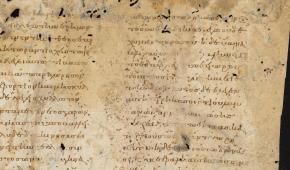
'This the season to live imaginatively in first millennium. The other day a hymn for the first week of Advent sent me there; and today a door to that other age opened with the news that the Bodleian Library and the Vatican Collections are digitizing giant caches of ancient manuscripts and offering access online. Here’s a ninth-century book of Psalms and commentary. You can click your way through the pages.

In the whirlwind of commemoration two weeks ago I missed a remarkable essay (in Guernica) by Bridget Potter, who happened to be in the CBS News studio — a twenty-year-old production assistant — when word came that “something had happened in Dallas”:
By 2:00, regular programming had been suspended and Cronkite was broadcasting live from Studio 40. A little after that, the editor took me by the arm, through the double doors into the tiny ice-cold studio. He stood by the one enormous stationary camera in the small newsroom and indicated that I should crouch down behind and to the side of the camera, out of the way. He gestured to the cameraman that I, a stranger, was with him. The fixed-focus camera pointed directly at Cronkite, who sat behind a desk cluttered with rotary phones, papers, a big electric typewriter. My knees hurt but I stayed still, frozen, awed. Cronkite announced that last rites had been given to the President. Then came an unconfirmed report from Dan Rather who was in Dallas, that Kennedy was dead. And then, less than a minute later, Cronkite, jacketless, button-down-shirted and narrow-tied, returned unfamiliar heavy-rimmed black glasses to his face and read from a piece of paper ripped from a news ticker machine which sat, chugging constantly and spewing out paper, bells ringing loud in the bustle of the newsroom behind him: “From Dallas Texas, the flash, apparently official, President Kennedy died at 1:00 pm Central Standard Time, 2:00 Eastern Standard Time.” He paused briefly to glance up at a large clock on the studio wall and then continued, “Some 38 minutes ago.”
Potter (who was a student of mine in the graduate writing program at Columbia) managed to intersect with history all through the Sixties — in a series of adventures she relates in her forthcoming memoir — and then to make history in her own right as a programming executive with HBO.
You might think there are enough memoirs of the Sixties, but there aren’t. We need this one.
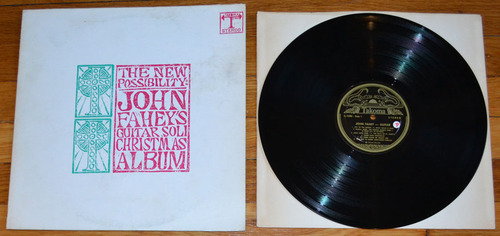
John Fahey died in 2001, but people are still getting introduced to his music. That’s how it is with Fahey: you feel you are still being introduced to him, and through him to the music that fascinated him, even if you’ve known his music, as I have, for (yikes!) more than thirty years.
This piece from the Guardian is an ideal introduction — stuffed with links, audio, video, and photographs. Here’s the author’s own summation, but the whole is worth reading word for word:
John Fahey made music without words on a six-string guitar, music so brimful of ideas and invention, so steady and sure-footed, that it seems to evoke the entire history of popular music, and yet suggest some place beyond it, a place both real and mythical, timeless and resonant. He once described his gift as a mixture of “divine inspiration and an open subconscious”. It was, and remains, transportative: a whole wide world evoked though six steel strings and a teeming imagination.
Another ideal introduction: Fahey’s Christmas record, The New Possibility.
And there’s an extraordinary recollection of one guitarist’s correspondence course with Fahey in Fretboard Journal.
And yet Richard Thompson — who can play circles around any folk guitarist of the era — confesses that "I never quite got John Fahey."
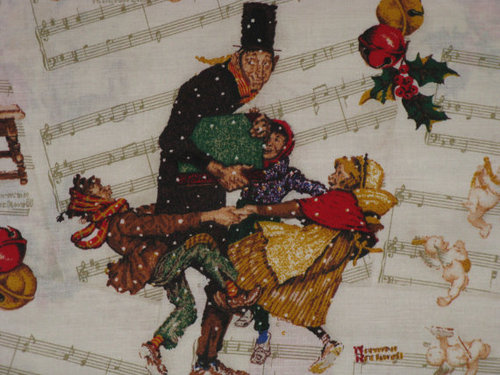
Don’t know about you, but I had no idea that the Hallmark Cards empire had a namesake founder, Mr. Joyce C. Hall of Kansas City. Or that Hallmark, far from dumbing down a traditional Christmas card market with its casual greeting cards, actually was among the first companies — can this be? — to produce Christmas cards with reproductions of great works of art on them.
Or that Hall – Deborah Solomon reports in a new biography – used this practice to woo Norman Rockwell:
Hall had brought Rockwell out to Kansas City to help garner publicity for a new project. In contrast to his usual greeting cards, most of which featured pastel-colored roses and pansies drawn by staff artists, he was inaugurating a deluxe line of cards known as the Hallmark Gallery Artists Group. Rockwell agreed to create four humorous paintings in time for Christmas, the most popular of which would show Santa Claus snoozing on the job as his staff of crafty elves took over for him. His cards, according to Hallmark ads, put Rockwell in the company of Leonardo, Michelangelo, and other artists tapped for the series. YULE CARDS TO DISPLAY GREAT ART, trumpeted a headline in The Washington Post, which explained that the project was “designed to bring fine art into the American home” for prices starting at ten cents.
It’s been said that Hall was the first person to put famous art on Christmas cards, but that is incorrect. The National Gallery of Art in Washington, for instance, was already selling a good number of radiant Madonnas by Raphael or Fra Filippo Lippi every December. What set Hall apart, by his own admission, was that he understood the possibilities that inhered in display fixtures. He credited his success to his patented “Eye-Vision” contraption, a walnut rack that allowed stationery shops to display his greeting cards standing up, or rather tilted at a natural reading angle, instead of lying flat on countertops or concealed in a drawer.
For the first week of Advent I went to the 6 p.m. Mass at the Oratory: locked bike, switched off taillight, doffed reflective vest, strode semi-purposefully up steps, and went from darkness into light.
The hour made all the difference. Most of what happens to me that can credibly be called religious happens at night. And that’s all the more true in Advent, a season characterized by imagery of people in darkness waiting for the light and then seeing a great light, etc. etc.
This week, one of the hymns was “Creator of the Stars of Night.” The fine print indicated that the text is from the ninth century. Sources on the web place it two centuries earlier than that. It is old, in any case; and as we sung it, I was moved, in the simplest, surest way, by the thought that believing people have sung that song of expectation on dark nights for twelve hundred years or more.
They waited then. I wait now. In a sense – a sense that makes sense to me – we wait together.
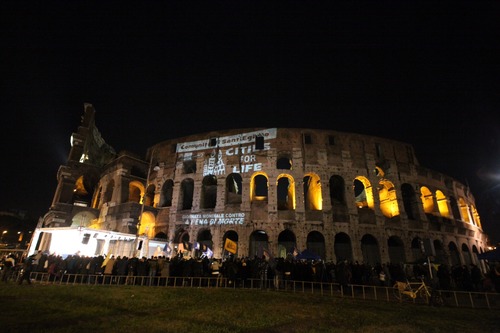
I tried to picture settings from twelve hundred years ago where this hymn might have been sung. I pictured a cave-church in Syria. I pictured a blocky stone church in Iona. I pictured San Clemente in Rome. And then I pictured the Colosseum in Rome – because my friend Rinaldo Piazzoni from the Community of Sant’Egidio had just sent me a photograph of the Colosseum lit up at night – the previous night, November 30 – to mark Cities for Life / Cities Against the Death Penalty.
Every November 30 is a World Day Against the Death Penalty, and the Community of Sant’Egidio has made this “againstness” manifest by persuading cities and states to declare their opposition to the death penalty and then lighting up the Colosseum, historic site of capital punishment – the Christians thrown to the lions – in recognition of this.
Twelve hundred years ago the Colosseum was there, bystanding in Advent. Now it is lit up, a circle of light set against the darkness, a star of night.