by Paul Eliefrom Georgetown University
Mandela Came to the Neighborhood
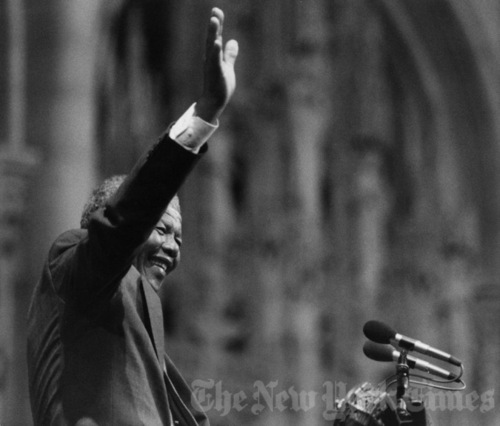
Nelson Mandela’s death makes so many of us feel that we have something to say. It’s a good, pure impulse – the impulse to pay tribute, to testify, to recognize a person “profoundly good” (as President Obama put it) whose like won’t come again. And yet it makes us feel, too, how little there is to say that isn’t inadequate.
So instead of trying to say something new I’m going to interrogate a piece of writing of mine, published in a book called Martyrs some years ago, about the day Nelson Mandela came to to the neighborhood.
“One morning in June 1990 I left my apartment to get a Pepsi, and walked into the new South Africa.”
So far, so good.
“I was a graduate student at Columbia University, and I lived in a neighborhood near the campus that might be called a religious ghetto. Union Theological Seminary and Jewish Theological Seminary face each other across Broadway, and Corpus Christi Church is shoehorned between apartment houses on West 121st Street; behind Union are Riverside Church, its tower looming overhead like a displaced part of Chartres, and the Inter-Church Center, a concrete-and-glass building known (this is what passes for humor among divinity students) as the God Box.
“It is a neighborhood where, perhaps more than anywhere else in Manhattan, religion is still seen and felt to be a going concern. That day it was the setting for the greatest local religious event since the Rev. Dr. Martin Luther King Jr. preached at Riverside Church in 1962. After serving twenty-seven years in a South African prison for his opposition to apartheid, Nelson Mandela had come to New York, free at last.”
And I was busy? What was I doing that day that was so important that I couldn’t pause for a few hours and rubberneck on the street – the street where I lived – to see Nelson Mandela? Writing, editing, working, moping? It couldn’t have been that important, could it?
Mandela was in the neighborhood, and I got a can of soda and went back to my little life. It was a mistake, and one I hope I wouldn’t make today.
And yet his visit to the neighborhood made a strong enough impression that I put it into a polished piece of writing. Maybe it was better to be honest about my own matter-of-factness toward Mandela than to bend the knee to the zeitgeist.
“That morning he would be meeting with American religious leaders at Riverside Church. The neighborhood had been transformed in anticipation. Television crews had laid down their cables, the police their sawhorses. Several thousand people, most of them African Americans, had gathered outside the church, wearing dashikis and robes embroidered with kinte cloth, or T-shirts screened with images of Mandela and the African continent.
“I wandered through the crowd, sipping my soda. I was used to seeing Africa celebrated in the neighborhood. On summer Wednesday evenings a festival of African crafts, food, music and the like is held at Grant’s Tomb, just north of the church. What struck me as odd was that this African feast had a Christian dimension as well as a civic and cultural one. I couldn’t remember a time when I’d seen Christianity so closely linked with unfolding world events. It was powerful, and it was nervous-making. I found myself slipping into the role of devil’s advocate.”
Uh-oh, here it comes. My younger self is going to quibble over the fact that Mandela was getting a hero’s welcome at the church even though he wasn’t a Christian believer.
“Mandela wasn’t a Christian, was he? Not so far as I knew. And wasn’t there something opportunistic in the welcome the church people were giving him? Sure, in recent years the mainline Protestant churches had publicly opposed apartheid, and as churches go, the nondenominational and racially diverse Riverside Church was an ideal place to honor Mandela. But I couldn’t suppress the thought that the event and all its trappings were one more instance of progressive Christians trying to get on the right side of history …”
So they were, and so they did.
When I read the passage now I think that they were right to get on the right side of history, and that I was right to question it.
You can’t get far in the life of religious belief without saying to yourself: If these beliefs are so important, why is it that unimpeachably great figures of the age like Nelson Mandela – holy figures – don’t go along with them? Why is it that, so often, believers are bystanders to the right side of history, when they are not actually opposed to it?
It’s a mystery, and a quandary.
Nelson Mandela’s life made clear that there really is a right side of history. That much is clear; that much is not at all mysterious. And if there is a right side of history, where else should we strive to be than there – even if we go there partially, and belatedly, bringing our own people’s mysteries and quandaries, the way he brought his?