
by Paul Eliefrom Georgetown University
Calling All Hospitallers
"In Maltese, the word for `thank you’ comes from Italian, the word for `please’ comes from Arabic, and the word for `hello’ is `hello.’"
So says a resident of the tiny archipelago of Malta, south of Sicily.
Malta (this long and sumptuously illustrated travel piece reports) is positioning itself as a place where Europe, Arabia, and Africa meet. So they did meet for much of the last millennium, through crusades and holy wars and the adventures of the men made members of the Sovereign Hospitaller Order of the Knights of St. John of Jerusalem, a k a the Knights of Malta.
Now the place is peaceable, cappuccini are drawn there, and the Knights are devoted to charity and the service of the poor. But the sun still shines and the old buildings remain, better preserved and less crowded than their counterparts to the north — and many of them sport wooden balconies that give an idea of what the southern Italian immigrants who built San Francisco had in mind.
Take a look at the photographs: they’re enough to make you want to be a Knight of Malta.
Blessed Are the Peacemakers — If Peacemakers There Are
Peace-deficient planet Earth lost several peacemakers already this month. Nelson Mandela, needless to say. And Alec Reid, and Paul Mayer.
Alec Reid was a Redemptorist priest in Northern Ireland; as the go-between for Gerry Adams (head of the Irish Republican Army’s military wing) and the British and Irish governments, he was the “most important person in the entire peace process, bar none.”
Father Reid was virtually unknown to the wider public until 1988, when he was captured in a photograph kneeling over the bloodied, spread-eagled corpse of a British soldier whom he had tried but failed to save minutes earlier from execution by the Irish Republican Army. It remains one of the most haunting images of “the Troubles,” the violent struggle that tore at Northern Ireland for three decades.
Paul Mayer was one of the circle of peacemakers — controversial of both ends and means — who gathered around Daniel and Philip Berrigan in the late sixties. Born a Jew, he became a Catholic (and a devotee of Thomas Merton), then a Benedictine brother, then a priest — and then a husband and a father, all the while insisting that, in the life of the spirit, at least, he remained a Jew and a priest.
He marched from Selma to Montgomery in 1965; he was arrested with Occupy Wall Street in 2011. Occupy’s website tells of his role in communicating the story of the Wilmington Ten, civil-rights activists who were convicted of arson in North Carolina in 1971 after a racially charged trial — and then were pardoned earlier this year.
Did Mayer & Co. bring peace, or the sword? Reasonable people can disagree, and many have.
Until these two men died, I’d hardly heard of either of them. That says something, I think, about the attention our society pays to peacemakers.
Here’s hoping there’s a fresh generation of peacemakers doing work that will get the attention of the obituarists, if nobody else.
Angels, Not Strangers
Every arts group that has ever sought a grant has produced a mission statement, and often enough these are written in the Hegelian register of the lofty-abstruse.
But the mission statement of the Compagnia de’ Colombari is a fairly matter-of-fact account of what this company is and does:
Company Colombari is a collective of performing artists that generates theatre in surprising places. Colombari intentionally clashes cultures, traditions and art forms to bring fresh interpretation to the written word — old and new …
Colombari believes that every public place holds the potential to be a space for the sacred architecture of theater. Colombari commits to using any means possible to flesh out the written word and making it heard and deeply felt.
Colombari’s sacred architecture of theater took shape Saturday afternoon on the patio and portico of the Museum of the City of New York on Upper Fifth Avenue. The work being “theatered” (the word is mine this time) was Strangers and Other Angels, their “re-imagining of the medieval mystery plays.” Some years ago the company theatered this work in the streets of Orvieto, an ancient Etruscan city not far from Rome; and to see it unfold along Central Park, with the city buses lumbering past, was to feel New York and Orvieto and Rome all joined the way Langston Hughes, the evangelists, St. John of the Cross, and the internet creators of “What Does the Fox Say?” were all joined in the performance — and the way angels and urban mortals were joined by music, movement, and Shakespeare-accented spoken word.
Asked midway through just what was going on, I spontaneously answered: “Oh, it’s an annunciation piece — a series of annunciations set alongside one another and strung together.”
I hope that was answer enough.
Karin Coonrod exercises her imagination through the company, and she and they will be coming to Georgetown in the spring. More soon.
Freedom Is Not Immaculate
"Whoever made the Feast of the Immaculate Conception the patronal feast of the United States understood America.
"The dogma that Mary from the moment of conception was free from the stain of original sin invites reflection on that central theme of American history: what it means to be free."
That’s not Garry Wills, or Isaac Hecker, or Alexis de Tocqueville. That’s Paul Rourke, chaplain at the Georgetown University Law Center, and his short reflection on the feast — which falls today — is itself a feast of insight: a few points, surprising at first, that, once made, seem incontestable.
Americans historically have conceived freedom as “freedom from” — whether the outlaw in the West or the Tea Party in the Capitol. But the biblical tradition that came to bear on Mary is a “freedom for” — for family, for community, for the larger society, for a vision of justice global and eternal in scope — and the Immaculate Conception is a feast “for all who seek freedom in, through, and for love.”
The university’s Advent daily e-mail goes to people in the Georgetown community — something like five thousand of us — who have asked to get it by ticking a box. It shows up, and it does its work, straight through till Christmas.
That vintage postcard shows the shrine to Mary Help of Christians overlooking Friess Lake in Wisconsin.
Humility and Simplicity, for Starters
In his forthcoming memoir Tim Shriver tells the story of how Nelson Mandela — at the height of his world fame and influence — made common cause with the Special Olympics movement, recognizing that the enforced “apartness” of people with intellectual disabilities was akin to apartheid.
The other day Tim told the story in brief on the Special Olympics website, and in a rhetorically apt touch he addressed the story not to the press or the general public but to Special Olympics athletes — whose story it is:
Beginning in 2001, Nelson Mandela became an outspoken champion of the Special Olympics movement and of your cause, athletes. He came to Robben Island for Special Olympics and lit our torch, the Flame of Hope, with Ricardo Thornton who, like him, had been imprisoned unjustly — in an institution in the United States. He traveled to Dublin to celebrate the Special Olympics World Games, where he was introduced by Bono and U2 as “The President of everyone who loves and fights for freedom.” He cheered you, athletes, and talked to our youth leaders and said, “You, the athletes, are ambassadors of the greatness of humankind. Your achievements remind us of the potential to greatness that resides in every one of us.” When he celebrated his birthday in 2004, he dedicated the entire day to Special Olympics athletes who came by the thousands to Polokwane where he blew out candles on a huge cake and cheered for the athletes saying, “Amandla Awethu” which means “power to the people,” a phrased used in rallies across South Africa against the apartheid regime.
What, Tim asked Mandela, was the secret of his leadership?
“In prison, I learned humility and simplicity,” Mandela explained, and went on:
That’s what the athletes of Special Olympics are teaching the world, Tim. Humility and Simplicity. These are the gifts that are most important if we are to achieve a more inclusive world.”
The conventional wisdom is that globalization is making the world smaller — but people like Nelson Mandela and movements like the Special Olympics are making the world larger: more inclusive, more personal, more open, more attuned to affairs of the heart.
Our Kind of Spirituals, No. 13: Thomas Mapfumo and Blacks Unlimited, “Corruption”
This classic piece of Afropop from Zimbabwe — northern neighbor to South Africa — has been on my playlist all fall, and its lilting rhythm and soft-spoken vocal gained a new poignancy with the death of Nelson Mandela earlier this week.
"In the streets there’s there’s corruption / Everywhere there’s corruption / Something for something / Nothing for nothing/ Corruption … throughout the society …" So it is, and not just in southern Africa, obviously: but the corruption epitomized by Robert Mugabe is a phenomenon that Nelson Mandela somehow heroically and miraculously managed to avoid.
"Come what may / It ain’t gonna change," Mapfumo sang. That was 1989. A few months later, a little to the south, something did change.
As it happens, another African leader died this week: Tabu Ley Rochereau, a soukous bandleader, self-exiled from Zaire, who later entered Parliament in the country’s new life as Democratic Republic of Congo. His story is told briefly here.
Out to Eat
 What’s something you do several times a day, every day, sometimes at the office, sometimes at a restaurant or cafe, sometimes on the go, but most often at home?
Eating a meal, yes. And logging onto the Internet from a full-featured computer.
The Internet connection and wireless network are down in our apartment for the first time in more than a year — and for the first time since I started posting pieces to Everything That Rises two or three times a day.
Sure, it’s possible to check email and do simple searches via smartphone and AT&T. But posting pieces to the web — written pieces, not links or tips — takes a computer and an Internet connection, even if the author of a recent full-length book about Lucian Freud wrote it on his BlackBerry.
So getting onto the web means going out. And it feels like eating out: a change, and not a bad one, you wouldn’t want to do it all the time.
I expect to have breakfast out tomorrow, but hope to lunch at home.
Shoe Leather Circa 2013
Sheri Fink’s Five Days at Memorial: Life and Death at a Storm-Ravaged Hospital – the hospital in New Orleans, commonly known as “Baptist,” that bore the brunt of Hurricane Katrina – is being named as one of the year’s best books. The author certainly deserves an A for effort: the Note to the Reader at the back of the book is a tour d’horizon of narrative journalism and what it requires today.
There are interviews to conduct:
As I was not at the hospital to witness the events, sources include more than 500 interviews with hundreds of people: doctors, nurses, staff members, hospital executives, patients, family members, government officials, ethicists, attorneys, researchers, and others.
There are documents to find, sort, read, and appraise:
Because memories often fade and change, source materials dating from the time of the disaster and its immediate aftermath were particularly valuable, including photographs, videotapes, e-mails, notes, diaries, Internet postings, articles, and the transcripts of interviews by other reporters and investigators. The narrative was also informed by weather reports, architectural floor plans, electrical diagrams, and reports prepared by plaintiff and defense experts in the course of civil litigation; and I visited the hospital and other sites depicted in the story.
And at every points, there moral decisions to be made:
This book relates the thoughts, impressions, and opinions of the people in it, perhaps the most fraught aspect of narrative journalism. Attributed thoughts or feelings reflect those that a person shared in an interview, wrote down in notes, a diary, or a manuscript, or, less commonly, expressed to others whom I interviewed. As any book reflects the interwoven interpretations and insights of its author, I have tried to make these distinct and to note in the Notes any possible areas of confusion between what is my perspective and what was the perspective of someone involved in the events.
Narrative journalism isn’t rocket science. It’s more complicated than that.
Madiba Is Dead, but Audio Is Forever
- A lost recording of the 1964 trial that resulted in Mandela’s life sentence
- A secret tape of a visit between Mandela and his family on Robben Island, saved for more than two decades by a prison guard
- Marching songs of guerrilla soldiers
- Government propaganda films
- Pirate radio broadcasts from the African National Congress
- First-person accounts from former ANC activists, National Party politicians, army generals, Robben Island prisoners, and ordinary witnesses to history. A range of voices from Desmond Tutu to former President F.W. de Klerk to Nelson Mandela himself
No, this isn’t a producer’s list of source materials for the imminent movie adaptation of Long Walk to Freedom, Nelson Mandela’s autobiography. It’s a partial list of the audio and other recordings featured in Radio Diaries’ Mandela: An Audio History, which aired in five parts on NPR ten years ago and is online at radiodiaries.org.
This is how to spend a part of this evening.
Mandela Came to the Neighborhood
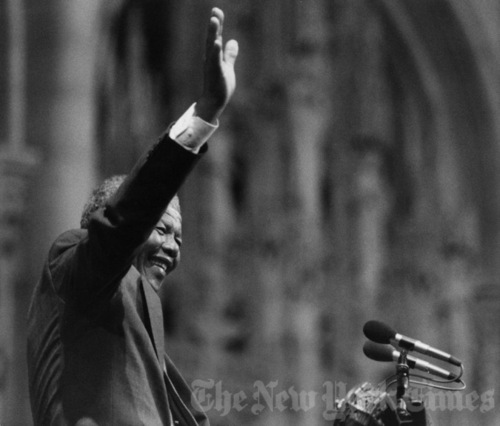
Nelson Mandela’s death makes so many of us feel that we have something to say. It’s a good, pure impulse – the impulse to pay tribute, to testify, to recognize a person “profoundly good” (as President Obama put it) whose like won’t come again. And yet it makes us feel, too, how little there is to say that isn’t inadequate.
So instead of trying to say something new I’m going to interrogate a piece of writing of mine, published in a book called Martyrs some years ago, about the day Nelson Mandela came to to the neighborhood.
“One morning in June 1990 I left my apartment to get a Pepsi, and walked into the new South Africa.”
So far, so good.
“I was a graduate student at Columbia University, and I lived in a neighborhood near the campus that might be called a religious ghetto. Union Theological Seminary and Jewish Theological Seminary face each other across Broadway, and Corpus Christi Church is shoehorned between apartment houses on West 121st Street; behind Union are Riverside Church, its tower looming overhead like a displaced part of Chartres, and the Inter-Church Center, a concrete-and-glass building known (this is what passes for humor among divinity students) as the God Box.
“It is a neighborhood where, perhaps more than anywhere else in Manhattan, religion is still seen and felt to be a going concern. That day it was the setting for the greatest local religious event since the Rev. Dr. Martin Luther King Jr. preached at Riverside Church in 1962. After serving twenty-seven years in a South African prison for his opposition to apartheid, Nelson Mandela had come to New York, free at last.”
And I was busy? What was I doing that day that was so important that I couldn’t pause for a few hours and rubberneck on the street – the street where I lived – to see Nelson Mandela? Writing, editing, working, moping? It couldn’t have been that important, could it?
Mandela was in the neighborhood, and I got a can of soda and went back to my little life. It was a mistake, and one I hope I wouldn’t make today.
And yet his visit to the neighborhood made a strong enough impression that I put it into a polished piece of writing. Maybe it was better to be honest about my own matter-of-factness toward Mandela than to bend the knee to the zeitgeist.
“That morning he would be meeting with American religious leaders at Riverside Church. The neighborhood had been transformed in anticipation. Television crews had laid down their cables, the police their sawhorses. Several thousand people, most of them African Americans, had gathered outside the church, wearing dashikis and robes embroidered with kinte cloth, or T-shirts screened with images of Mandela and the African continent.
“I wandered through the crowd, sipping my soda. I was used to seeing Africa celebrated in the neighborhood. On summer Wednesday evenings a festival of African crafts, food, music and the like is held at Grant’s Tomb, just north of the church. What struck me as odd was that this African feast had a Christian dimension as well as a civic and cultural one. I couldn’t remember a time when I’d seen Christianity so closely linked with unfolding world events. It was powerful, and it was nervous-making. I found myself slipping into the role of devil’s advocate.”
Uh-oh, here it comes. My younger self is going to quibble over the fact that Mandela was getting a hero’s welcome at the church even though he wasn’t a Christian believer.
“Mandela wasn’t a Christian, was he? Not so far as I knew. And wasn’t there something opportunistic in the welcome the church people were giving him? Sure, in recent years the mainline Protestant churches had publicly opposed apartheid, and as churches go, the nondenominational and racially diverse Riverside Church was an ideal place to honor Mandela. But I couldn’t suppress the thought that the event and all its trappings were one more instance of progressive Christians trying to get on the right side of history …”
So they were, and so they did.
When I read the passage now I think that they were right to get on the right side of history, and that I was right to question it.
You can’t get far in the life of religious belief without saying to yourself: If these beliefs are so important, why is it that unimpeachably great figures of the age like Nelson Mandela – holy figures – don’t go along with them? Why is it that, so often, believers are bystanders to the right side of history, when they are not actually opposed to it?
It’s a mystery, and a quandary.
Nelson Mandela’s life made clear that there really is a right side of history. That much is clear; that much is not at all mysterious. And if there is a right side of history, where else should we strive to be than there – even if we go there partially, and belatedly, bringing our own people’s mysteries and quandaries, the way he brought his?