
by Paul Eliefrom Georgetown University
Into the Wild of Yellowstone Park with Tor Seidler (and an Expert Guide)
One book-reviewing school of thought holds that the review should tell the reader whether the book is worth reading. Another holds that the review should make the reader feel one way or another that she has read the book: with so many books written, and published, and reviewed, 49 times out of 50 the reader’s encounter with the book will begin and end with the review – so the book review that approximates an encounter with the book itself is something like a work of art in its own right.
All this came to mind as I read, with loving attention, the review of Tor Seidler’s new novel, Firstborn, in yesterday’s Times Book Review. It’s a book review from the latter school: it puts the book’s characters (a magpie and some wolves), setting (Yellowstone Park), and situation (wolves and bird coexist authentically if uneasily) deftly into the small space of the book review (the front page of the Children’s Books section) – so deftly that, reading it, I feel confident that I am getting acquainted with the book as it actually is.
With loving attention, reader, because I am married to the review’s author: Lenora Todaro, who edited the Voice Literary Supplement when it was robust, and who has written for the Times and Salon and Bookforum since then, fitting in writing around homeschooling with our three sons in Brooklyn.
That’s the context for this rave review of a review. Here (from Lenora’s review) is the context for the book:
“Firstborn” is dedicated to Jean Craighead George (1919-2012), the great naturalist writer for young readers who Seidler says introduced him to Yellowstone’s wolf life. George’s magnificent “Julie of the Wolves,” the 1973 Newbery Medal winner, tracks an Eskimo girl lost in the Alaskan tundra who survives by mimicking the ways of a wolf. But where George developed human characters who use their knowledge of nature alongside the animals they love, Seidler creates animal characters who have humanlike consciences. And where George made the Alaskan tundra as tangible as her Julie, Seidler uses Yellowstone’s sulfurous hot springs and bubbling caldrons mainly as a stage for the action. He’s a storyteller first, not a naturalist, and at times “Firstborn” strains under the weight of homage.
There in a few sentences we see an arc drawn across forty years of writing for young readers and Seidler placed at our end of it.
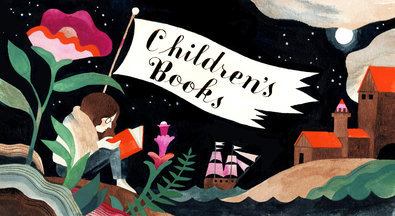
As this review shows, good book reviewing is an art. Clearly the Times thinks so: the editors ingeniously commissioned an illustration by Carson Ellis, who has collaborated with her husband, Colin Meloy, leader of the Decembrists, on Wildwood and other books.
Here’s hoping Lenora and I get a chance to collaborate soon.