
by Paul Eliefrom Georgetown University
Amtrak’s Secret: It Works
Amtrak regional train 188 is “my train.” I am one of the many thousands of people who take Amtrak regularly from New York to Washington and back, and I have taken the 7:10 regional train out of Washington dozens of times. On Thursday – after three eventful days at Georgetown – I returned to New York by Greyhound instead, and the experience underscored what most of us Amtrak regulars know, even if we rarely acknowledge it: that Amtrak’s Northeast Corridor system generally works very well, and that we couldn’t imagine our working lives without it.
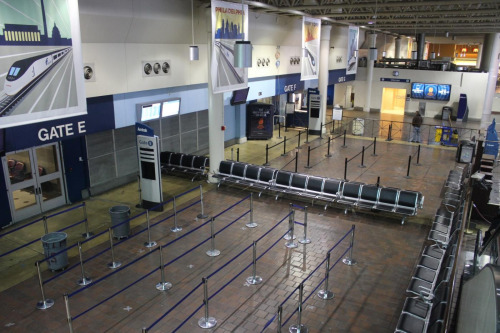
Facing competition from Megabus, Boltbus and other low-cost carriers, Greyhound now runs new, clean buses, with more legroom, leatherish seats, and functioning wi-fi. From Washington, buses depart from Union Station, up an escalator from Amtrak’s platforms, and on a pleasant day like yesterday, waiting there, under a roof but in the open air, is more civilized than waiting for Amtrak downstairs.
And yet Greyhound is still Greyhound. Buses for New York were scheduled to depart at 8:30 and 10 a.m. As the 8:30 bus was delayed, passengers for the two buses formed a single bloblike queue. The staff seemed to know little more than the passengers, who quarreled with the staff and one another. The 8:30 bus finally pulled in more than an hour late, at 9:40 – ten minutes after the 10 o'clock bus pulled in. So passengers with tickets for the later bus (I was one) boarded and departed earlier. But the bus wasn’t on time for long. Due in New York at 3:30 – after a five-hour journey with stops in Baltimore; Mt. Laurel, N.J.; and Newark – the bus lingered in Baltimore and wound up arriving at 4:30, more than an hour late, and eight hours after I’d arrived at Union Station in the first place. And although the bus was new and clean, the ride is still an essentially captive experience, with no stop for a snack or a stretch of the legs.
By contrast, trains on Amtrak’s regional service – such as wrecked train 188 – make the trip in about three and a half hours. In my experience, trains that run in the daytime are on time 14 times out of 15; only the late-night trains seem regularly to run into long delays. The regional trains are swift and reliable enough that those of us who sometimes take the high-speed Acela (2 hours 50 minutes from New York to Washington) routinely calculate whether it’s worth paying the much higher fare for the high-speed train when the regional train will take only 35 or 40 minutes more to get there. And in some ways the regional train is preferable to the Acela, with better colors and lighting, full tables in the cafe car, and a little more room in the aisle for those of us who like to amble during the ride.
When Amtrak is safe, it works, and its speed and comfort are a privilege. It’s not cheap; and its relative efficiency likely comes at the cost of safety, too. It’s likely that those regional trains run on time – or ahead of time, to the delight of passengers – because engineers exceed the speed limit. According to a notice that popped up when I Googled “Amtrak train 188” a few minutes after Tuesday’s crash, train 188 was delayed 15 to 18 minutes out of Washington that evening due to a mechanical problem. Maybe the “mechanical problem” was on the tracks north of Philadelphia. Or maybe the engineer was speeding to make up the lost time.
I hope some other writer is looking into it. Meanwhile, I expect to ride “my train” 188 dozens of times in the years to come.
“Like a Mantra, It Greases the Brain”
That’s one writer’s explanation of why she likes writing on Amtrak, which is now experimenting with a writer-in-residence program – which might better be called writer-in-transit. The Paris Review (no surprise) got there first. A few reasons of my own:
The Acela café car is the proverbial clean, well-lighted place – and one with Chesapeake Bay or Long Island Sound out the window.
The café car on the regional train still has booths, done away with in so many restaurants.
You might espy Malcolm Gladwell (happened, last October) or E.L. Doctorow (November).
The poor Wi-fi signal quality on Amtrak is a stimulus: why tap out emails or crawl the internet when you can write, really write?
When you are done, you can disembark – debark – detrain into city life.
I’ll never forget writing this scene involving Thomas Merton and the Long Island Railroad (incorporated into my first book) on an Amtrak train bound for Washington (and a backyard book party) in 1999:
He saw The Spirit of Medieval Philosophy in the window of the Scribner’s bookshop on Fifth Avenue while browsing after class “with ten or twenty dollars burning a hole in my pocket.” On a whim, he bought it. Though it was in English, the author, Etienne Gilson, the dust jacket reported, was a professor from the Sorbonne.
On the train back to Long Island he opened the book and spied some odd Latin text on an early page: black cross, a Latin inscription – Nihil Obstat. Imprimatur – and below it, a bishop’s name, printed like a signature.
He knew what the Latin meant: Nothing stands in the way; officially stamped. “I felt as though I’d been cheated! They should have warned me that it was a Catholic book! Then I never would have bought it. As it was, I was tempted to throw the thing out the window at the houses of Woodside – to get rid of it as dangerous and unclean.” …
He didn’t throw The Spirit of Medieval Philosophy out the window, however. He started to read it. When the train reached his stop, he took it with him.