
by Paul Eliefrom Georgetown University
Walter Isaacson Returns to the Group
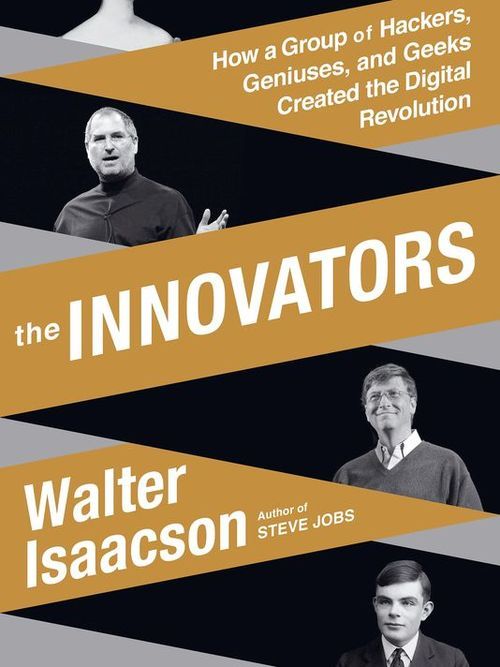
Walter Isaacson’s The Innovators is here, and it is good – and it is on the nonfiction longlist for the National Book Awards.
I hope to post several pieces about the book, not least because its theme – the role of collaboration in innovation, and the role of technology in sponsoring such collaboration – runs right through Reinventing Bach.
Today – with the finished book fresh from the mail – I am thinking about its cover. The bound proofs sported a plain white cover with the title and the author’s name in color against a field of dot-composed letters meant to suggest the early days of computing. The finished book sports a cover, richly enfoiled, which incorporates photographs of some of the protagonists within a helix of sorts.
It’s a significant change, and not just because of the foil. It suggests the act of reinvention that the book spells for Isaacson – and suggests the challenge of representing the act of collaboration in the marketplace.
Isaacson – Jacob Silverman puts it sardonically in a Bookforum essay – is “America’s leading chronicler of Great Men.” It’s true, but that doesn’t give anything like full credit to the man. Isaacson learned physics to write Albert Einstein. He learned about computers and Silicon Valley digital culture to write Steve Jobs. For the new book, he boned up on the often recondite histories of the complex machines and mathematical operations that led to the personal computing revolution beginning in the late Seventies.
It’s impressive, and the fact of it conceals something else he has learned, or learned again: namely, the art of group portraiture. Since he wrote The Wise Men: Six Friends and the World They Made with Evan Thomas in the mid-Eighties, a vast – and innovative – body of group portraiture has emerged: R.W.B. Lewis’s The James Family and Rachel Cohen’s A Chance Meeting in literature, Louis Menand’s The Metaphysical Club in philosophy, David Hajdu’s Positively 4th Street and my Bach book in music, and Jenny Uglow’s The Lunar Men and Richard Holmes's The Age of Wonder in science. In my view, this literature has been to biography what the iPod was to digital music: a game-changer. It suggests that group portraiture is the way forward for the biographically inclined.
It seems natural and necessary that Isaacson should tell the story of “the innovators” as one story. (But if it was so natural, why didn’t anybody do it before him?) And Isaacson’s return to group portraiture also suggests just how consequential the rise of group portraiture has been. For many subjects, the group portrait is now the default option.
It’s also significant because group portraits are generally harder to publish – harder to sell, that is – than straight biographies. And that’s because our expectations for biography, like our expectations for innovation, have primed us to look to great individuals, rather than groups or people joined by what Edmund Wilson, quoting Melville, characterized as “the shock of recognition” that “runs the whole circle round.”
Here’s hoping that, in the way of innovation, Isaacson’s group portrait calls forth others.
 blithbarn liked this
  cfcasper liked this
  etr-gu posted this