
by Paul Eliefrom Georgetown University
Thank You, Mary Stewart
Certain authors leave us feeling not admiration or devotion so much as gratitude – gratitude for the time we spent, the peak experiences we had, with the books they wrote.
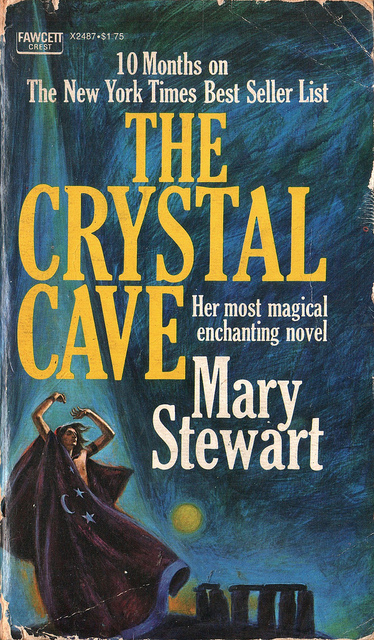
For me, Mary Stewart was such an author. She died yesterday in Scotland, where she lived, age 97. But the memory of her novel The Crystal Cave, and my time with it, grows more vivid as I get older.
She described the phenomenon – of childhood memories growing more vivid and intense with time – in the opening pages. At the end of his life Merlin – the Merlin of Arthurian legend – is telling the story of his own coming of age, and he finds that
… the recent past is misted, while distant scenes of memory are clear and brightly coloured. Even the scenes of my childhood come back to me now sharp and high-coloured and edged with brightness, like the pattern of a fruit tree against a white wall, or banners in sunlight against a sky of storm.
The colours are brighter than they were, of that I am sure. The memories that come back to me here in the dark are seen with the new young eyes of childhood …
I have such a memory of reading the novel: not of sitting on the couch in our home in upstate New York and turning its pages (which I frankly don’t remember), but of being in the novel – in the world of ancient Britain and kings and queens and sorcerers and magic. It is a world deep-dyed with color, like a tapestry, which probably was just the effect that Stewart intended (see the triple repetition of “coloured” and “colours” in the short passage quoted above). And I can remember feeling, as if for the first time, the power of a writer to make things half-familiar and half-understood suddenly alive and real and actual through the imagination – to make a world out of words.
In our time, the literature presented to young people is strong on fantasy – with the Harry Potter series being only the most obvious example. For the young people in my apartment, historically inflected fantasy literature is the default option. Of course, plenty of people my own age (forty-eight) read such literature as young people – such as Adam Gopnik and Daniel Mendelsohn, whose New Yorker essays about Tolkien and Mary Renault represent two radically different reckonings with young male literary experience. My own reading tended to nonfiction – sports books, biographies, stories of city life – and so I suspect that The Crystal Cave was something like a first encounter with imaginative literature written for adults.
And it was probably something like a first encounter with old age. Colum McCann, in conversation at Georgetown earlier this month, proposed that literature makes possible a “radical empathy” among author, characters, and readers; and Merlin in the opening passage of The Crystal Cave invites the reader – in my case, the young adult reader – to feel radical empathy with a storyteller in old age:
I am an old man now, but then I was already past my prime when Arthur was crowned King. The years since then seem to me now more dim and faded than the earlier years, as if my life were a growing tree which burst to flower and leaf with him, and now has nothing more to do than yellow to the grave.
The author lived another forty-five years after writing that passage. Twenty-five years after I read it, I found myself in Powell’s, the Portland, Oregon, bookstore that has literally everything, new and used, and I left with The Crystal Cave in the same Fawcett Crest paperback edition I read as a teenager. I started rereading it this morning, figuring that now is the time to pass it on to the next generation.


