by Paul Eliefrom Georgetown University
Reading Joshua Ferris’s New Novel: Like Going to the Dentist?
The novelist’s only obligation is to be interesting, Henry James said. (James said it in his inimitable way: “The only obligation to which in advance we may hold a novel without incurring the accusation of being arbitrary, is that it be interesting.”) But is the novelist obligated to seem interesting? That is, does the novelist have to make a work that the reader – coming to it from the outside – actually wants to read? It’s not right to judge a book by its cover, but is it right to judge a book by its premise?
Whether or not it’s right to do so, we judge books by their premises all the time. I’d guess that premise-judging is the faculty of literary judgment we exercise most often. Richard Ford’s Independence Day had a premise – father and son take a road trip to sports halls of fame – that appealed to me, and the appeal was enhanced by the strong title and the memory of just how good The Sportswriter was; Ford’s The Lay of the Land had a premise – father welcomes son home for Thanksgiving as he deals with prostate cancer – that didn’t appeal, and the lack of appeal, already strong and then magnified by the off-putting cliché of the title, couldn’t be overcome by the memory of just how good The Sportswriter and Independence Day were. I tried reading the novel anyway, but stopped after the tedious New Jersey traffic-jam set-piece opening.
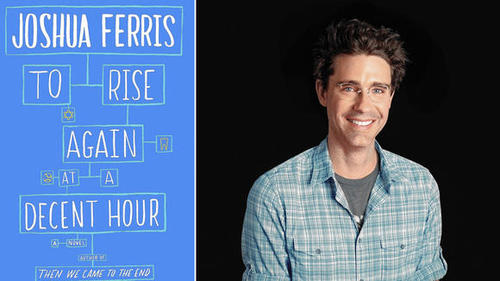
It’s the news of Joshua Ferris’s new novel that puts the question of premise-interestingness in mind. To Rise Again at a Decent Hour has the least appealing premise I’ve come across in a long time: Irish-surnamed Upper East Side dentist follows internet-identity trail into life of digital double who is obsessed with legacy of obscure Old Testament tribe. Now, I’m on record as a reader who is interested in contemporary fiction dealing with matters of belief – but that novel just doesn’t sound interesting, does it?
Early reviewers – doing their jobs – deal with the question of whether the novel manages to stir up some interest in spite of its premise. Ron Charles in the Washington Post compares reading it to going to the dentist, and judges it “a brilliant mess of a novel that drills at a raw nerve of existential dread.” David L. Ulin in the L.A. Times concludes that a big problem of plot and theme doesn’t “derail the book. How do we live in a world where God, where spirit, has forsaken us, if, indeed, it ever existed at all? How do we make meaning out of trivia, out of the detritus of desire? These questions drive both Paul and this curiously provocative novel, which seeks a reconciliation life cannot provide.” Sarah L. Courteau in the New Republic charitably hypothesizes that “in tackling the cornucopia of boring topics that comprise To Rise Again at a Decent Hour, Ferris hoped to set himself the ultimate challenge,” and then goes all uncharitable on him: “What would it take to get me to reread To Rise Again at a Decent Hour? You’d have to hold a gun to my head. No, I take it back. You’d have to pull the trigger.”
Myself, I found I was looking for interesting things outside the text of the reviews. The photographer who took the picture of Ferris in the LAT (and above) is named Beowulf Sheehan. The New Republic's Courteau is described in her little bio as “a writer living in the South Bronx.” The New Yorker's recent interview with Ferris (in connection with a short story, not the novel) asks him about “your last two stories for the magazine” – confirming the general suspicion that writers of fiction associated with the New Yorker write their work “for” the magazine, rather than writing their work “for” the sake of writing it and then sending it to the New Yorker's fiction editors in the hope that the magazine will publish it.
I not-so-eagerly await a James Wood New Yorker review of Ferris’s novel.
- lilyrm likes this
 danielsullivanburke likes this
 etr-gu posted this
