
by Paul Eliefrom Georgetown University
Two Americans, One Empty Tomb
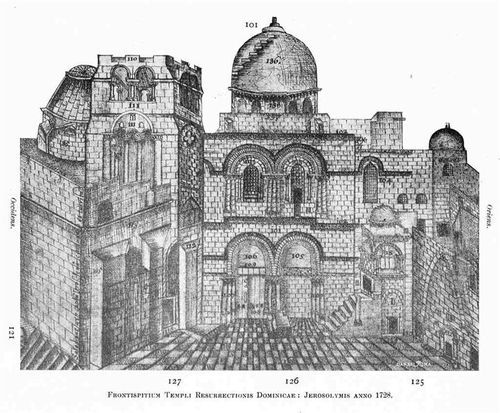
In two strong recent books American writers make the pilgrimage to the Church of the Holy Sepulchre. Here (from Darling) is Richard Rodriguez:
“I wait in line to enter the sepulchre, a freestanding chapel in the rotunda of the basilica. A mountain was chipped away from the burial cave, leaving only the cave. Later the cave was destroyed. What remains is the interior of the cave, which is nothing. The line advances slowly until, after two thousand years, it is my turn. I must lower my shoulders and bend my head; I must almost crawl to pass under the low opening.
“I am inside the idea of the tomb of Christ.”
Here (from Jesus: A Pilgrimage) is James Martin, SJ:
“The man in front of me kept checking his smartphone. Probably ignoring some code of pilgrim’s etiquette, I peeked over his shoulder to see what could be so important and half-expected him to be typing, “Can’t talk. In church where Jesus died. Call you in 5.” Instead, he was playing a video game …
“The appointed time came. As at the entrance to the Church of the Nativity, you must crouch to enter. Bending slightly, I walked in with a man and a woman. Before me was a pinkish gray stone, about waist high. On ledges around the stone, which also served as an altar, dozens of tapers burned brightly. Already I knew that besides reverencing this holy site, I would bypass asking the saints to pray for me to Jesus and go directly to Jesus himself. My mother was thinking of moving into a retirement community, and I prayed for that process to go well. “Make this happen, Lord,” I said. It was one of those times in prayer that I felt that I had really expressed myself, that I had been as clear as I could about this single intention.”
Easter is there. Easter is here.
The engraving, from 1728, is courtesy of Wikimedia Commons.
 debbergstrand liked this
  cfcasper liked this
  etr-gu posted this

