by Paul Eliefrom Georgetown University
A Missed Meeting in Rome
It must have been quite a weekend in Rome. Patti Smith was there, rehearsing for the Vatican Christmas concert. Georgetown’s president, John J. DeGioia, was there, with my Berkley Center colleagues Tom Banchoff and José Casanova, for a conference on the Jesuits and Globalization. And several dozen Nobel laureates were there, including the Dalai Lama.
That Pope Francis declined to meet privately with the Dalai Lama is already last weekend’s news. The reasons given – through Vatican Secretary of State Parolini – are unimpeachable: a meeting might lead Chinese officials to seek reprisal against the “free” Catholics in China, and it might clog up the opening for religious freedom that Francis and other religious leaders are trying to create in China.
But there is collateral damage from the Vatican’s decision —- in Europe, not in China.
Pankaj Mishra, in a recent column, argued that you don’t have to be religious to recognize the pope as the last man standing against the ever-stronger European regime of financiers and technocrats.
The pontiff represents an older European religious and ethical worldview that now finds most of its adherents outside the West: among people still striving for the political and financial stability achieved by a majority of Europeans. He finds himself ranged against a pitilessly Darwinian outlook in Europe itself, which, maintained by self-interested political and business elites, seems to go unexamined by apathetic voters and a largely acquiescent intelligentsia.
The legacy the Pope represents is that of a Europe whose character is prior to and deeper than modern politics and economics:
The Pope realizes that the heedless pursuit of private wealth has compromised rather than secured the freedom and dignity of human beings. He cannot but react against the secular cult of money and power, which reduces politics to some procedural aspects such as elections, depriving it of its moral and spiritual imperatives — those that modern democracy and liberalism inherited from the ideals of Christianity.
From this point of view, Francis should meet with the Dalai Lama precisely because political leaders in thrall to “the secular cult of money and power” consider it imprudent to do so. To fail to do so is to accept China’s definition of the Dalai Lama as a political leader only, and to diminish the pope to something like a political leader in the bargain. And it’s to make standing apart from the Dalai Lama the new normal.
Here’s hoping that somebody in Rome is arranging an event that Francis and the Dalai Lama – two religious leaders — could attend as guests.
Maybe Patti Smith could moderate.
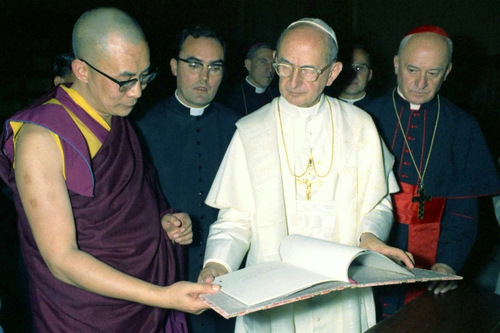
The photograph shows Pope Paul VI receiving the Dalai Lama at the Vatican, September 30, 1973.
 cfcasper likes this
 freelyfadingsublime likes this
 etr-gu posted this