
by Paul Eliefrom Georgetown University
Caffeine-Powered Literary Revival
It took nearly two hundred pieces posted here this fall — this one is number 196 — before a person in a position to know reminded me of a first principle of social media: use your site to point readers toward your work in other media.
I am lucky to have a number of pieces in other media just now, so I am going to be posting links to some of them in the days to come.
First up is an address at a conference on Walker Percy’s book Lost in the Cosmos, sponsored by the Walker Percy Center for Writing and Publishing at Loyola University in New Orleans. Video is here.
You can see in it how tired I was, which perhaps explains the exuberantly caffeinated answers I gave in an interview with Joseph O’Brien of Dappled Things just beforehand. The interview, artfully transcribed and introduced, is up on their site. A takeout:
DT: ”So taking our lead from Flannery O’Connor, what strategy ought the Catholic writer take in seeking to be published—and published widely?”
PE: ”Instead of making blanket assumptions about what is possible and what’s not, you get in there and try to figure out how to get it done. You have to be savvy about what the obstacles are to getting your work read, but you have to ignore the big blanket statements about what you can or can’t do. Truly, it wasn’t any easier for Catholic writers in the 1950s. For every better aspect then, there were also worse ones in the culture. You had more believing readers, possibly, but you also had a lot of teachers pushing pious pap on people. You had Cardinal Spellman writing a novel (one Flannery O’Connor thought `pretty short’); you had Madame Bovary on the Index; and on and on.
"You’re getting me on one of my soapboxes here, but I prefer to work at a more specific level — whether it’s in The Life You Save or the Times essay. I prefer to say; Let’s look at the works and the twenty ways in which religious belief figures into some recent novels. Instead of saying that this stuff doesn’t exist, I’ll work through twenty examples of how it does appear, and then wind up by saying, `OK, but still: the central religious experience isn’t there in the way I yearn for.’ So what do we do? We look to non-fiction, other countries’ authors. We keep hoping. And we try to make the work ourselves.”
Dappled Things is a lively website devoted to Catholic literature and its revival.
Always With Us — But Why?
"I immersed myself in the project, going out almost on a daily basis and walking five, six, seven hours a day," the artist explains. "Once, I even walked 12 hours around the city – uptown to Harlem, East and West, downtown to Battery Park and back home to the East Village. I never took transportation anywhere because I felt that since the homeless live on the streets, I had to walk the streets like they do. After a while, a few said to me, `I’ve heard of you. You’re the guy going around buying signs. I was wondering if you were ever going to find me.’"
The artist is Andres Serrano, whose large Cibachrome photograph of a crucifix immerse in urine gained him notoriety twenty years ago. The project is Sign of the Times, in which he sought out homeless people on the streets of New York and bought their hand-lettered cardboard signs from them. He usually paid the people $20. He posted a piece about the project on Creative Time Reports, a website ancillary of the artists’ collective Creative Time that “aims to publish dispatches that speak truth to power and upend traditional takes on current issues.”
Serrano, a native New Yorker, says he “had never seen so many people begging and sleeping on the streets” as he saw this fall. If true — and I suspect that it is — this is surprising and appalling.
It might be said that Sign of the Times is merely provocative, as was said of “Piss Christ.” (I thought otherwise. I found it very powerful and wrote this piece in Commonweal about it.) But what does it mean to say “merely” provocative? Provocation has its uses. Last week the Times ran a multipart essay, with photographs, about a girl who is homeless in my own neighborhood — Fort Greene, Brooklyn — but I haven’t gotten around to reading it or writing about it. Then here comes Serrano with his sign project and suddenly I am thinking and writing about homelessness.
In an age that we are told is an age of smartphones and bitcoin, the very constancy of the materials of homeless people’s signs — cardboard and magic marker — says otherwise. It reminds us that the circumstances of everyday life change less than the trendspotters tell us. It reminds us of how little the astonishing economic “development” of recent years has touched homeless people or developed the stock of affordable housing.
To be homeless is still to be homeless. The streets are still the streets. A sign is still a sign. And even if, as we have on good authority, the poor will always be with us, the human responses to poverty and homelessness must always begin in something as simple as a feeling about a cardboard sign — in the feeling of shame that Kwame Anthony Appiah points out is the basis of social conscience.
My friend Rosanne Haggerty has spent her adult life creating housing for people who have been homeless. I am going to write to her and ask her what she thinks of Sign of the Times.
Season of Desire
For anyone who has read deeply in Thomas Merton – who has had his life changed by Thomas Merton, as some of us have – the Advent season brings to mind the Advent sequence from The Seven Storey Mountain, in which Merton gives away his possessions and writes farewell letters to friends and sets out from the Franciscan college of St. Bonaventure in upstate New York and takes a long train ride south and disembarks in Kentucky and catches a ride out to the country and goes to the gate in the wall (where it seems a monk has been waiting for him) and enters the Abbey of Our Lady of Gethsemani – and becomes a Cistercian, a k a a Trappist.
Seventy-some years later, Merton’s account of his first few days in the monastery is an Advent reflection to beat all: the sometimes schematic piety offset by the vigor of the writing, the monk’s ritual life made real and actual by the clear, tough description of a Kentucky winter (and by a perfectly apt piece of poetry):
“Liturgically speaking, you could hardly find a better time to become a monk than Advent. You begin a new life, you enter into a new world at the beginning of a new liturgical year. And everything that the Church gives you to sing, every prayer than you say in and with Christ in His Mystical Body, is a cry of ardent desire for grace, for help, for the coming of the Messiah, the Redeemer.
“The soul of the monk is a Bethlehem where Christ comes to be born – in the sense that Christ is born where his likeness is reformed by grace, and where his Divinity lives, in a special manner, with His Father and His Holy Spirit, by charity, in this `new incarnation,’ this `other Christ.’
“The Advent liturgy prepares that Bethlehem with songs and canticles of ardent desire.
“It is a desire all the more powerful, in the spiritual order, because the world all around you is dead. Life has ebbed to its dregs. The trees are stripped bare. The birds forget to sing. The grass is brown and grey. You go out to the fields with mattocks to dig up the briars. The sun gives its light, as it were, in faint intermittent explosions, `squibs,’ not rays, according to John Donne’s conceit in his Nocturnal on St. Lucy’s Day …
“But the cold stones of the Abbey church ring with a chant that glows with living flame, with clean, profound desire.”
St. Francis of Assisi, Inventor
Edmund Burke said that people don’t need to be taught so much as reminded. That’s the sense of it, as cited over and over again by Richard John Neuhaus in First Things. (Here’s the precise quotation.)
Now here is Andrew Sullivan — he who knows Burke — to remind us that, among everything else he did, St. Francis of Assisi came up with the Christmas nativity scene.
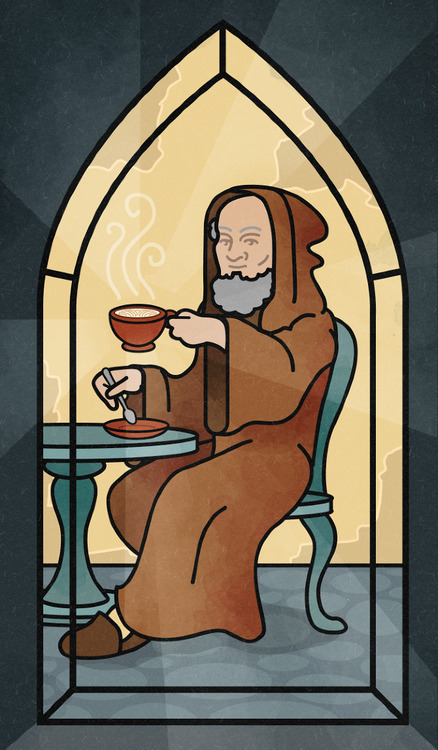
My book Reinventing Bach makes the case that Johann Sebastian Bach is best understood as an inventor of a kind, and something like the same is true for St. Francis. Sure, it’s strange to picture him clad in a lab coat and tinkering at a worktable, stringing pulleys Leonardo style, or grinding lenses à la Ben Franklin. But think about it. Francis invented the mendicant order; the vernacular devotional poem; the Christmas nativity scene; the whole scheme of affection for animals as we know it; and, indirectly, cappuccino. And lent his name to an inventive pope.
Where would we be without him? We would be poorer, and less poor.
Trending in Los Angeles: Coprolaliac Dog-Eat-Dog Buddhism
Walker Percy liked to say that there were no great Buddhist novels, and over the years Tom Wolfe has proposed that the great unwritten American novel is the one about Left Coast religion.
Well, Bruce Wagner is trying. His book Still Holding was received as “a weird, coprolaliac amalgam of Buddhism and Us Weekly”:
Sometimes, the horrors of this book are such that one is certain it’s hell, with all its circles of celebrity, Hieronymus Bosch in smoggy sunlight. But really, the effect is more like a Buddhist El Greco, a coil of figures spiraling awkwardly heavenward against a garish backdrop.
And his new book of twined novellas, The Empty Chair, apparently takes the axiom “if you meet the Buddha, kill him” as a formula for the practice of authorial omnipotence.
Kelly, “an ardent, even fanatical Buddhist” — according to Michiko Kakutani’s quote-fest of a review –
received a contract for a spiritual memoir that she thought of calling “Nirvanarama” or “Impermanence Rocks.” And she got into a sort of competitive rivalry with her former mentor Dharmabud over spiritual territory — like teaching Buddhism to elementary school kids. She was particularly enthusiastic — at first, that is — about doing “mindfulness workshops” at San Quentin prison.
“Part of the allure was ego,” Charley says. “It was kind of a trophy gig — frontline bodhisattva service. It was sexy.” Here was a woman with gumption enough “to suck it up and walk straight into the belly of the beast… for the enlightenment of others. I think she dug people at the Zen Center knowing too. Gave her a major uptick in the incestuous world of the sangha, where competition for humility was dog-eat-dog.”
The other day I posted a piece on the extraordinary longevity of the critics at the Times and some other big places. That longevity has been extraordinarily good to Wagner. A daily Times review is hard to get, a good one even harder — but Kakutani has reviewed his novels I’ll Let You Go, Memorial, Dead Stars, The Chrysanthemum Palace, and now The Empty Chair, all favorably.
Talk about good karma.
Trending in Los Angeles: Coprolaliac Dog-Eat-Dog Buddhism
Walker Percy liked to say that there were no great Buddhist novels, and over the years Tom Wolfe has proposed that the great unwritten American novel is the one about Left Coast religion.
Well, Bruce Wagner is trying. His book Still Holding was received as “a weird, coprolaliac amalgam of Buddhism and Us Weekly”:
Sometimes, the horrors of this book are such that one is certain it’s hell, with all its circles of celebrity, Hieronymus Bosch in smoggy sunlight. But really, the effect is more like a Buddhist El Greco, a coil of figures spiraling awkwardly heavenward against a garish backdrop.
And his new book of twined novellas, The Empty Chair, apparently takes the axiom “if you meet the Buddha, kill him” as a formula for the practice of authorial omnipotence.
Kelly, “an ardent, even fanatical Buddhist” — according to Michiko Kakutani’s quote-fest of a review –
received a contract for a spiritual memoir that she thought of calling “Nirvanarama” or “Impermanence Rocks.” And she got into a sort of competitive rivalry with her former mentor Dharmabud over spiritual territory — like teaching Buddhism to elementary school kids. She was particularly enthusiastic — at first, that is — about doing “mindfulness workshops” at San Quentin prison.
“Part of the allure was ego,” Charley says. “It was kind of a trophy gig — frontline bodhisattva service. It was sexy.” Here was a woman with gumption enough “to suck it up and walk straight into the belly of the beast… for the enlightenment of others. I think she dug people at the Zen Center knowing too. Gave her a major uptick in the incestuous world of the sangha, where competition for humility was dog-eat-dog.”
The other day I posted a piece on the extraordinary longevity of the critics at the Times and some other big places. That longevity has been extraordinarily good to Wagner. A daily Times review is hard to get, a good one even harder — but Kakutani has reviewed his novels I’ll Let You Go, Memorial, Dead Stars, The Chrysanthemum Palace, and now The Empty Chair, all favorably.
Talk about good karma.
This Is What a Philosopher Looks Like
In December a gift book is circulated in the Georgetown community, and this year’s book is Justice: Faces of the Human Rights Revolution — a big book of portraits “highlighting the work of individuals making an impact across the globe. These individuals share a profound commitment to human rights and social justice.”
The photograph of Kwame Anthony Appiah caught my eye. He is a friend of the Berkley Center, and his work, well known today, will become even better known with the passing of the years — and through his new role as a global philosopher with NYU.
"Accompanying each portrait is a micro-essay exploring the life, legacy, and singular spirit of its subject,” as Maria Popova put it on Brainpickings, and the micro-essay alongside Appiah’s portrait is eye-catching for his succinct way of framing human rights in the vocabulary of morality without hectoring or harking back to the past.
Human rights, Appiah explains, are enshrined in law, expressed in culture, and tested in the shame we feel when such rights are violated — which ought to stir us to try to change things.
That process of cultural change means developing a sense of pride in the fact that we — we Pakistanis, we Americans, we Ghanaians — have a society that is respectful of these fundamental rights. People will then feel ashamed when they discover their country has failed to respect them. I feel a profound shame as an American citizen when I think about Guantánamo.
When he was the president of PEN, Appiah worked in support of Liu Xiaobo, the Chinese Nobel Peace Prize laureate who has been stifled by China’s government.
Not long after Liu got the Prize, I spoke to a Chinese exile in Washington, D.C., and, entirely unprompted, she spoke of the shame she felt about what her country was doing. Her shame at Liu’s imprisonment, mine at Guantánamo: we understood each other.
The sheep’s name is Daisy, as far as I can tell.
Il Papa della Scarfa
Last month I posted a photograph of Flannery O’Connor wearing a Georgetown sweatshirt, only to figure out a little later that it was a Georgia Bulldogs sweatshirt. But that photograph of the former Jorge Maria Bergoglio holding a Georgetown scarf is absolutely, positively the real thing.
John Allen posted this piece about the conference that wound up with some Georgetown colleagues of mine meeting the pope.
Along with Mandela, Remember Steven Biko
“It is ended,” South African premier Jacob Zuma said yesterday, and the finality of the statement – biblical echo intended or not – captured just how long a journey Nelson Mandela’s long walk to freedom was.
No one now would wish Mandela’s life had gone some other way than the way it did. But the ennobling of his years of imprisonment by his eventual freedom and triumphant leadership – and by the arranging of these events into a narrative of purpose and destiny – makes it possible to forget that there were many, many people (thousands; no, tens of thousands; no, more) whose lives ended in prisons like the one on Robben Island that Mandela walked out of with his smile wide and his head held high.
Steven Biko was one of those people. He died in prison in 1977, age thirty, bludgeoned to death by one of his guards.
In an essay a few years ago – almost twenty years ago, I realize – I proposed that, had he lived, Steven Biko, even more than Nelson Mandela, likely would have emerged as the president of a democratic South Africa. As an organizer of the Black Consciousness Movement, Biko showed exceptional leadership qualities, even after he was placed under a “banning order”:
Deprived of a public role, he developed a King William’s Town branch of the BCP; headquartered in a disused church, it became a vital agency for blacks of the district, and a focal point for political activity as well. Then and until the end of his life he led the Black Consciousness movement by working in stealth mode – holding clandestine meetings, using associates as go-betweens, and flouting the banning order as he dared.
Challenging the apartheid government’s account in the death of a colleague, he brought a hard truth to light:
Working behind the scenes, he was a key figure in the inquest into Mohapi’s death. It was established that Mohapi had “died by strangulation” but that no one was at fault – a blatant equivocation on the government’s part, but nonetheless a rare acknowledgment that a detainee had died suspiciously.
Imprisoned, he made his status as a “detainee” come to stand for all the ways in which apartheid was a system of detention:
What was being detained was the development of justice in South Africa, the long march toward notions of universal human rights.
Murdered, he called forth an extraordinary homily from Archbishop Desmond Tutu:
For Biko – Tutu uses the language of scripture – had been called by God to be his servant in South Africa, to proclaim God’s righteousness by calling blacks to the fullness of their humanity. Biko’s great insight was to see that “until blacks asserted their humanity and their personhood, there was not the remotest chance for reconciliation in South Africa.” (Tutu fiercely adds, “You don’t get reconciled to your dog, do you?”)
And from his friend the Anglican priest Aelred Stubbs:
In the purified church that will be reborn out of the destruction of this racist society, in that church he will be venerated everywhere, as he is by some of us now, as a true martyr of Christ, the Christ whom he maybe could not consciously be often in communion with because of the disfiguring guises with which the churches had distorted him.
Biko’s story began in the west with Richard Attenborough’s film Cry Freedom and Peter Gabriel’s song “Biko.” Now, as Nelson Mandela’s life story is capped with the film of Long Walk to Freedom, let’s not forget all the people of South Africa whose stories, lacking happy endings, need to be told even so.
Turn, Turn, Turn
I can’t remember the last time I actually liked using a Microsoft product. Most of them feel as ossified as this bone church.
This morning, though, I followed a tip from Nick Bilton and went to Photosynth, the company’s 3D-auto-photo-stitch application site. A new upgrade is due tomorrow (and made Safari crash today). Meanwhile, I circumambulated the bone church (the Sedec Ossuary in the Czech Republic), rubbernecked at the church of Santa Maria in Trastevere, and peered in at this Neapolitan creche. Fifteen minutes unobjectionably spent — and without a single error message!